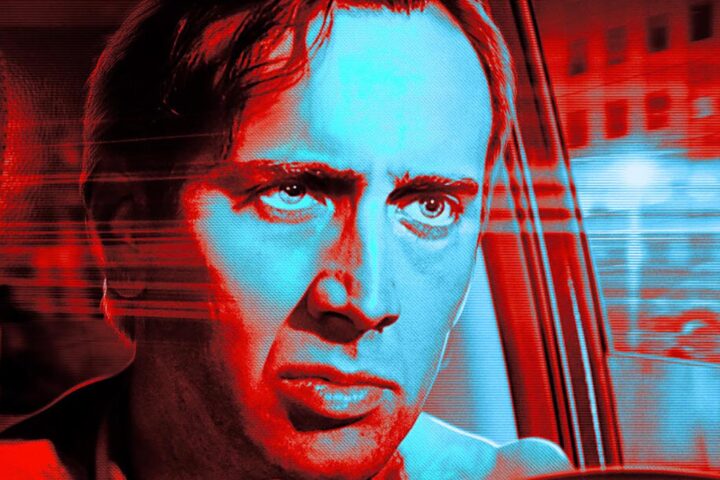
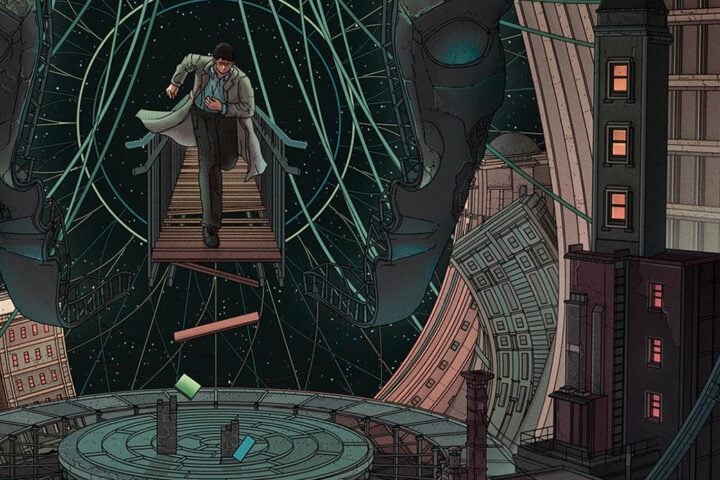
More than a mere account of an artist’s life, Paul Schrader’s Mishima: A Life in Four Chapters is keyed to the aesthetic and spiritual evolution of postwar Japanese author Mishima Yukio (Ogata Ken). The film opens on the day of the artist’s failed coup d’état and subsequent suicide, then traces his life to that point via flashbacks. Schrader juxtaposes the sight of the author in military regalia with younger images of a frail, sickly child, gradually charting how the young Mishima turned to both writing and exercise to overcome his sense of weakness. The flashbacks move in a linear fashion, tracing the artist’s radical evolution from stuttering, isolated young man to physically fit reactionary whose objections to American postwar occupation and cultural influence inspire a devout cult of militaristic men.
Complicating this relatively straightforward narrative are Schrader’s elaborately theatrical stagings of some of Mishima’s novels. Befitting Mishima’s style, these stagings are a mix of traditional and modernist formal sensibilities. Shot against vast but minimal backdrops on a soundstage, the segments replace the naturalistic colors of the 1970-set scenes and black-and-white flashbacks with florid colors and angular, surreal production design.
The adaptation of The Temple of the Golden Pavilion sees the set’s orange walls interspersed with paintings of verdant mountains and plants overlooking a small walkway of floorboards over a sketch of a pond. This segment’s evocation of Japanese traditional art contrasts sharply with the modish look of Schrader’s take on Kyoko’s House, which crackles with splashes of electric pink that illuminate interior sets that connote the seedy influence of Western culture.
By folding these vignettes into the larger narrative of Mishima’s life, the film illustrates just how much his art reflected his changing attitudes and beliefs. The Golden Pavilion chapter presents its young, repressed protagonist, Mizoguchi (Bandô Yasosuke), as frail and skittish. The miniature of the Buddhist temple that torments him is scarcely taller than he is, but it seems to loom over him with ominous intent. The cultural history represented by the temple terrifies the immature, repressed Mizoguchi, but that fear of Japan’s history has morphed into fascistic protectiveness of it in Schrader’s adaptation of Mishima’s later novel Runaway Horses.
Here, the warm colors of the Golden Pavilion chapter are replaced by stark reds, whites, and blacks befitting Mishima’s reactionary militarism. The image of a temple recurs again in the background as the cult leader (Nagashima Toshiyuki) addresses his private army on a beach. This time, though, the temple looks tiny, scarcely visible as it sits behind the revolutionary who faces away from the building to speak to his men. Organizing a coup to nominally preserve Japan’s old culture, the leader ultimately seeks only to boost his self-importance.
Schrader leans heavily on the tortured sadomasochism of Kyoko’s House and fascistic homoeroticism of Runaway Horses to intimate aspects of Mishima’s own character. Similarly, the filmmaker uses his takes on the novels to visually explore the changes in Mishima’s internal mindset, charting a clear artistic shift from impressionable naïveté into stubborn machismo that seems a belated response against the perceived weakness of Mishima’s younger self. The film doesn’t shy away from the tragic farce of Mishima’s final day, but in exploring the author’s art, it takes seriously the creative and intellectual journey that led to that point and marks one of Schrader’s finest efforts in documenting his characters’ impulses toward self-annihilation.
Image/Sound
Criterion’s 4K UHD presents the restoration used for its 2018 2K Blu-ray in native 4K, maximizing its excellent rendering of the film’s vibrant color palette. The dreamy recreations of the worlds of Mishima Yukio’s novels abound in colors that practically pop off the screen, while the monochrome scenes boast satisfying inky black levels and brilliant white levels.
The Japanese stereo track, which is the same as the one on the 2018 disc, clearly renders the film’s dialogue and Foley effects amid the boisterous, enveloping din of Philip Glass’s score. The disc also comes with the option to listen to the track with Japanese narration or with one of two English narration tracks, including the original by Roy Scheider.
Extras
All the extras here have been ported over from Criterion’s earlier Blu-ray release. An audio commentary, recorded in 2006, features Paul Schrader and producer Alan Poul. The way Schrader occasionally gives into pettiness (he audibly bristles at Glass retaining the rights to his score and thus licensing it into ubiquity) adds amusing flavor to an otherwise informative track, which contains copious insights into the production of the film and the director’s thematic preoccupations. (There’s a sense that Poul is primarily here to keep the irascible director on track.) The hour-long documentary The Strange Case of Yukio Mishima from 1985 covers the life of the controversial author, while an interview with Mishima conducted for French TV shortly before his death is notable for his thoughts on his work and Japanese society.
Mishima biographer John Nathan and film historian Donald Richie examine how the film tackled the subject of the author’s life, while writer-producer Chieko Schrader discusses her experiences throughout the film’s production. Interviews with various crew members, including Glass and cinematographer John Bailey, delve deeper into various aspects of the film and its making. The most fascinating of these interviewees is costume designer Ishioka Eiko, who recalls initially wanting to turn down the job due to her dislike of Mishima and his beliefs, only for Schrader to assure her that her objections made her ideal for the task. The accompanying booklet comes with production stills and an essay by Kevin Jackson that analyzes the film’s experimental structure and how it illuminates, rather than obscures, Mishima’s life.
Overall
Paul Schrader’s transcendent biopic of Mishima Yukio gets a definitive 4K transfer.
Since 2001, we've brought you uncompromising, candid takes on the world of film, music, television, video games, theater, and more. Independently owned and operated publications like Slant have been hit hard in recent years, but we’re committed to keeping our content free and accessible—meaning no paywalls or fees.
If you like what we do, please consider subscribing to our Patreon or making a donation.