 As part of an essay cycle that roves the cinema of the 1990s for vestiges of intelligent life, Phillip Lopate identifies several attributes that typify the early style of writer turned directors: creatively interpolated exposition, admirably ham-fisted mise-en-scène, and skewedly erudite characters among them. The blistering dyad of movies that British author Bruce Robinson produced with HandMade Films in the late ’80s proudly manifests all of these, and adds one by way of aggressive underscoring: an acerbic worldview.
One can’t blame Lopate for overlooking this quality, as there’s nothing in the debuts of David Mamet or Paul Schrader on par with Robinson’s reckless piss and vinegar. House of Games and Blue Collar possess a crafty bleakness, to be sure, but a modern fable wherein the body of an advertising exec is commandeered by a sentient, puss-dribbling shoulder boil suggests unprecedented vocational spite. As with both Mamet and Schrader, however, Robinson playfully uses film as a sensual extension of language (evens fans tend to praise his work as though it were illustrated dialogue); the lysergic scenarios and scene-nibbling actors make his wit appear so limitless that its targets are rendered defenseless.
Both Withnail and I and How to Get Ahead in Advertising are exemplars of the “hateful paean” tradition, salvos of social disgust filled uneasily with self-deprecating doubt. If the former seems the weaker of the two, it’s only because de-glamorizing the boho-isms of the late ’60s has fallen in and out of style multiple times (our culture’s paradoxical reliance on—and lack of trust in—marketing, on the other hand, only continues to evolve and fester). Originally conceived as a novel, Withnail and I is Robinson’s “Fear and Loathing Through the English Country,” a burnt-out ode to both town and city faux-artistry squalor and a stoner bromance par excellence.
In the film, two out-of-work thespians and flatmates (Richard E. Grant and Paul McGann) in 1969, tired of London’s soot-stained, fish ‘n’ chip paper urbanity, con a rich relative into offering the key to his cottage in Cumbria. What follows is a frenzied fog of booze-fueled betrayals and comic misunderstandings that eventually reveal to the duo the toxic nature of their dynamic.
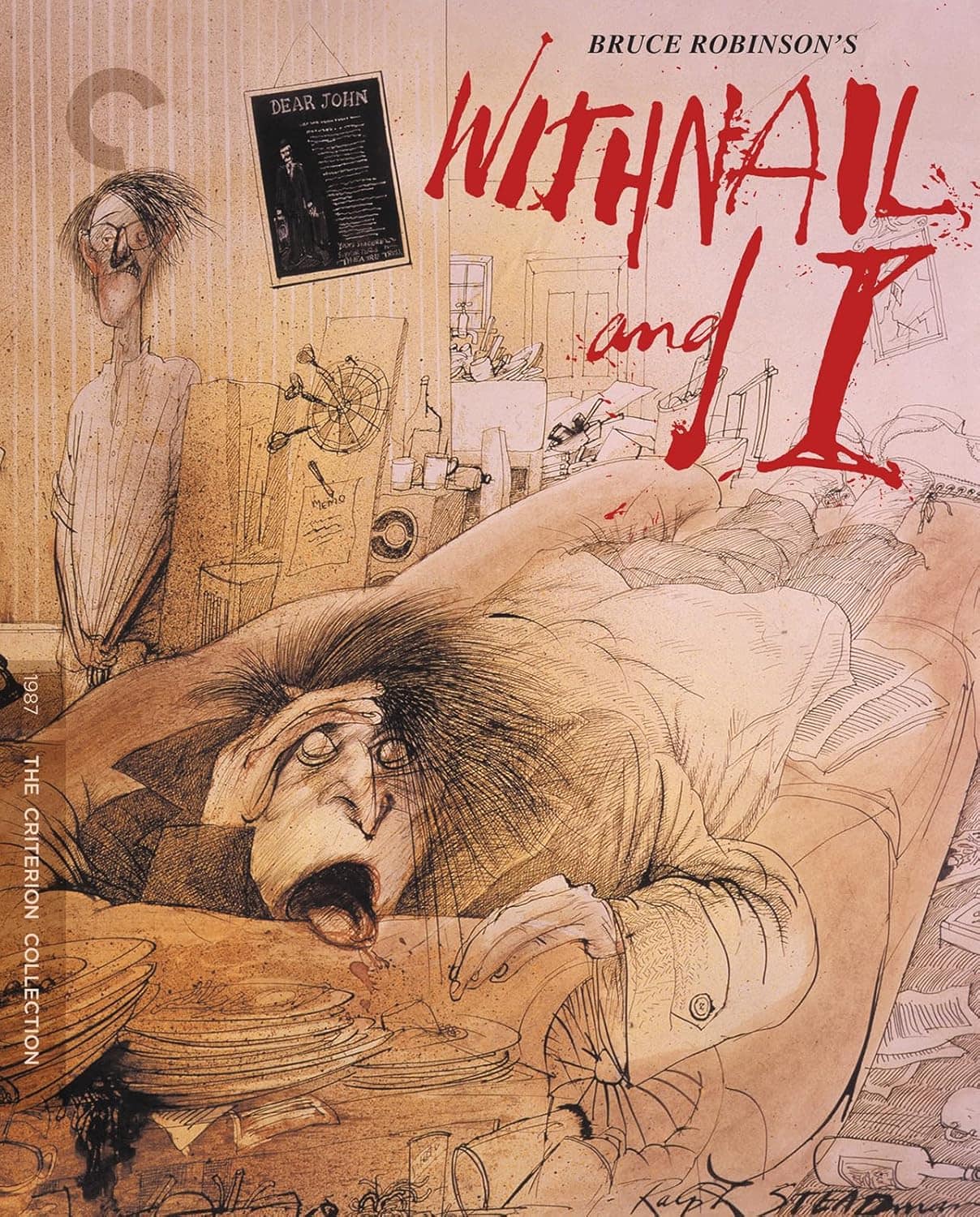
There are, curiously, few narcotics involved aside from alcohol, which is so desperately sought that lighter fluid is gleefully imbibed in one scene, and an epic spliff rolled by a cockney cohort, Danny (Ralph Brown). But, taking cues from idol Hunter S. Thompson, whose occasional illustrator/collaborator Ralph Steadman provided Withnail and I’s promotional art, Robinson likens the demise of the Summer of Love to a bad drug trip, maintaining an achily inebriated cadence with paranoid voiceovers and a giddily episodic structure.

The film’s environment doesn’t demystify the hippie myth so much as bathe it in fatigued rancor until it becomes sympathetically believable; the Hendrix tracks on the soundtrack were easy-FM picks far before 1986, and the afro-sporting Black he-man that appears in the bathtub during act three seems to have wandered in from an off-Broadway production of Hair. But rather than epitomizing the countercultural lifestyle of the era in extremis as, say, Raoul Duke and Dr. Gonzo did, the two titular characters here patrol its antsy, mournful, disillusioned limits.
Grant’s celebrated performance as Withnail (pronounced “whith-null”) grows increasingly campy in the rearview; he savors pithily vulgar bon mots like “I’ve got a bastard behind the eyes” with enough oily dramaturgy to give you indigestion in the midst of all your side-splitting contortions. And yet, it’s the frothy whirlpool of Withnail’s pouty, egocentric over-reactions that draws us in as mercilessly as it does I, McGann’s uptight, unnamed protagonist and Robinson surrogate. This masochistic stranglehold provides the film’s most cogent metaphor for the self-destructiveness that may have ushered us into, as well as out of, the “revolution” of the 1960s.
In Cumbria, the unhappy couple bicker about whose turn it is to fetch firewood, upset the locals in a mostly fruitless search for non-fermented sustenance, and find themselves on the wrong end of a stunned eel who’s been docilely occupying a gruff poacher’s trousers. And through it all, they nervously roil from the realization that the country is just as putrid and unwholesome as the city they abandoned, an intermittently clever analogy for the unrecognized futility of the Age of Aquarius’s free love and corporeal experimentation.
The story almost fatally swerves into dated socio-political cartoonishness when the brilliantly flaming and ruddily corpulent Uncle Monty (Richard Griffiths) arrives with plans to seduce the curly haired, boy-faced I. Inspired by the reportedly untoward advances he suffered from director Franco Zeffirelli as a young, struggling actor, Robinson unfairly fashions Monty as an appalling symbol of effete, closeted decadence and despondency.
The uncomfortable climax succeeds despite Monty’s unnecessary humiliation because of the homoerotic tension that punctures the surface of Withnail and I’s relationship, a partnership that we accept at misshapen face value throughout. Withnail’s charisma is such that we don’t even recognize him as a tragic hero until he hackishly spews a Hamlet soliloquy into the rain after I dumps him for the less risky compromises of adulthood and self-sufficient success. The film’s satire at times collapses under the weight of its unkempt irascibility, but the conviction of Robinson’s ire toward a generation led astray is nigh unparalleled in boomer culture.
Image/Sound
Criterion’s UHD perfectly preserves the film’s sickly beauty. You can make out every shade of the restless main characters’ raccoon eyes. The squalor of 1960s urban Britain and filth of the countryside are equally vivid in their crusty unpleasantness, and the generally dark lighting of the cinematography never evinces any crushing artifacts. The mono soundtrack keeps dialogue and ambient sounds clear while threading in David Dundas and Rick Wentworth’s mockingly romantic score and the occasional needle drop of ’60s psychedelic music.
Extras
Criterion’s disc comes with two audio commentaries, one a Covid-era livestream Q&A featuring director Bruce Robinson, and the other from 2001 featuring actors Ralph Brown and Paul McGann. Both are abundant in anecdotes and information about the film’s making and its enduring popularity. Also included is a 1999 making-of documentary, new and archival interviews with Robinson and Richard E. Grant, and a gallery of reference photos by poster artist Ralph Steadman. In his booklet essay, critic David Cairns lauds Robinson for make something as idiosyncratic as Withnail & I, particularly singling out his use of long takes to develop the film’s knife-edge balance of black comedy and pathos.
Overall
Criterion’s disc of Bruce Robinson’s cult comedy offers the film in all its squalid, stained beauty.
Since 2001, we've brought you uncompromising, candid takes on the world of film, music, television, video games, theater, and more. Independently owned and operated publications like Slant have been hit hard in recent years, but we’re committed to keeping our content free and accessible—meaning no paywalls or fees.
If you like what we do, please consider subscribing to our Patreon or making a donation.