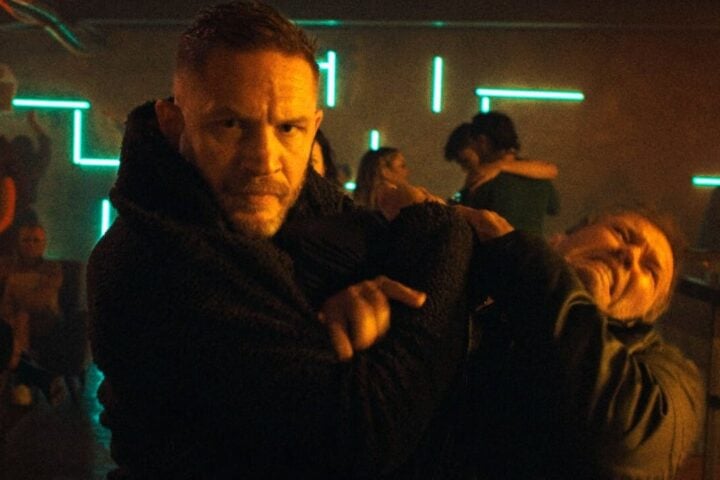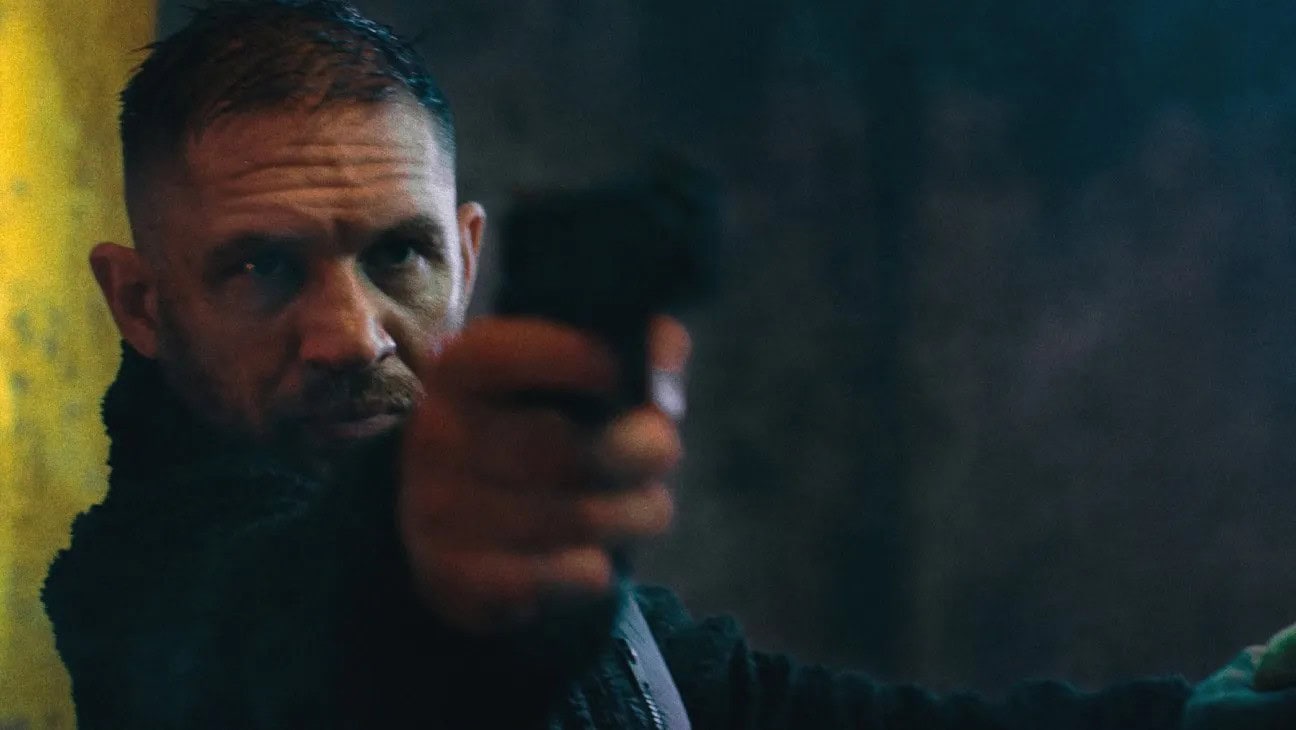
Gareth Evans’s Havoc has a setup as elementally simple as the filmmaker’s 2011 breakout The Raid: Redemption and its 2014 sequel: A grizzled detective, Walker (Tom Hardy), fights his way through a gang war in a city plagued by urban rot, along the way uncovering that the highest echelons of society have ties to the drug-peddling underworld. Along the way, he puts down one gangster after another in violent fashion.
It’s established immediately that Walker is a capable but crooked detective whose history of taking dirty money puts him at the mercy of higher-ups. One such figure, Lawrence Beaumont (Forest Whitaker), comes to Walker when word gets out that the politician’s son, Charlie (Justin Cornwell), is the chief suspect in a drug robbery gone bad and on the run from both police and cartel soldiers. “Don’t forget,” Beaumont growls, “I know what you did,” threatening to expose Walker’s buried crimes if the detective can’t get Charlie to safety.
But where The Raid films quickly shift into high-action gear, Havoc takes a much too leisurely approach to its plot, settling into its criminal underworld without doing much to build out either its stock characters or its setting. The latter’s exteriors are rendered in glossy CGI that clashes with the muted, metallic color palette that defines Matt Flannery’s cinematography. Rather than play up the visible artificiality of the urban landscape to expressionistic ends like, say, Frank Miller and Robert Rodriguez did in Sin City, or lean into an elaborate fantasy, a la the John Wick moves, Evans attempts to present this backdrop as realistically immersive.
The two-dimensionality of the film, which Evans also wrote, is exacerbated by the plodding scenes of Walker and his more straight-laced partner (Jessie Mei Li) investigating Charlie’s trail and the matriarch (Yeo Yann Yann) of a Chinese gang delivering ominous monologues about wanting vengeance for her son, who died in the opening robbery. A procession of mob soldiers and beat cops stalk alleyways and rundown tenement corridors spouting generic dialogue that makes them sound like NPCs with limited speech options. Indeed, a number of Havoc’s early sequences depicting police chases bring to mind video game cutscenes, with each element so slickly rendered so as to make the city feel unpopulated by real people or objects.
Just as Havoc threatens to completely fall apart, though, Walker finally catches up with Charlie, and at the same time as several other interested parties, and an action sequence erupts that rapidly escalates into mayhem. If both the major characters and bit-part henchmen of the Raid movies all wore the real actors’ martial arts backgrounds on their sleeves, the characters here fight with a more slapdash, unpredictable desperation that often proves more interesting.
Instead of elaborate exchanges of close-quarters strikes and counters, the characters here tend to get the upper hand based on who has the quickest reflexes in tackling an assailant or getting a block up at the last possible second. Despite the advanced choreography that Evans and Flannery capture with a generally superior sense of visual fluidity than they displayed in the Raid movies, there’s an overwhelming sense of chaos here that feels realistic.
Even when a climactic fight at Walker’s cabin retreat on the outskirts of town sees him pitted against more skilled assassins, the action remains grounded in everyone’s quick-thinking but undisciplined responses. This leads to some moments where sheer pluck prevails, as when a ruthless assassin (retired UFC fighter Michelle Waterson) gets caught off guard by Walker bum-rushing her into a window with all the clumsy effectiveness of a drunk scoring a lucky hit in a bar brawl. It’s a shame that this kinetic intensity comes at the end of such a sluggishly paced hour of recycled noir tropes. If the rest of it had been as driven by such a ferocious sense of purpose as its final act, Havoc would be one of the finest action movies of the decade so far.
Since 2001, we've brought you uncompromising, candid takes on the world of film, music, television, video games, theater, and more. Independently owned and operated publications like Slant have been hit hard in recent years, but we’re committed to keeping our content free and accessible—meaning no paywalls or fees.
If you like what we do, please consider subscribing to our Patreon or making a donation.