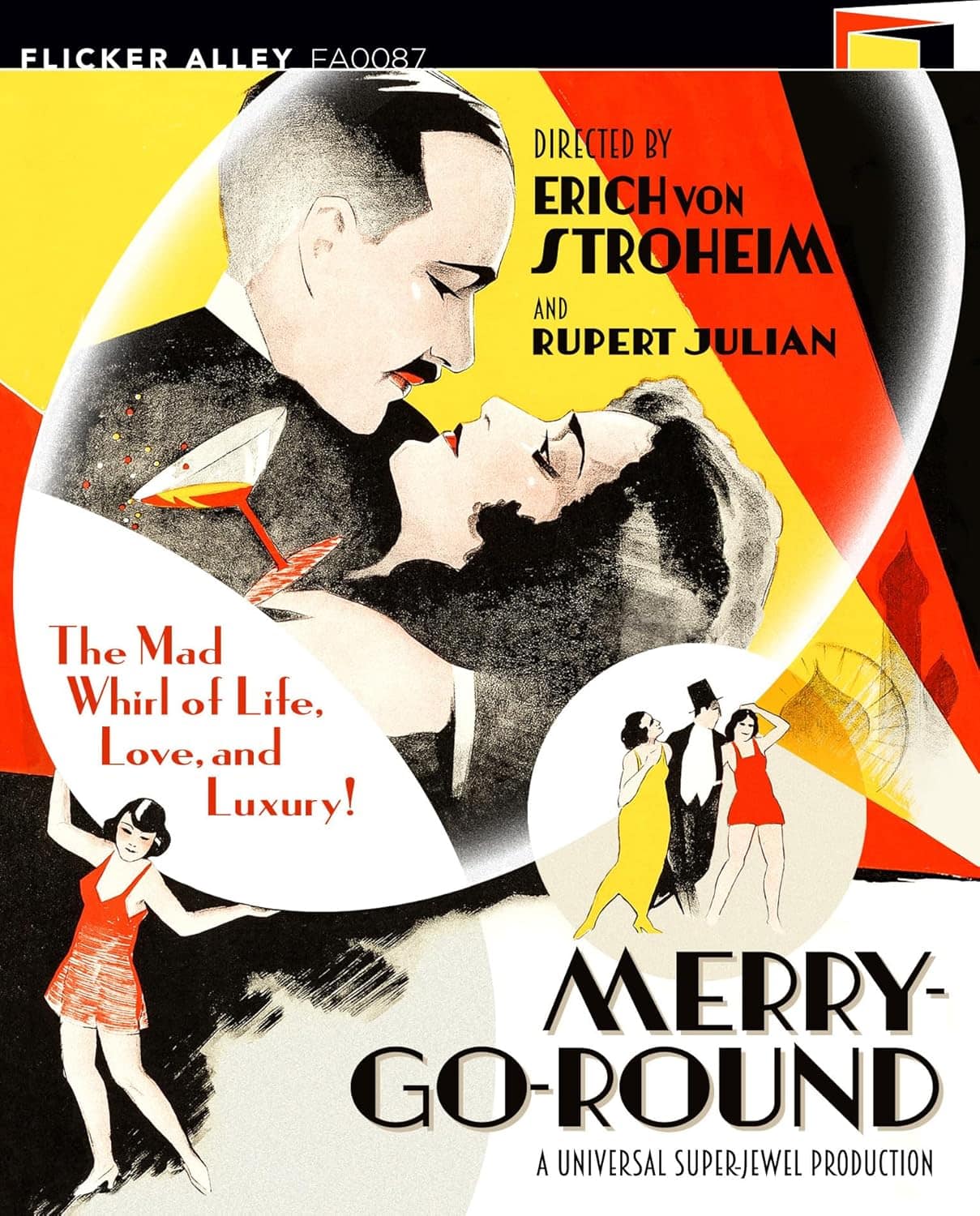
 The placement of Erich von Stroheim’s name above Rupert Julian’s on the cover of Flicker Alley’s release of Merry-Go-Round is mostly a marketing strategy capitalizing on von Stroheim’s auteurist bona fides. The film was to be von Stroheim’s next project after Foolish Wives, but what little goodwill remained between him and studio heads after that production ran wildly over time and budget soon evaporated during the making of Merry-Go-Round. After six contentious weeks of delay-filled filming, Universal execs fired the director and replaced him with Julian, who remained mindful of the core themes of von Stroheim’s scenario but didn’t set out to channel the maestro’s trademark visual opulence.
Merry-Go-Round plays like a Cliff’s Notes version of a von Stroheim film. Set in pre-World War I Vienna, the story concerns Count Franz Maxmilian von Hohenegg (Norman Kerry), a member of Emperor Franz Joseph’s (Anton Vaverka) court who dreads a loveless arranged marriage to noblewoman Gisella (Dorothy Wallace). To let off some steam, he and some friends dress down as common folk and head to a circus at the Prater, the city’s famous amusement park, where he encounters and becomes smitten with an organ grinder, Agnes (Mary Philbin). Naturally, Franz’s family doesn’t consent to his marriage with a commoner, leading to tensions as he alternately withdraws from and returns to Agnes, who believes him to be nothing more than a modestly successful salesman with commitment issues and increasingly resents his absences.
The film, which was written by von Stroheim, Julian, Finis Fox, and Irving Thalberg, oscillates between the grandiose interiors of the Habsburg court and scenes of Dickensian poverty that afflict Agnes, her father (Cesare Gravina), and the members of the circus. Julian presents this dichotomy drably, with jarring cuts between starkly framed tableaux of decadent high and despondent low societies. Without illustrating the underlying social failures that link the two strata in mutual decline, the film rapidly loses narrative and thematic momentum.
Similarly, a tonal disparity is set up between, on one side, the story’s increasing melodrama surrounding Agnes’s economic woes and interrupted romance and, on the other, the moments of comic levity around the circus. Around the time that the young woman is sitting at her father’s sickbed under the belief that her lover has jilted her, we get an interlude, wherein one of the circus orangutans gets loose and takes a lackadaisical stroll over Vienna’s rooftops, that feels as if it’s been edited in from an entirely different feature. And when World War I erupts in the final half-hour, the horror of that conflict overrides everything else in a manner that, while understandable, only further heightens the unresolved tonal instability of the film.
To Julian’s credit, he does take pains to honor von Stroheim’s desire to capture a Vienna that no longer exists. Shot on Hollywood stages, Merry-Go-Round replicates the ornate beauty of Schönbrunn Palace’s vast parlors and corridors with remarkable fidelity. (Some genuine Habsburg relics, such as Franz Joseph’s personal carriage, were flown from Austria for use as verisimilitude-adding props.) The WWI material is handled with appropriate solemnity, with battlegrounds dissolving into shots of military graveyards cluttered with memorial crosses. If the film loses sight of its drama for long stretches, it nonetheless captures a parting note of hard-won hope in a lovers’ reunion amid so much death and decay.
Image/Sound
Sourced from an arduous restoration undertaken by Blackhawk Films from a variety of prints, Flicker Alley’s transfer inevitably betrays the wildly variable quality of materials used to re-assemble the original theatrical cut. Some shots show heavy damage and debris while others are remarkably clean and sharp. Nonetheless, given the state that even the best-loved and best-preserved silent films exist in today, it’s clear that the only flaws in the presentation are endemic to the prints themselves. In the best-quality moments, detail is sharp enough to make out the minuscule ornamentations of palatial decor or the roughness of peasant clothing fabric. A newly commissioned orchestral soundtrack by Robert Israel is clear throughout, with ample depth around the instruments to bring out their full sonority and dynamics.
Extras
Film historian Richard Kosarski contributes a commentary in which he lays out the film’s production drama and its place in the context of Erich von Stroheim’s career and silent Hollywood. A featurette detailing the restoration of Merry-Go-Round emphasizes the reconstruction effort undertaken to source cut footage from prints around the globe to amend the theatrical release to something closer to von Stroheim’s intended vision. The disc is rounded out with footage of Vienna collected in the years leading up to World War I, as well as a fully restored bonus film, John Emerson’s 1915 drama Old Heidelberg, that not only stars von Stroheim but influenced the writing of Merry-Go-Round.
Overall
Flicker Alley’s release of Merry-Go-Round is a testament to how much of silent cinema restoration is an act of archaeology as much as preservation.
Since 2001, we've brought you uncompromising, candid takes on the world of film, music, television, video games, theater, and more. Independently owned and operated publications like Slant have been hit hard in recent years, but we’re committed to keeping our content free and accessible—meaning no paywalls or fees.
If you like what we do, please consider subscribing to our Patreon or making a donation.