Sarah Friedland often describes her feature directorial debut, Familiar Touch, as a “coming-of-old-age story.” That clever turn of phrase is where the cuteness ends with her treatment of Kathleen Chalfant’s Ruth as the character transitions into assisted living for dementia care. Senescence shares more with adolescence than a mere passage of years, as her carefully crafted work demonstrates with sincerity rather than detached irony.
Just as a teenager’s process of maturation lends them a new aperture through which to view the world around them, so, too, does Ruth’s world expand into new sensorial territory. The fully embodied aesthetic experience of Familiar Touch bears no resemblance to more sensationalized depictions of dementia that turn the condition into a theme park ride for viewers. Both Friedland and Chalfant approach Ruth’s journey with enormous sensitivity, gently capturing the unexpected emotional and physical textures that reveal themselves as her condition progresses.
I spoke with Friedland and Chalfant in New York ahead of Familiar Touch’s theatrical debut at the Film Forum in Greenwich Village. Our conversation covered how their artistic partnership functioned, where cinematic grammar added empathy to the recreation of dementia, and what it looks like to truly value elders as well as their caregivers.
Especially since Sarah has such a specific background in movement at the center of her practice, what was the nature of your collaboration on this project?
Sarah Friedland: I mean, Kathleen is additive in all ways! She had been on my dream list of people to work with for a long time, and part of that was because I had seen her work in Yvonne Rainer’s performances and films. But one of the great joys of this collaboration was coming to set and discovering that talking about the body and movement could be a way for us to find Ruth together, in part because I entered into this film terrified. I had never directed a company of professional actors performing dialogue before, and that was the gap in my skill set. I practiced and prepared all of these ideas and notes, and then got to set and discovered that actually we had very compatible ways of thinking about a character. It came quite naturally.
Kathleen Chalfant: We had a great deal in common apart from Yvonne Rainer. I’m a non-dancing Yvonne Rainer collaborator.
SF: And I’m just a fan!
From your professional experiences, what was the most helpful for understanding movement? Does that come from the theater?
KC: I never thought of it as being anything other than doing what you always do. I work mostly in the theater, and in the theater, your entire body is involved all the time. You work from the soles of your feet out to the ends of your fingers all the time, so it is natural to me when I’m making a character to use my whole self. The other thing that made it easy here was that Sarah and her team had a meticulously worked-out shot list, which meant that it was clear all the time where in space the character was meant to be. The final thing is that everybody is responsible for the whole thing on the stage. In movies and television, the only thing that exists is the thing that you see, so the orchestration of the movement is very much in the hands of the cinematographer to begin with, then the director and the editor. I often say that in the movies and the television, as an actor, you bring the furniture and somebody else decides where to put it.
SF: We tend to think about choreography as something that one artist makes and then passes to a performer, who then reproduces that movement. In the case of movement in the context of a character study, the choreography is in both directions. It’s not like I’m saying with every scene, “Kathy, you’re gonna gesture just so.” We would talk more about who Ruth is, and then much of the movement emerges from Kathy. Our shot list would also respond to Kathy’s choices in her body. We had planned [for the kitchen scene] a close-up on the back of her back right where she flips a towel midway through. Then, once we actually started doing the scene, we noticed that there was this wonderful shaking in her shoulder blade in the way she severed the grapefruit. We decided this shot actually has to tilt down because we need the shaking.
Given that the first iteration of the script was described as a “movement score,” how did you two discover the relationship between motion and dialogue for Ruth?
SF: It was a movement score written in screenplay format, so it still said “fade in,” “interior,” etcetera. But I think about screenwriting as a process of annotating movement, whether that’s of image or body. The dialogue just came through over the years. I wrote the script over about a decade, and during that time, I was working as a caregiver. A lot of the dialogue just emerged over time while I was kind of learning more about care work and was spending more and more time with my clients. And one of the great joys of production is that there are a few people I’ve met in my life who have such a precise relationship to language as Kathy.
KC: A lot of people imagine that a fair amount of the dialogue was improvised. None of it was improvised. The only part that was improvised was the words starting with “f.”
SF: I think it said in the script that she had to use “fucking” at least once, have at least two or three “ph” words, and that there needed to be some sort of grocery item list in there.
KC: We did maybe three takes, and it was a slightly different list every time.
As an actress, was it helpful to know how the cinematography or the editing would convey Ruth’s condition to calibrate your own performance?
KC: You never think about the editing and the cinematography. It was comforting to know how meticulously the shot list had been developed, partly because we had such a short time. We shot it in 18-and-a-half days. It was like walking into a comfortable room. You had all the furniture to play with, but the furniture was placed so you knew where to go. The care with which the film was prepared made it possible for us to do it in that short time.
SF: We’re gonna keep doing this dance where you say it was all me, but the preparation that we did was so that everything could reverberate from her performance. The shot list that we created was always premised on the idea that the camera was going to be still and patient enough that the smallest disturbances in her expression, in her body, and in the way a word was expressed would feel greater in scale than the minutiae of what that might be if it were in the wrong shot. We really thought about the grammar of image and sound. It was all prepared so that it could be so sensitively attuned to her performance. We were preparing for her to enter that room.

The fluctuation of Ruth’s age identity is something you’ve both identified as part of her journey in the film. How do you anchor that, especially when it wasn’t something you always spoke about?
SF: Sometimes we would say, “This scene, we both know that Ruth is showing up as her 20-year-old self.” And then, sometimes, she would surprise me.
KC: You don’t [identify it], nor would Ruth have thought of it consciously. It’s just who showed up that day. For instance, the person who recited the borscht recipe was Ruth [at her current age], with a thing to prove. The person who made the list of words starting with “F” was Ruth, probably at any [age] just giving people shit. Ruth in the swimming pool was an entirely sensual being without age.
Was the idea that you wouldn’t necessarily pick an exact number or range? Should age identity be measured by a number?
KC: The people who watch it make those choices. From the inside, you don’t. For instance, people decide that it’s not appropriate for 80-year-olds to flirt like Ruth does. They decide that she’s some other age, in an odd way. From Ruth’s point of view, the better way to describe her sense was that she lives in the eternal present. That’s one of the effects of dementia. The eternal present presents itself in different ways, given the circumstances. Ruth feeling betrayed and heartbroken, screaming through the garage, is every betrayed lover. The sense of being a betrayed lover is the same throughout your whole life. I don’t think it gets easier!
SF: It just occurred to me that I, in a way, on set, had the experience that our viewers have. I would get flashes of a very particular age of Ruth. For example, in the kitchen scene, there are flashes where it’s specifically scripted that it is twentysomething Ruth. But then in these other scenes, going back to the idea of temporal vertigo, she’s all ages and no ages. In that eternal present, watching takes on set, I would perceive the vertigo…and then also these little moments that called upon a certain age that have just as much to do with my interpretation of what different ages look like as they do with whether or not you were making a specific choice in that moment. That was one of the most interesting parts for me about our process: what was explicit and what I got to witness that went in and out of clarity.
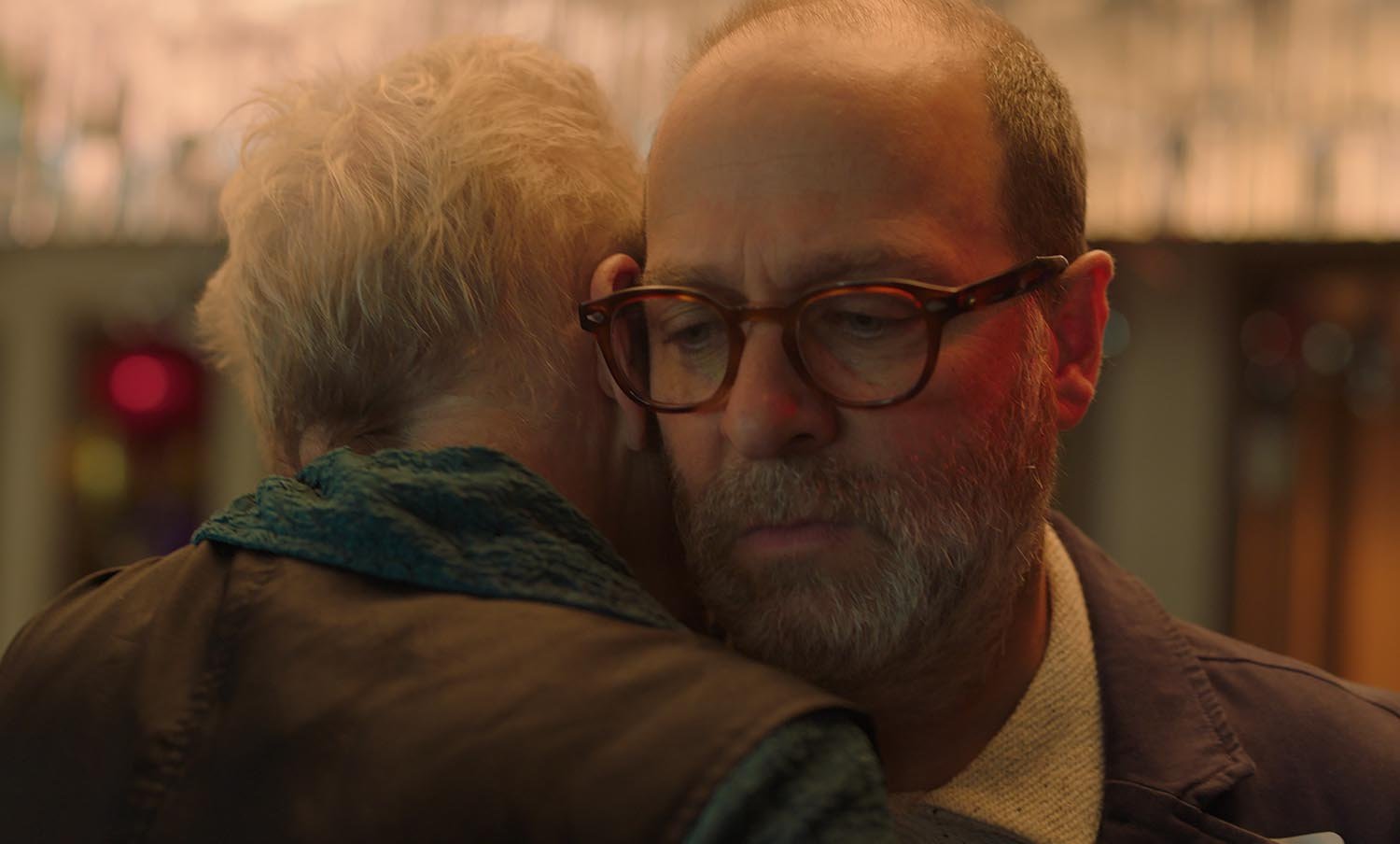
KC: The birthday party scene, when [H.] Jon [Benjamin, who plays Ruth’s son, Steve] comes to show me the books, the person that he encounters at the beginning of the birthday party, is Ruth in the present. By the time the dance finishes, it’s Ruth at the prom.
As memory fades, the other senses heighten. In trying to capture some of those other senses like the touch, olfactory, and taste, did conveying those require you to develop or sharpen a different skill set?
SF: As much as the film is a character study of an older woman in transition, I think it’s just as much a film about trying to locate a sense of selfhood or subjectivity not in sense-making and our sensory experience of ourselves and the world around us. One of the first choices that I and Gabe Elder, my cinematographer, made was thinking about the camera as being almost at the position of a caregiver. Most of the time, you are distant enough to allow the person you’re caring for to be in their physical autonomy, but close enough to perceive subtle shifts in their behavior and movement. We thought about the camera being also eye level with Ruth, which is a big part of training as a caregiver. You learn that postural differences can be very intense for a person with memory loss. The camera would be at this position, which is also still enough to see the gestural experience that tells us so much about her senses.
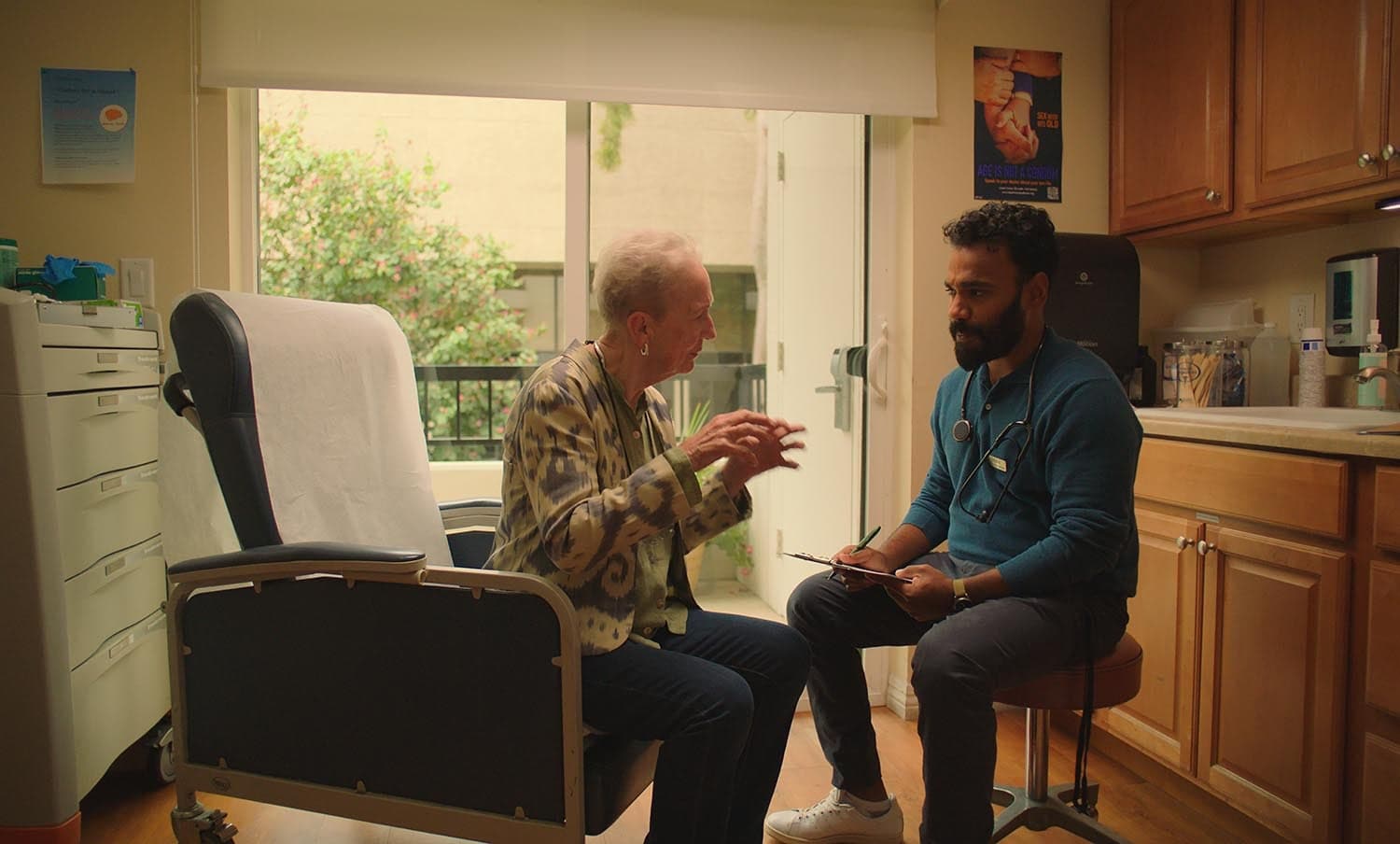
We also had this idea that we called “echoes” in the cinematography. Certain gestures that are repeated in the film would have similar framing so that the viewer might experience a sense of déjà vu. For example, the moment that she flips her hand over in the car for Steve is the same lens and optical diffusion and very similar framing to the exam room when she’s touching herself. We thought about ways that the framing could invoke a physical response in the viewer.
We were also thinking a lot about creating sound design that mimics the experience of sound for older adults in general, not just older adults with memory loss. It’s very common to experience a collapsing of sonic scale and space. Distant sounds will become close, so the person having the conversation on the other side of the room can feel quite near to you. Most films you mix so that all of the ambient, diegetic sound goes away or is diminished. In this film, it was a matter of actually pulling out and heightening them. Ruth, in her younger age identities, looks around and says, “What are all these old people doing here?” I wanted to create this symphony of older voices, and we actually had to record it because one of the ways ageism appears in our film industry is that the canned [sound] that’s added as room tone is all younger voices.
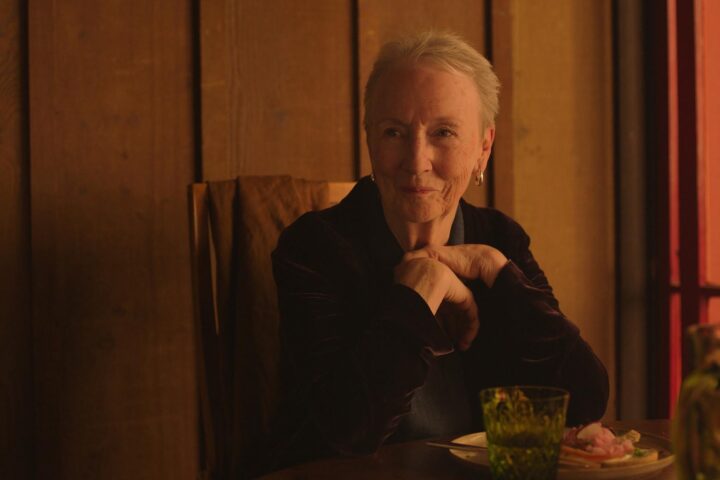
KC: It’s not so much different [from an acting perspective], but it’s all part of the idea of being in the eternal present. One of the effects of dementia is to lose inhibition so that you can give yourself [over] without self-consciousness. I think the greatest sensory moments were the time in the swimming pool, which was one of the most remarkable sensual experiences of my life. And it was perfect. The pool was 85 or 90 [degrees], and there were floats so that I didn’t have to do anything but be. I, myself, was a little bit self-conscious about wearing a red Speedo, which was the choice of the costume designer and was exactly the right choice. However, Ruth didn’t care! I could just give myself to Ruth; she was cool with the Speedo.
SF: We gave her the option: “Do you want to get out of the pool between takes, or stay in the pool?” She decided to stay and float. I don’t think you remember this, because you were in such a reverie, but floating Kathy said to me, “Why don’t we just rewrite the whole thing to be in the pool? It’ll be an Esther Williams film, we’ll just do the whole thing like a water ballet!”
What’s the balance to avoid tipping over into over-sensationalizing? Is that part of why you didn’t necessarily want to do a lot of ocular perspective?
SF: Grounding it in Ruth’s body, in her sense of self, her sense of time, is part of what keeps us away from that sensationalism. There are two lanes, if you will, that occurs in. One is all a narrative of decline. The experience of aging, whether that’s memory loss or not, is depicted as this tragic descent into loss of self and decrepitude. That perspective usually comes in cinema through the child of an older adult who is understandably grieving this transition that their loved one is going through. The sensationalism comes from a drama about loss and decline.
Then, when it’s from the perspective of the older adult itself, that sensationalism in American films—there are beautiful examples in non-American cinema—comes from that drama around loss. It almost turns aging into a psychological horror. It’s not to say that there aren’t elements that are terrifying and full of loss and grief, but [Familiar Touch] is about her relationship to herself rather than the idea of who she should be. That’s how we stayed away from the sensational. One of the extraordinary things about Kathy as an artist is that she understands the immense capacity of restraint and small detail. From day one, part of how we trusted each other was understanding that sometimes the biggest feeling would come from the subtlest of shifts.
KC: You always have to be careful though. There’s always a very thin line between subtlety and doing nothing at all. You don’t want to fall over! [laughs]
SF: You toe that line so well!
KC: I think when you’re 80, you can finally say you’re an old person. You’re not a finished person, but you’re an old person because I don’t know anybody who’s 160; I can no longer be middle-aged. You understand that this is the way it goes. This happens to everybody. A while ago, I did a play called Wit, and we spent a lot of time in hospitals and with doctors. I discovered that almost all doctors see death as a defeat. That’s peculiar, since it’s the only way out. Growing older is one of the things that happens. Certainly, from the point of view of the person inside, you’re just living every day. Ruth was living every day fully. It didn’t matter to her what it looked like from the outside, which is one of the kinds of freedoms that you’re given if you have dementia. You don’t mind anymore what it looks like from the outside.
This might not be a way in which you would evaluate the film, but do you see Familiar Touch as having a happy ending for Ruth?
SF: Yes. This is the first time I’ve thought about it on that rubric. I’ll say I thought a lot about the choice not to end with the dance scene, which has more of a tonally generic happy ending. It’s one of my favorite tropes in cinema: the idea that a dance can knit together the social fabric of a world, even though, of course, it’s an illusion.
KC: Fred and Ginger!
SF: I knew from the beginning that it was going to have an ending that’s not the ending. We privilege familial care over care work that’s done by professionals. The reality is that, as much as Steve is a wonderful, loving son who’s dedicated to his mother, the majority of the intimate relationships of Ruth’s days will be spent more with care workers than with family members. It was clear to me that we had to return to the intimacy of that care labor rather than a familial relationship. It’s a happy ending because Ruth has care that allows her to age with dignity, and her needs are taken care of on that level. I feel trusting that Ruth will have a good death, that she will have what she needs to live out the next years of her life. We’re in a moment where so many Americans, because of the cuts to Medicaid, are at risk of not having access to care at all.
KC: Ruth is privileged. A graceful, dignified life to the end shouldn’t be a privilege.
Beyond not having Medicaid cuts to senior care, what does a world look like where we truly value our elders and their caregivers?
SF: The first is investment in care workers’ wages as the most skilled and valuable work.
KC: And I think we need to see it as skilled and valuable work, particularly now. The definition, somehow, of noble work is assembling an iPhone or working in a coal mine. These are both jobs that people in the past would have given anything not to have to do, whereas care work is important, creative, essential work that can only be done by actual human beings. If that’s not the definition of noble work, I don’t know what is.
SF: Another cultural shift has to happen. So much of our ageism comes from our relationship to capitalism. The minute someone is no longer “productive” in our marketplace, we see them as no longer valuable. There’s a really direct link between the neoliberal market society we live in and ageism. We live in a culture that sees care as a burden. If someone needs care, they’re burdensome and dependent. We need to shift to an idea that you don’t just need care when you’re born and when you grow older. We all give and receive care in other ways throughout our lives. To move toward an idea of interdependence as opposed to care as a form of dependence would be really crucial and allow us to not be so siloed by age. So many older adults, once they need care, are isolated from the rest of the living. I think intergenerational relationships are the best! The fact that it’s an anomaly for most, as opposed to just how we live, is astounding to me.
KC: Carrying on from what Sarah was saying, the value of living qua living, rather than living as a time to make something, is an important change. A society in which we’re governed by the principle of “enough” rather than the principle of “more.”
Since 2001, we've brought you uncompromising, candid takes on the world of film, music, television, video games, theater, and more. Independently owned and operated publications like Slant have been hit hard in recent years, but we’re committed to keeping our content free and accessible—meaning no paywalls or fees.
If you like what we do, please consider subscribing to our Patreon or making a donation.