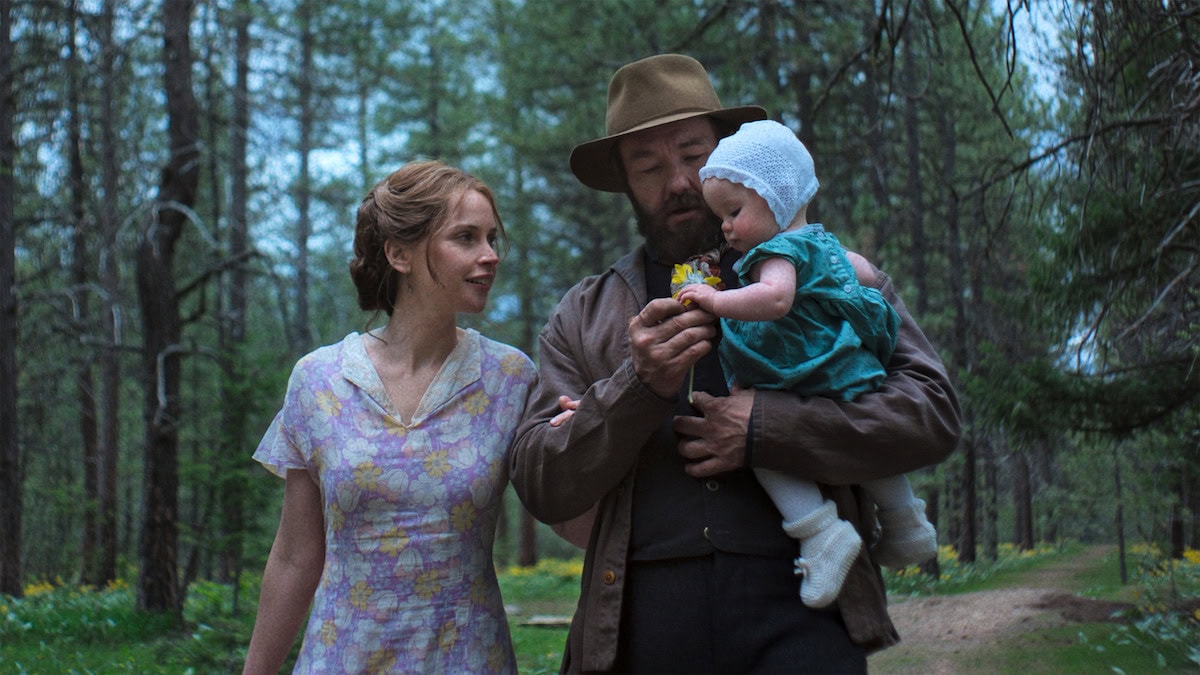
Adapted loosely from Denis Johnson’s 2011 novella of the same name, Clint Bentley’s Train Dreams depicts an aspect of early 20th-century America that remains somewhat overlooked on the big and small screen. Bentley’s second feature is centered on the life of logger and railroad worker Robert Grainier (Joel Edgerton) in the Pacific Northwest, set some distance away from the epicenter of the lawless frontier action and emerging urban life, and it surveys the era’s unprecedented upheavals with an ambivalent eye.
The film covers a broad sweep of time, from Robert’s birth in the 1890s to his eventual death in the late 1950s, quickly progressing from his early rural childhood through to an initial meeting with future wife Gladys (Felicity Jones) in a local church, after which the couple soon settle down and start a family. For much of the first half, the central conflict that emerges is Robert’s regret over missing out on his young daughter’s growth, as his train company employer frequently has him camped out at far-off construction sites for weeks at a time. But eventually a particularly dark sequence of events sends him down still more fraught, unpredictable paths.
With its swooning shots of untouched American wilderness and surfeit of magic-hour lighting, the film invites comparison to the work of Terence Malick, but this kind of lyricism isn’t always an ideal fit for the literary source material. As prone as it is to elegizing an evening sky or the play of sunlight through a canopy, Johnson’s declarative writing also balances its open-mouthed awe with a narrative style that’s terse, directly evoking the taciturn Robert.
The film’s visual aesthetic can seem somewhat disconnected from the story being told, with Bentley also a little over-reliant on third-person voiceover narrration to elucidate Robert’s thoughts. Aside from the occasional evocative image, like the boots of a deceased character gradually being subsumed over the years by the tree trunk to which they were ceremonially nailed by his workmates, it can feel as though cinematographer Adolpho Veloso is merely providing elegant illustration to personal struggles that are primarily happening off screen.
But even when it more closely resembles a photo book than a living, breathing work of art, Train Dreams is consistently engaging. The passive, often bewildered Robert is continually forced to adapt to understanding his place in the world, and Edgerton’s impressive performance conveys these shifts with sublety. Whether facing his increasing obsolescence as he ages, or haunted by his inability to stop the racist murder of a Chinese co-worker, the character remains something of a mystery to himself, and the actor succeeds in combining warmth and humility with this enigmatic aspect, portraying a man mostly at the whim of larger, unseen forces.
Notably more talkative than Robert is grizzled old sage Arn Peeples (William H. Macy), a veteran logger and explosives expert who helps to draw out the film’s broader themes, in more reflective moments between his rambling geriatric anecdotes. A soulful turn from Macy breathes life into what could otherwise be a relatively hackneyed character, his world-weary warnings about the infringement of human progress upon the country’s millenia-old natural environments never quite drowning out the film’s primarily low-key, character-driven approach.
This teetering between the anecdotal and the universal gets smoother as the film progresses, with the traumas that Robert experiences or bears witness to becoming increasingly insignificant in the larger tapestry of life. Though its occupation of a middle ground between two opposing poles ultimately prevents it from resonating too deeply, the film’s mythologizing is refreshingly measured, and it offers an appealingly earnest take on the American story.
Since 2001, we've brought you uncompromising, candid takes on the world of film, music, television, video games, theater, and more. Independently owned and operated publications like Slant have been hit hard in recent years, but we’re committed to keeping our content free and accessible—meaning no paywalls or fees.
If you like what we do, please consider subscribing to our Patreon or making a donation.