The found-footage horror genre often suggests a hiding place for amateur filmmakers, who can embrace a lack of skill as a virtue. Audiences are often driven to zone out during the early portions of these films, which are often composed of ad-libbed banalities that will eventually be paid off with a fleeting glimpse of a forgettable big bad. Early on in writer-director Robbie Banfitch’s found-footage nightmare The Outwaters, it’s clear that something else is going on, though, and it gets your anxiety coursing. The film’s juxtaposition of images and sounds is insidiously purposeful, steeling the viewer for what may lie ahead.
Yes, the camera seesaws all over the place and sounds drift in and out of the mix while characters set up selfies and prattle on arbitrarily, but the film’s images are vivid and beautiful, and the inconsistent sound quality constantly underscores the disconnection between the main characters. Banfitch, who also shot and edited The Outwaters, as well as stars in it, isn’t an amateur trying to pass himself off as a pro but rather the opposite: a filmmaker with surgical precision, using found-footage aesthetics to lull you into a complacent trance. He’s an alligator with eyes just above the surface of the water, waiting to strike.
The film’s setup is the minimalism incarnate that we expect from the found-footage genre. We’re watching memory cards from a trip gone awry, which reveal an L.A. filmmaker, Robbie (Banfitch), agreeing to camp out with friends in the Mojave Desert to shoot a music video for Michelle (Michelle May). Tagging along are Robbie’s brother, Scott (Scott Schamell), and best friend, Ange (Angela Basolis), who’s brought on as the makeup and hair person.
Apart from Scott’s sad, mellow cool-dude-of-few-words routine, Banfitch goes to little effort to differentiate the characters. It takes The Outwaters a while to even tell the audience of the crew’s purpose for their trip. This tactic is shrewd, as found-footage films often stumble trying to mix their “realistic” lo-fi aesthetics with screenwriterly exposition. Understanding that all you need to know is that these characters are going to the desert, Banfitch discards exposition almost entirely, allowing you to groove on his rich aural-visual tapestry.
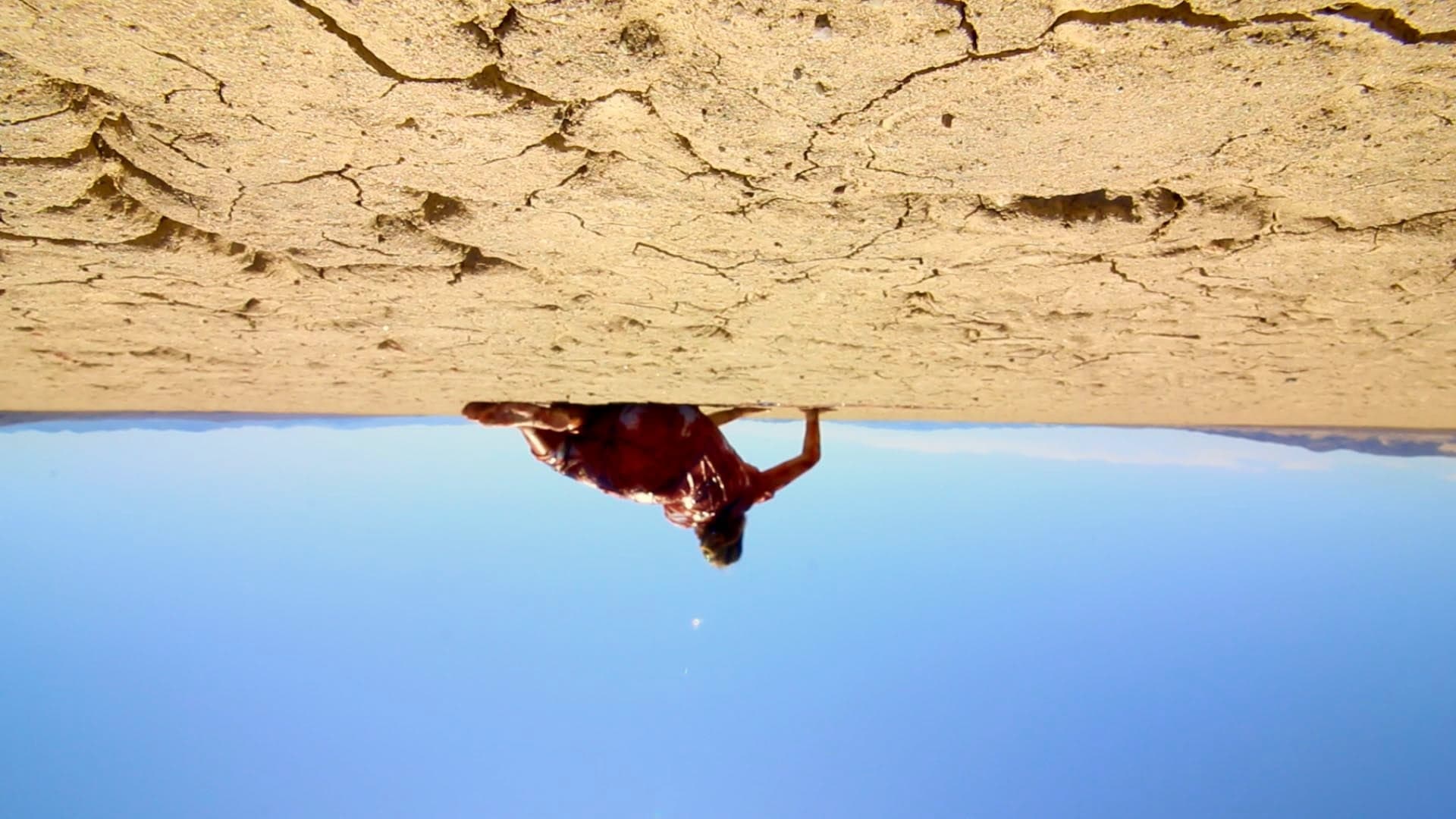
Once in the Mojave, Banfitch offers a sensory bath that should be the envy of filmmakers with far greater resources. Imagine Last Movie-era Dennis Hopper collaborating with Michelangelo Antonioni on a horror thriller and you’re close to capturing this film’s cocktail of existential desolation and dread. As director and as an actor playing a director, Banfitch utilizes the portability of his camera to suggest a topsy-turvy alien world that’s closing in the characters, particularly with upside-down tracking shots that outdo a similar sequence in Ari Aster’s Midsommar. Banfitch’s ongoing tricks of perspective, communicating the shifting relationships between the various planes of compositions, are even more impressive for seeming accidental.

Later, the camera homes in on Michelle’s gorgeous eyes and even on the pores of her skin, establishing her fragility. Michelle is also at the center of one of the film’s most breathtaking sequences: a wordless march across the terrifyingly bright, cracked desert accompanied by ambient noise that evokes less the music video that the group is making than a vast, pitiless environment readying itself to humble her—a siren’s stroll as doomy requiem.
Elsewhere, Ange’s cresting anxiety registers in fleeting glimpses on the periphery of images, and the sheer hallucinatory extravagance of the color spectrum in The Outwaters inspires a shuddery awe that’s intensified by irrational sounds. The bass-heavy gurgling on the soundtrack often resembles the movement of the ocean, except that the characters appear to be as far from water as you can get. Or is that the internal rumbling of something in the mountains?
The Outwaters is the rare found-footage movie that’s actually and profoundly cinematic, and Banfitch weaponizes your gratitude for this unexpected formalist bounty. At a certain point, you will probably accept that not much is going to happen in narrative terms and that maybe this isn’t even a real horror film, but a mood bath fashioned by a filmmaker with a motherlode of talent. And it’s probably at just this point when the bottom drops out of The Outwaters, as it takes one of the most shocking tonal U-turns in cinema since Leatherface slammed that metal door shut in Tobe Hooper’s The Texas Chainsaw Massacre.
One moment, Robbie is wandering the Mojave in the middle of the night, priming us for creepy yet seemingly low-stakes Blair Witch-inspired shenanigans, and in the next the group is plunged into a primordial charnel house, gripped by either insanity or alien interlopers, possibly both in conjunction. Suddenly, foreshadowing that we assumed was scenic misdirection begins to pay off ferociously. Was that electricity that the characters seemed to feel in the ground, and were those rockets or shotguns, maybe both, blasting into the sky? Remember that reference to re-experiencing an acid trip? As you remember these details, volatile and irrational images keep hitting you at a merciless clip. Blood sits in the sand like snot-crusted slugs. Ange cries into the desert darkness, only periodically illuminated by Robbie’s flashlight. Something may be burrowing in her skin, a suspicion encouraged by an insectile buzzing on the soundtrack that, come to think of it, has been audible on a low hum long before hell opened up.
Banfitch denies us the pleasure of a group drawn together in opposition to a menace and even the satisfying tension of seeing a group dissolve in the face of adversity. Instead, the group as a unit is merely obliterated in the blink of an eye by indifferent gods. Robbie is left alone as our surrogate, as our yarn spinner, and perhaps as the film’s central monster. Unstuck in time, Robbie dissociates from himself while his settings instantaneously shift from desert to cave to bodies of water, almost as if he’s chasing another version of himself. Banfitch’s formalist bravado is fluid, intuitive, and seemingly inexhaustible. With The Outwaters, the found-footage horror film has unexpectedly found its trippy, unmooring, ultraviolent answer to the cosmic horror of H.P. Lovecraft and the free-associative barbarity of A Page of Madness.
Since 2001, we've brought you uncompromising, candid takes on the world of film, music, television, video games, theater, and more. Independently owned and operated publications like Slant have been hit hard in recent years, but we’re committed to keeping our content free and accessible—meaning no paywalls or fees.
If you like what we do, please consider subscribing to our Patreon or making a donation.