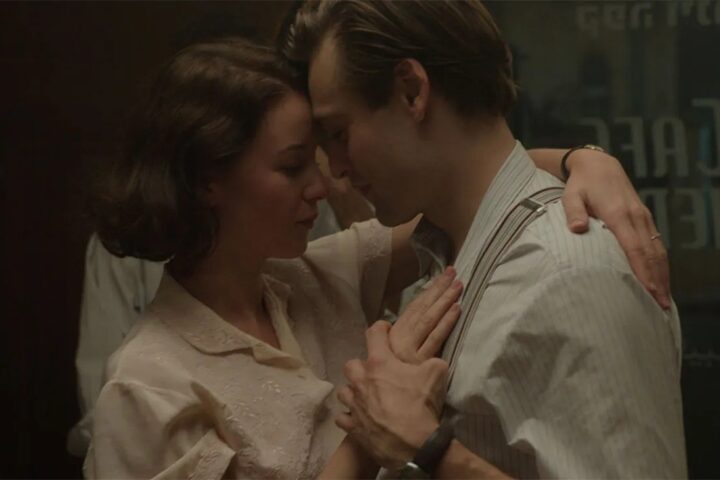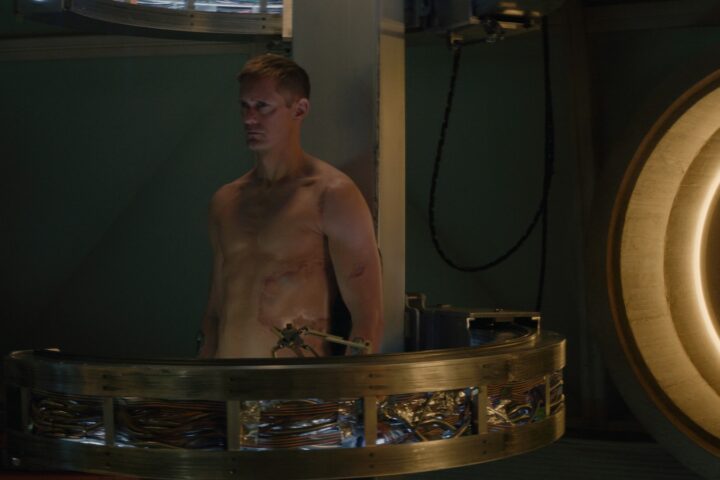
Think of writer-director Harry Lighton’s Pillion as a BDSM spin on David Lean’s Brief Encounter. Adapted from Adam Mars-Jones’s novel Box Hill: A Story of Low Self Esteem, the U.K.-set film updates the era from the 1970s, when living in the closet was almost always a necessity, to a more generally open and accepting present day—one among several page-to-screen changes that help to make the story less bleak, more bittersweet.
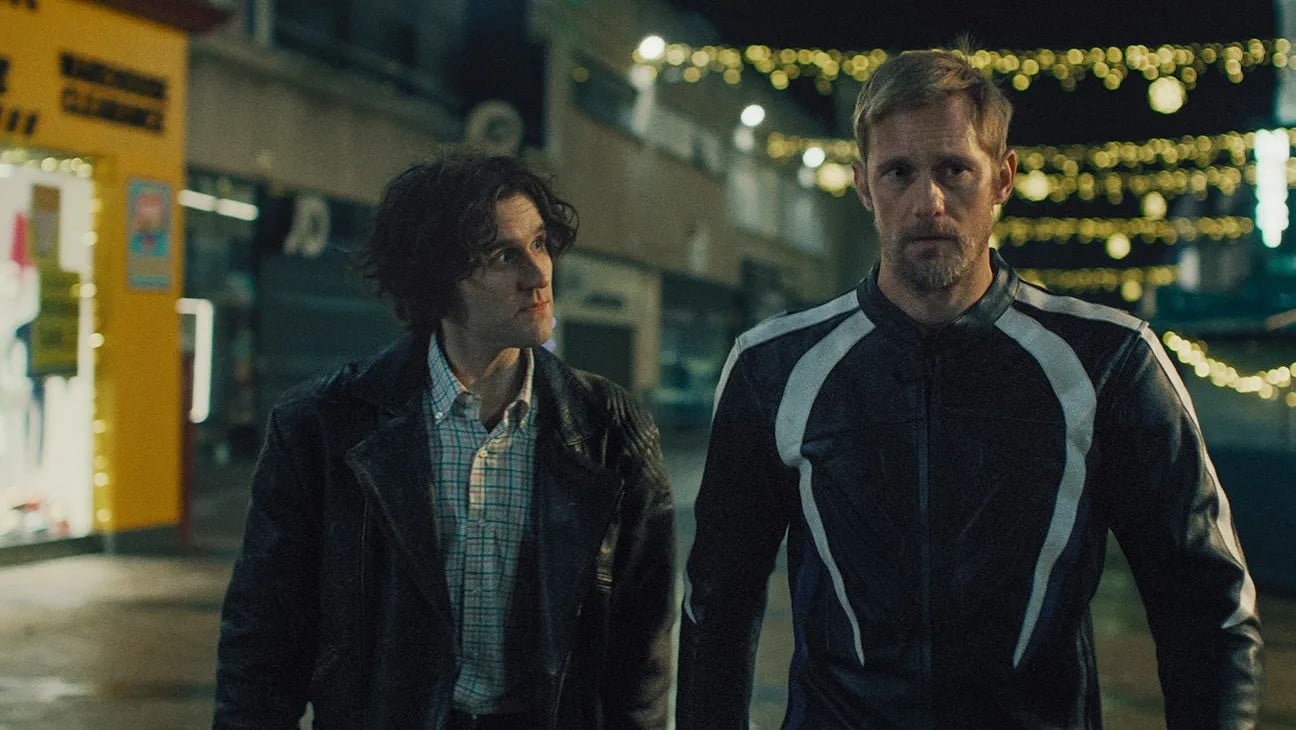
Colin (Harry Melling) is a lonely gay youth who works in parking enforcement and lives with his parents. Colin’s mother, Peggy (Lesley Sharp), is in the final stages of cancer, and she and Colin’s father, Pete (Douglas Hodge), are dotingly supportive, determined to help their son find love. During one of the blind dates they organize for him—this time with a goofy bloke amusingly sporting an “Alexa, Free Britney!” T-shirt—Colin crosses paths with Ray (Alexander Skarsgård), a strapping motorcyclist whom few would or could resist servicing.
Skarsgård oozes sexual charm and menace in the role, evident from his initial entrance when he leans into frame beside Colin. The lusty pleasures continue soon after, when Ray, standing stoic in chest-baring S&M regalia, gets Colin to his knees in a back alley during a Christmas Day date. Gag reflexes are tested and an intoxicating, if eventually traumatizing, relationship begins.
Which isn’t to say that Pillion is a haughty cautionary tale. The subculture which Colin finds himself a part of is always presented sans condescension or critique by Lighton. And if there’s humor to be found in some of the particulars—say, when Ray and Colin have a body-flexing, groin-grabbing, ass-baring wrestling match—it’s never to judge or to poke fun, but to revel in the very real delights of consensual sexual roleplay. And both Skarsgård and Melling are experts at conveying the erotic highs of body and, to a point, spirit.
Emotions can only take the characters so far. Pillion’s tragedy stems from the very specific fact that what Ray wants (a submissive plaything and nothing else) isn’t what Colin wants (a dom daddy who truly loves his devoted boy). Both men are at cross-purposes from the start, though it takes both of them a long time to recognize that. For the most part, Colin is content to let Ray rule the roost, forcing him to sleep at the foot of his bed like a dog, controlling every aspect of his life even in off hours via surprise calls or texted shopping lists.

A long-delayed meet-the-boyfriend dinner allows Colin’s mother to express her disapproval of this relationship to Ray’s face, though he gives as good (or cruelly bad) as he gets. Ray’s monstrousness is inseparable from his allure, and when things do finally come to a head between he and Colin, his malevolent stare feels like it could blot out the sun.
There’s a fairy-tale quality to much of Pillion, particularly when Ray eventually gifts the not-as-meek-as-he-seems Colin his wish for a day off, during which they both act like as much of a “normal” couple as possible: They do a playful singing contest for two older ladies, sensually canoodle in a movie theater, and run heedlessly through the streets, whooping it up. Yet the joy they feel is always shifting imperceptibly between genuine and manufactured. And an earlier scene in which a fellow submissive, Kevin (Scissors Sisters frontman Jake Shears), has a heart-to-heart with Colin about how Ray never locks lips hints at the eventual point of no return.
It’s a nicely subversive twist on romance-flick formula: the climactic kiss that proves poisonous as opposed to being a cure-all. Lighton gets Melling and Skarsgård to an incredibly potent place in their final scenes together, particularly in the way Skarsgård shows Ray’s mask dropping, his vulnerability bubbling up like lava from a long-dormant volcano.
It’s debatable whether the film fully sticks its landing, since Lighton goes for both the pitiless emotional devastation of the finest cinematic tearjerkers and a life-goes-on poignancy that, down to a direct quote of the ubiquitous musical ditty “Smile,” feels tremulously Chaplin-esque. That uncertainty still rhymes nicely with Melling’s final close-up, which makes very clear that this particular love affair, in all its ups, downs, and in-betweens, will leave a permanent scar.
Since 2001, we've brought you uncompromising, candid takes on the world of film, music, television, video games, theater, and more. Independently owned and operated publications like Slant have been hit hard in recent years, but we’re committed to keeping our content free and accessible—meaning no paywalls or fees.
If you like what we do, please consider subscribing to our Patreon or making a donation.