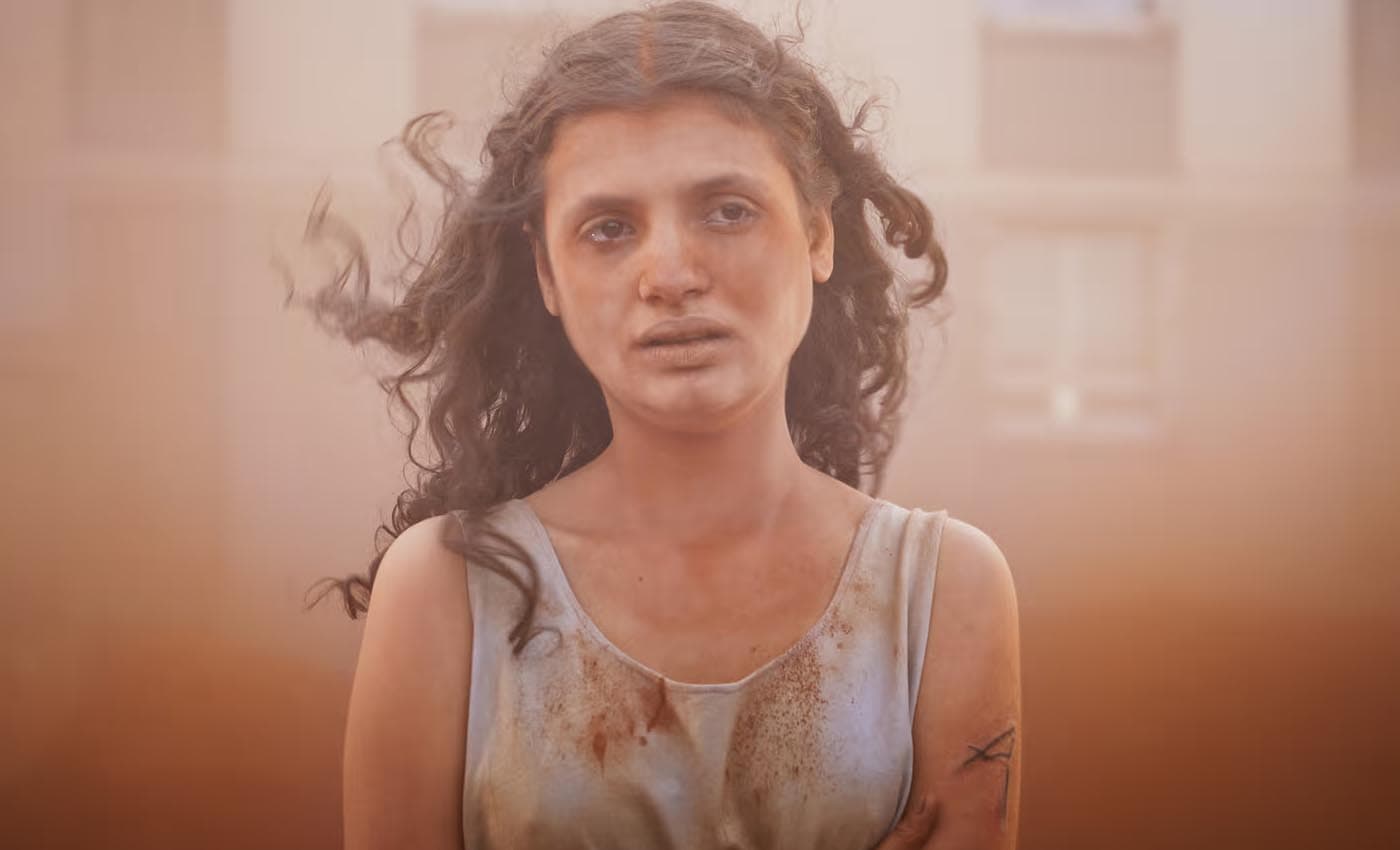
Four years after walking away from Cannes with the Palme d’Or for Titane, Julia Ducournau returns to the well of body horror with Alpha, albeit a little tentatively. Ducournau’s third feature sheds some of the genre baggage of her previous work, demonstrating simultaneously more ambition and a more personal, low-key approach.
The film’s setting appears to be a French city sometime in the not-so-distant past, which has been devastated by the spread of an unnamed virus. Alpha (Mélissa Boros) is the 13-year-old daughter of a doctor and second-generation Moroccan immigrant (Golshifteh Farahani), whose work primarily sees her attending to victims of this unprecedented epidemic, which has made the population particularly anxious about blood contamination. She’s understandably horrified, then, at Alpha’s decision to let classmate and sometime love interest Adrien (Louai El Amrousy) tattoo her at a house party, with the girl’s consequent bleeding also making her a social pariah in school. Alpha’s traumatic coming-of-age is complicated further by the return to the family home of Amin (Tahar Ramin), the drug addict uncle with whom she’s obliged to share a room.
If Alpha sounds a little over-stuffed thematically, that’s because it is, though that’s equally true of Titane and Ducournau’s debut feature, Raw. It also shares their tendency toward self-seriousness, which her exhibitionist aesthetic and audacious narrative conceits mostly helped to alleviate. But no such respite from the ponderous gloom is offered this time around.
Alpha’s anonymous urban environments are shot in an oppressive, deliberately muted color palette, which only changes slightly to differentiate between flashbacks of the virus’s initial outbreak and present-day scenes. This time-jumping structure also serves to sap what is mostly a straightforward story of momentum, as well as dulling the impact of a crucial final twist.

Ducournau has stated that Alpha was partly inspired by her childhood memories of the AIDS crisis, a biographical tidbit that could go some way toward explaining the film’s unceasingly somber mood. But it’s a little unclear what drove her to invent an imaginary virus as a stand-in for a real-life one, besides a lingering desire to flex some of her attention-grabbing visual sense. And, in fairness, the symptoms of the disease are genuinely squirm-inducing, with the flesh of the infected turning into a discolored, veiny marble that eventually crumbles away into dust.
Still, as disturbing as this physical abjection might be, it doesn’t seem to lend itself to the ambivalent curiosity and allegorical richness that accompanied the bodily transformations of Titane’s protagonist, not to mention those of many a character across David Cronenberg’s work, to which Ducournau is indebted. So when Alpha defiantly tells one affected patient that he’s “beautiful” even in an advanced stage of illness, the statement rings a little hollow.
Significantly more affecting than the virus itself are the heroin use and tortured withdrawal of Amin, which ultimately form a more central part of the story here. His self-destructive impulses have apparently been worsened by his prior exposure to the disease, with his habit and the possibility of death from overdose seemingly presenting the only plausible escape from a bleak, hopeless situation. Ramin’s raw, nervy performance conveys a believable suffering that Ducournau otherwise renders too distant throughout the film, benumbing it through obscure symbolism and unnecessary complexity. Alternately stoic and panic-stricken, Farahani also brings the occasional flash of humanity to a story oddly devoid of it.
As Alpha finally reveals itself to be a study of memory and inter-generational trauma, the relationship between Ramin and his sister proves to be the film’s emotional core, with Alpha’s own maturation realized through her new role in this anguished central trio. But it’s too late by that point for any lasting resonance. The possibility of relating to these characters is constantly hindered by the struggle to make sense of the story’s messily sketched dystopia.
Since 2001, we've brought you uncompromising, candid takes on the world of film, music, television, video games, theater, and more. Independently owned and operated publications like Slant have been hit hard in recent years, but we’re committed to keeping our content free and accessible—meaning no paywalls or fees.
If you like what we do, please consider subscribing to our Patreon or making a donation.