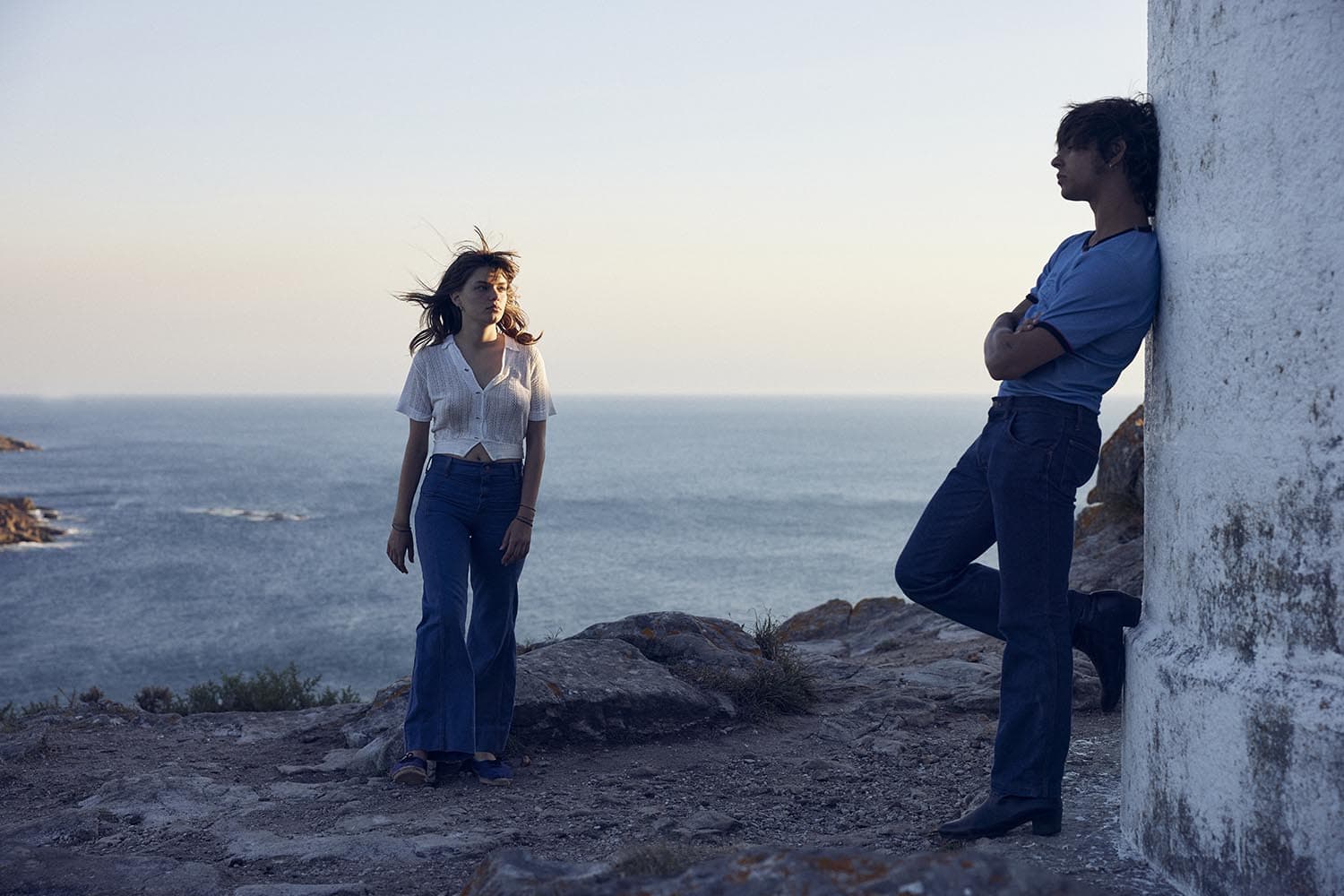
The title of writer-director Carla Simón’s Romería is Spanish for pilgrimage, which points to the complicated nature of Marina’s (Llúcia Garcia) more than just physical journey across the film. Orphaned at a young age and raised by her mother’s family in Barcelona, Marina travels to the coastal Galician city of Vigo, seeking to obtain the signatures of her paternal grandparents to have her name added to her father’s death certificate for a college scholarship application. Meeting uncles, aunts, cousins, and nieces for the first time, Marina learns things about her parents’ lives that contradict what she’d been raised to believe.
Set in 2004, Romería could be seen as a sequel of sorts to Simón’s autobiographical debut feature, Summer 1993, especially since some of the details of Marina’s backstory mirror those of Frida, the six-year-old orphan at the center of the earlier film. Marina lost her parents to addiction and AIDS, and just as the maternal relatives in Summer 1993 talk around Frida’s mother’s fate out of a sense of shame, so do Marina’s paternal relatives, particularly her grandparents (Marina Troncoso and José Ángel Egido), with some of the revelations about how they treated their son during his last years being especially disturbing.
Simón’s instinct for sketching in crucial narrative and character detail within a naturalistic context remains as unerring as ever. That’s evident in everything from an aunt’s mention to her children of Marina possibly having a “blood disease” to the grandfather offering Marina a generous monetary gift to help fund her college education. The former points to all the shame this family turned into secrets over the years, while implicit in the grandfather’s gesture is his selfish desire for his granddaughter to stop poking around in the family’s past. The way Marina spots one of her uncles, Iago (Alberto Gracia), quietly sneaking in and out of her grandparents’ home after he had initially told them over the phone he couldn’t make a family gathering is sufficient for us to grasp how much of a black sheep he’s considered by the rest.
It’s on a visual level, however, that Romería marks an advance on both Summer 1993 and Simón’s 2022 follow-up, Alcarràs. Throughout, Marina, who says she plans to study filmmaking in college, is seen holding a digital-video camera, and we see some of the comparably low-resolution footage she’s shot, contrasting with the sharp high-definition video of the present. (For this film, Simón worked with arguably her highest-profile cinematographer yet, Hélène Louvart.) Some of these scenes are overlaid with voiceover narration featuring passages from the diary her mother kept during the early to mid-1980s, with each selection corresponding to what her parents did in the specific location Marina is visiting for the first time.
But Simón reserves her most striking filmmaking gambit for Romería’s second half, when the film suddenly dives into full-on fantasy. A dramatization of the dark truths Marina has learned about her parents—most notably, a mutual descent into heroin addiction—this mid-film sequence has the telltale signs of celluloid (at least based on the amount of visible grain on screen). It also features a bit of animation and even a macabre musical number in which some of the performers have white sheets draped over them, suggesting dancing corpses.
Across this sequence, it’s telling that Garcia plays Marina’s mother and that the single-named actor Mitch—who elsewhere plays Nuno, a cousin to whom Marina develops a bit of an unspoken romantic attraction—plays her father. For the way Marina imagines what her parents’ life might have been like before her birth, and through the visual vocabulary of a medium she’s becoming interested in, makes this moment an intensely personal one.
The way the sometimes harrowing images throughout the sequence counter the hedonism projected by Marina’s mother’s diary entries as they’re read aloud on the soundtrack suggests that our protagonist is willingness to confront, with brutal honesty, the hidden corners of her family’s past. Rapturous enough to elevate the whole film, the sequence is deeply moving not only for its sense of clear-eyed grace and forgiveness, but for the way it evokes the feeling of a budding filmmaker discovering the cathartic power of artistic creation.
Since 2001, we've brought you uncompromising, candid takes on the world of film, music, television, video games, theater, and more. Independently owned and operated publications like Slant have been hit hard in recent years, but we’re committed to keeping our content free and accessible—meaning no paywalls or fees.
If you like what we do, please consider subscribing to our Patreon or making a donation.