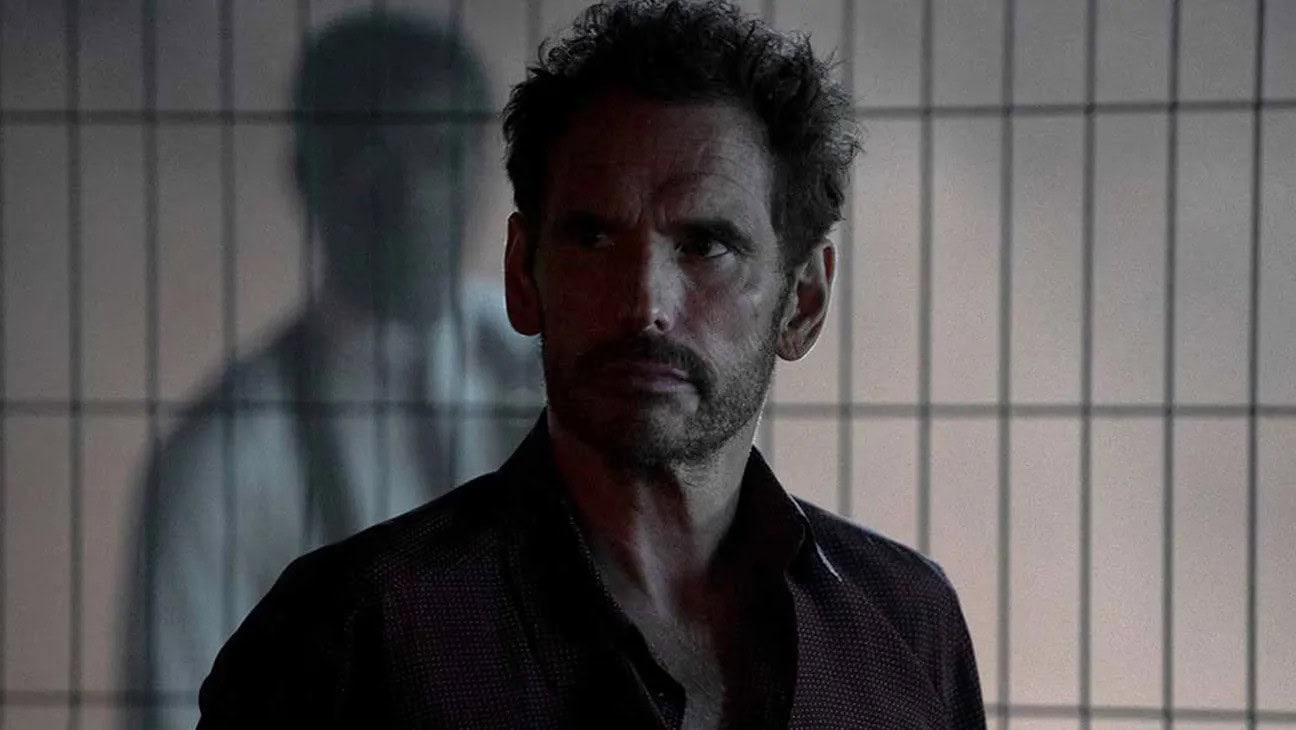
The play’s not the thing in Claire Denis’s The Fence. A mostly English-language adaptation of Bernard-Marie Koltès’s Black Battles with Dogs, the film dramatizes a tense nighttime standoff on a West African construction site between Horn (Matt Dillon), the white foreman, and Alboury (Isaach De Bankolé), a local demanding the return of his brother’s corpse.
Wrapped up in the confrontation is Horn’s wife, Leonie (Mia McKenna-Bruce), newly arrived from overseas and increasingly alienated by her unfamiliar surroundings. Also on hand is Cal (Tom Blyth), Horn’s cocky second-in-command who may have had something to do with the circumstances surrounding that aforementioned dead body. It’s a simple setup, though it’s one that Denis approaches via a discordant melding of cinematic and stagy modes.
The French auteur’s distinctive stamp is all over the initial two sequences. In the first, an unnamed African woman walks slowly along a dirt landscape pockmarked by bulldozer tracks, eventually stopping to lay a large green leaf over a puddle-filled hole. In the second, Cal drives heedlessly to work while “Beds Are Burning,” Midnight Oil’s Aboriginal land rights rock anthem from 1987, blares on the radio. Scene one’s evocativeness collides with scene two’s obviousness, which may very well provide a key to what Denis is up to in The Fence.
That doesn’t make much of what follows an easy sit, with the lengthy interactions between Horn and Alboury tiresomely circling the same socially and racially charged impasses. Horn gruffly denies any culpability for the unfortunate situation. Alboury stoically demands restitution and refuses to leave. Wash, rinse, repeat. Was something lost in translation between French and English? (Denis is credited with the script along with both the young writer, director, and actress Suzanne Lindon and movie subtitler extraordinaire Andrew Litvack.) Or might there be some kind of Brechtian method to the didactically verbal madness?
Denis and cinematographer Eric Gautier, for one, utilize the widescreen frame and the various sounds and sights—watchtower soldiers calling to each other, perimeter lights dimming and brightening—to distance us from or bring us closer to the action at pivotal points. And in the midst of one of Horn and Alboury’s arguments, Denis may additionally cut away to Leonie or Cal in a nearby interior, eavesdropping on the men’s muffled voices.
The late Koltès’s 1979 play isn’t opened up so much as clinically dissected by the film, with every character an enfeebled pawn in situations they’re at a loss to resolve. McKenna-Bruce continues in the vein of many an opaque Denis female, wandering this dust-strewn setting in high heels and a skimpy red dress, her mind breaking down alongside her wardrobe. She and de Bankolé (unsurprisingly) are keyed in to Denis’s moody formalism, though de Bankolé’s standout scene comes early—an emotional monologue delivered in a dream sequence featuring a slobberingly rabid dog that looks like it was birthed via A.I. prompt. The uncanniness of the animal coupled with de Bankolé’s all-too-human sorrow makes for a strangely sublime pairing.
By contrast, both Dillon and Blyth are sadly out of their depth, with the former working overtime to make Horn’s red-blooded prattling into something impactful and consistently coming up short. Though his exertions are at least more captivating than those of the overdramatic Blyth, his twitchy performance casting a retrospectively favorable light on the pallid Joe Alwyn in Denis’s prior late-career oddity Stars at Noon.
It isn’t quite right to say that Denis has lost a step, since The Fence does linger in the mind as almost all of her work does. Its detriments and its riches work in tandem to conjure, in toto, a most mysterious object. A film of such jumbled vitality is at least one well worth pondering.
Since 2001, we've brought you uncompromising, candid takes on the world of film, music, television, video games, theater, and more. Independently owned and operated publications like Slant have been hit hard in recent years, but we’re committed to keeping our content free and accessible—meaning no paywalls or fees.
If you like what we do, please consider subscribing to our Patreon or making a donation.