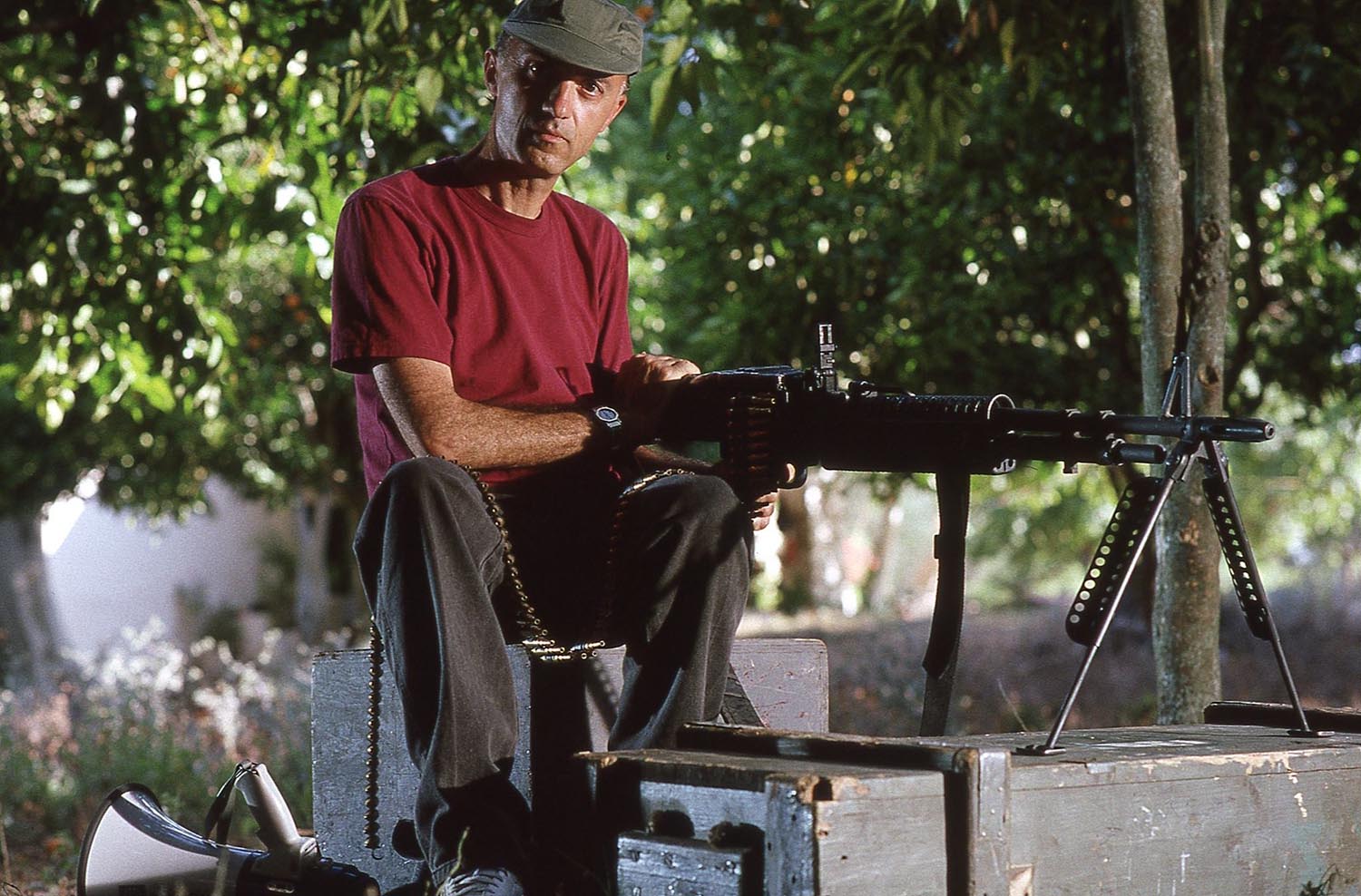
Nico Mastorakis has an uncanny ability of pulling ideas from various sources and running them through the Cuisinart of his peculiar sensibility, producing something altogether idiosyncratic. The six films assembled in Arrow Video’s new box set—one evocative religious allegory and five bawdy action comedies—testify to Mastorakis’s skills as a pop-cultural bricoleur. As a result, they serve as a series of variably amusing time capsules, deploying plenty of medium-specific references that might just delight viewers who came of age in the 1980s and early ’90s. Others will have to spend some time doing due diligence on Wikipedia.
The Time Traveler, from 1984, stars Keir Dullea as a man who fell to Earth, found naked along the Mykonos shore by expat American widow Andrea (Adrienne Barbeau). The new arrival soon names himself Glenn (as in astronaut John Glenn) and proceeds to learn the ways of the world. Unsurprisingly, a romance like the one in John Carpenter’s Starman soon develops between Glenn and Andrea, while Glenn’s budding friendship with Andrea’s son, Tim (Jeremy Licht), echoes Steven Spielberg’s E.T. in its warm, fuzzy glow. There always seems to be something unearthly about Dullea’s presence, and his participation in Stanley Kubrick’s 2001: A Space Odyssey only lends a certain heft to this film’s admittedly lo-fi sci-fi trappings.
Perhaps taking a page from the works of Carl Jung, The Time Traveler makes explicit the Christian underpinnings that are kept subtextual in many stories about UFOs and aliens. This connection is suggested early on when we see the number 1225-1 stenciled on Glenn’s flesh, though it remains oddly unremarked upon by the characters. In its rather good-natured way, the film has Glenn finding affinities with the crucified Christ, who, he says, “looks nice.” These sympathies prove literal in the film’s twist ending, revealing Glenn’s true connection with Jesus, before a Twilight Zone-like coda indicates why the film’s alternate title is The Next One.
The Time Traveler argues that our imperfections are the engine determining mankind’s evolution, whereas 1985’s Sky High suggests that our foibles lead only to rather strained comedy. Mastorakis’s later action comedies almost invariably center on a hapless pair of lusty young men caught up in events beyond their control, but here in its larval stage we get a trio of dipshit exchange students who find themselves in the middle of some Cold War espionage while visiting Greece: hunky Bobby (Clayton Norcross), geeky Lester (Daniel Hirsch), and jokey Mick (Frank Schultz), whose signature gag is a passable Rod Serling imitation.
The MacGuffin sought by both sides of the imbroglio is a tape containing a low-frequency tone that brings on hallucinations. Mastorakis hilariously renders these visions as cheapjack music videos that even MTV in its early days would never have aired, accompanied by some pretty awful pop tunes, an element that features in all of Mastorakis’s subsequent action comedies.
Sky High sets the template for the later films in this set: The action stakes are achievably low, the comedic material scattershot, and production values (particularly locations) modestly impressive. Above all else, a thick impasto of unabashed female nudity serves to spackle over any gaps in narrative logic. And, for those keen on grubbing up some social commentary, there’s a corrupt C.I.A. agent (John Lawrence) playing both sides for personal gain.
Terminal Exposure, from 1987, centers on two buddies named Lenny (Mark Hennessy) and Bruce (Scott King). Taken together, their names are an homage to Lenny Bruce, the king of “sick” standup comedy, though Mastorakis’s film decidedly lacks anything even remotely as cutting as Bruce’s best work. The plot involves amateur photo bug Lenny accidentally taking pictures of a murder on Venice Beach, which leads to a series of narrow escapes from various hit men in the employ of the film’s Big Bad, Mr. Karrothers (John Vernon).

In one of Mastorakis’s more highbrow references, he stages the scene where Lenny examines enlarged images in order to glean further information about the crime as a direct nod to Antonioni’s Blow-Up. Mastorakis may not exude Antonioni’s pervasive sense of existential alienation, but they do seem to share a fascination with mimes.
From 1988, Glitch! again focuses on two pals, Todd (Will Egan) and Bo (Steve Donmyer), aspiring thieves who break into the Beverley Hills mansion of movie mogul Julius Lazar (Dick Gautier) in his absence. At the same time, a secretarial screw-up has scheduled a cattle call for actresses to appear in Lazar’s latest magnum opus. So, of course, Todd proceeds to convincingly impersonate Lazar by donning one of his monogramed bathrobes.
This is all merely an excuse for Mastorakis, as he mentions in one of several interviews included on this Blu-ray release, to find a luxe manor where he can live during the shoot while surrounding himself with dozens of nubile (and often unclothed) actresses. Glitch! is characterized by really broad humor (no pun intended), including some ethnic stereotypes that don’t play so well these days. There’s also a gay ninja named Brucie (Dan Speaker) who minces around a lot, but at least when the chips are down, he can actually kick some serious ass.
If you think the title of 1989’s Ninja Academy sounds an awful lot like Police Academy, well, there’s a reason for that. Instead of dealing with cops, this film features a ragtag bunch of social misfits who undergo some sort of rigorous training only to emerge as fledgling ninjas. Egan returns for this one as Josh, a trust fund baby forced to attend ninja school in order to toughen up. Other new recruits at the Topanga Canyon Ninjutsu Ryu include a klutz (Jack Freiburg), a gun nut who’s equal parts Rambo and Eastwood (Robert Factor), two self-professed bimbos (Kathleen Stevens and Lisa Montgomery), and a mime (Jeff Robinson).
The Naked Truth, from 1992, finds Mastorakis at his most referential. The opening titles use the blocky Monty Python font; the storyline’s a straight crib from Some Like It Hot; and it closes with a protracted, and seemingly unmotivated, pastiche of Casablanca with no less than three actors doing lackluster Bogart imitations. Along the way, Mastorakis goes full bore Zucker, Abrahams, and Zucker, doubling down on bizarre stunt casting and supposedly zany sight gags.
This time our not-so-dynamic duo are both named Frank (Robert Caso and Kevin Schon), and they’re forced to don drag after mafia hitmen take out a fed (M. Emmett Walsh) who has just slipped a ledger full of incriminating information into one of the Franks’ suitcases. Somehow this also involves the contestants in a ketchup magnate’s beauty pageant, among whom the two Franks, now going by Ethel and Mirabelle, manage to find a hiding place as makeup artists.
The Naked Truth represents the apotheosis of Mastorakis’s obsession with crossdressing, which also turns up as a method of avoiding bodily harm in both Sky High and Glitch! But there’s never a moment in these films that equals the empathetic “Nobody’s perfect!” that closes Some Like It Hot. If Glitch! was mired down by ill-advised ethnic gags, The Naked Truth is paralyzed by some truly abysmal gay jokes. The Naked Truth is also emblematic of Mastorakis’s larger body of work in that its sum is quite often less than its often endearingly charming parts.
The Nico Mastorakis Collection is now available.
Since 2001, we've brought you uncompromising, candid takes on the world of film, music, television, video games, theater, and more. Independently owned and operated publications like Slant have been hit hard in recent years, but we’re committed to keeping our content free and accessible—meaning no paywalls or fees.
If you like what we do, please consider subscribing to our Patreon or making a donation.