With his latest feature, Misericordia, French filmmaker Alain Guiraudie again evinces his preoccupation with de-sensationalized depictions of male sexuality and the murky morasses of carnal desire. The film, which enjoyed its world premiere at last year’s Cannes Film Festival, also finds Guiraudie operating at the intersection of openness and opacity.
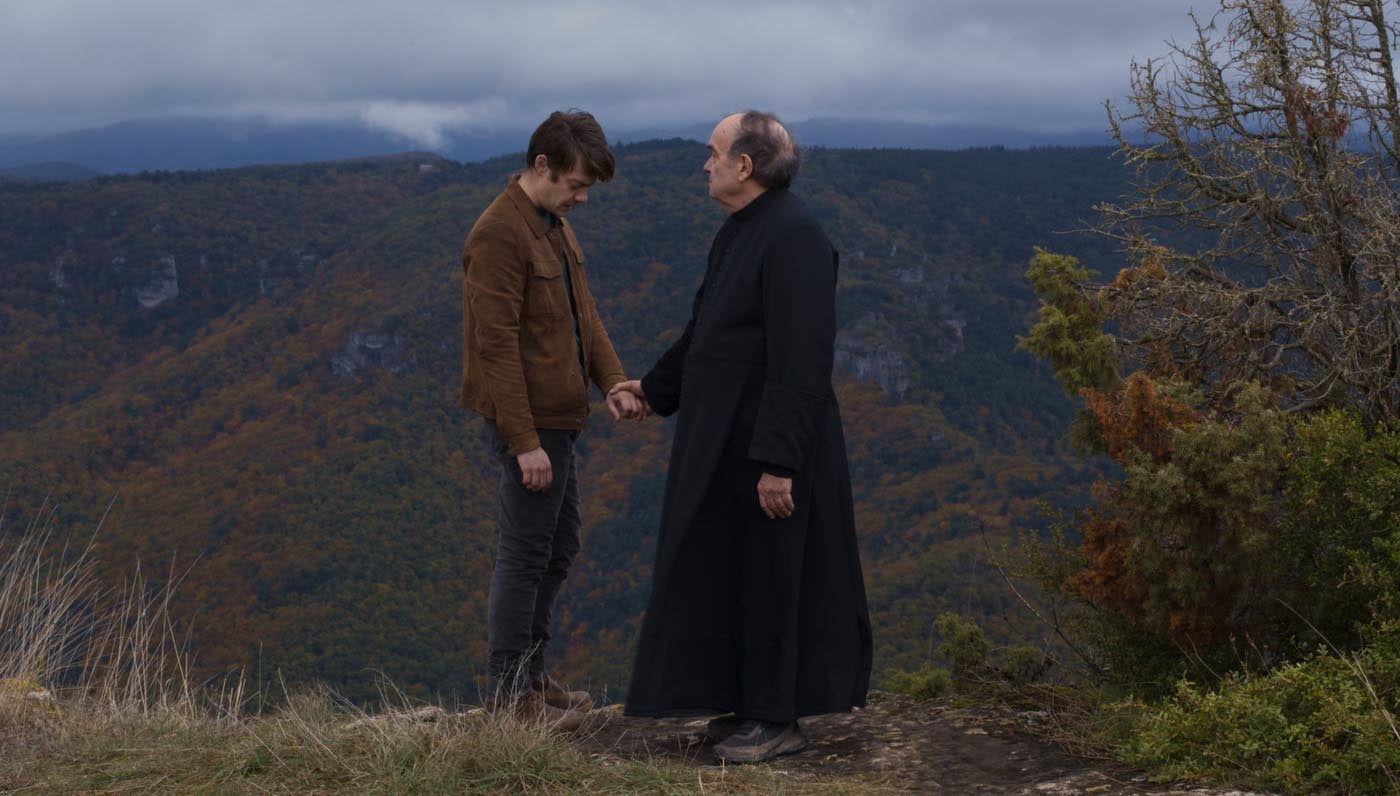
Félix Kysyl’s Jérémie returns to the rural French town of Saint-Martial to mourn his former boss, yet his homecoming opens up more emotions than the grief that spurred the trip in the first place. In short order, the young man finds himself enmeshed in a web of competing attractions between the newly widowed Martine (Catherine Frot), an estranged childhood friend (Jean-Baptiste Durand), and a particularly perceptive priest (Jacques Develay).
It’s the latter figure of divine authority who proves capable of assessing the developing and dangerous situation created by Jérémie’s impulsive instincts with stark clarity. Yet even when the priest boils down Misericordia’s essence via something of an impromptu sermon, the film never retreats into simple moralism. Guiraudie remains as spry and sly as ever in depicting the competing promise and peril of being true to one’s self.
I caught up with Guiraudie last fall when he presented Misericordia at the New York Film Festival. Our talk covered how he formalized a Freudian gaze for the project, where his religious background influenced the film, and what message he hoped to communicate through the story.
When asked how Staying Vertical’s filmmaker protagonist related to yourself, you replied, “All my characters are alter egos.” Where are you in this film?
[laughs] First and foremost, the priest. He’s my favorite character.
The word “misericordia” is derived from Latin words meaning “to pity” and “heart” that form together to signify a Christian-infused mercy. Do you think any of these characters deserve the audience’s pity?
“Pity” as a word is one that I would distance myself from in favor of “mercy.” For me, pity always has some level of contempt or differential in the power [in order] to attribute pity. Whereas mercy has more something to do with forgiveness, which, for me, has to do with empathy and understanding. It’s a very radical comprehension of the other and a being within proximity.
Do you view the film’s characters as people we should see at eye level, identifying with their situation rather than looking down on them?
I hope that I put myself at level with them. The way that I film, the camera is always placed from the perspective of one of the people involved. I’m always looking from somebody’s point of view. I’m helped in that by putting a lot of myself into each one of the characters! [laughs]
The film is rooted in some of your religious upbringing and background. Were you thinking of Misericordia as a parable for more morally ambiguous times?
There’s something in this film where I was questioning something contemporary to us. I’m trying to question what I find to be a certain value system in place, where I feel that we have lost the capacity to be moved by the grief, sorrows, and miseries of others. It’s true that, in finding that, I’ve returned to my Christian roots, to some degree, because I find the fundamental precepts of Christianity are good…or at least I would think so, in the way that I hold them. Doubtlessly, while making the film, I was also thinking a lot about Gaza and the Palestinians who were being bombarded with nowhere to go.
The powerlessness from far away is true also for the powerlessness nearby. The priest talks about the way that homeless people dying on the street where [they] are is just as alarming and as much a topic of discussion. It’s also a reflection on prison and on what it means to have prison as a form of punishment, making individuals bear [punishment] with their time for crimes that just don’t weigh up to humanity’s crimes at large.

The priest gives something of a sermon on guilt to Jérémie on the hill. How much of that should an audience take to heart given his blasé attitude toward morality?
For me, it was important that the priest be shown in such a way that we are stating that he’s a man first and foremost. He has to conjugate his ideas, values, morals, and generosities with even the most carnal desires. I’m not trying for what he says to be necessarily taken to heart, but what I would like is for us to be with him as he says what he says. I’m trying to raise questions more than anything. I’m trying to take stock of a certain condition that I find myself in where I also have big ideas, and I would love it for all of us to live together in peace. At the same time, I also have immediate desires that I can see would put me on the side possibly of being an assassin. Maybe not an assassin, but having some less clean behaviors that would sort of counter the ideals! There’s a contradiction there that I want to take stock of. Doubt is a pillar of the film, and I wanted to be running through every moment so as never to settle any of these questions.
Do you approach writing characters like a priest or an officer of the gendarmerie, who also represent a system of authority, differently than an everyday citizen like Jérémie in your films?
I start, really, from social archetypes. All characters are social archetypes, to some degree. But I try to work against what the cliché would be for these archetypes and what the conventions are, especially when there are such cinematic figures as policemen and priests. Whereas, perhaps with Jérémie, I do almost the opposite. I would say that I settled first on his singularity, and then I go forward in trying to find conformity for him. I go from his singularity to try and make him normal…and then not quite succeeding. My protagonists are mitigated figures that have a kind of ambivalence. They’re a little bit cowardly, a little bit courageous, a little bit intelligent, a little bit dumb, a little bit generous, a little bit not. They’re often not the ones that catch and cast the most emotion. In this case, I think the priest is more moving and funnier. Maybe Martine or the policeman are [more emotional] in all these ways. Often, I make my protagonists without too much psychology. If anything, they cast a light onto all of the supporting characters. In the end, [the protagonists] are the ones [doing the] supporting.
So with Jérémie, do his actions ultimately boil down to something of a twisted Oedipal complex, or is he just pure animal instinct?
I think the reference to Oedipus is very apt and pertinent. I didn’t conceive of it as such, but definitely I see, especially in the last sequence, that there’s something very Oedipal about it. I would say that I was trying to keep the character in that zone where he might be both impulsive and instinctive in his way of acting. He also has the necessary distance and stoicism to be able to deal with his actions and not panic. I wanted to cultivate the ambiguity around his moral character in this way where we don’t know if he’s somehow possessed by some evil or just a good boy who made a mistake. Whether or not he’s innocent or whether he’s a serial killer is exactly the sort of oscillation that I wanted the film to continue to carry forward.
How did you settle on having the dad be a baker? Especially given how his eulogy talked about devoting his life to giving bread, I couldn’t help but think about how, in Christian faith, Jesus’s life through death is represented through bread.
It wasn’t a conscious decision that I made, although you’re probably right that this has impacted me in some way. It’s a profession that I have a lot of admiration for. It’s a kind of craftsmanship that really works in the shadows, and there’s a huge sacrifice [involved] because people sacrifice their social lives to work at night and sleep during the day so as to provide bread for everyone. This thing of never really seeing them because they work both behind those doors and at different hours is something that I’ve always been really interested in and that I find very noble.

Many scenes, especially those involving sexuality or seduction, feel like they could go in any direction. How do you maintain that feeling of possibility with the actors?
It was a desire of mine to make an erotic and sensual film, as I [often] do. But with this film, [I wanted] there to be no resolution to these desires, for there to be no consummation through sex, and that there would be this play of gazes and people looking at each other—and for the spectator to wonder who’s gonna end up sleeping with who. It’s surprising to me that it comes through so well on film because I don’t think this is something that I worked on with the actors in any particular way. I don’t remember at any point giving any indication of the circulation of desire in this way. If anything, I think it happens a lot through the gaze of the camera since, as every camera angle is [someone’s] point of view. The camera bears the burden of the desirous object that makes this circulation possible and visible.
Something I’ve been conceptualizing and formalizing recently is a term in Freud’s work, which is the idea of “scopophilia,” an erotic relation through gaze. It goes to the point of almost possessing the other through one’s gaze, a kind of appropriative and desirous gaze. I formalized that first through photography, and I think this film was shot with that in mind.
Does the sexuality of the priest in Misericordia tie back to the project that began in Stranger by the Lake of dismantling hierarchies of attractiveness by age or body type when depicting desire?
It was important for me to sexualize the priest, as it always is for me to eroticize bodies that aren’t usually eroticized in cinema. [It has to do with] priests always being alone and what chastity means. Chastity only comes into being because for chastity to exist, there must be a desire that’s renounced. In some way, that’s what we see in the confessional. We understand that there’s this sublimation to an eternal love or desire that drives him in his practice. Yet, despite all of that, I still want to remind [viewers] that he’s a man first and foremost.
How did you approach the sound of Misericordia, both in terms of the non-diegetic score and the crisp design of things like the cutlery and the leaves? Do you hear, not just see, a movie as you’re envisioning it?
I’m very sensitive to sound—in this case to the sounds of nature but also to the sounds that come and disturb the quiet of nature. This was something that I had in mind. There was only one film, Stranger by the Lake, where I really worked the sound in the editing room and in the pre-cutting—[and in] the way that one would an image. I didn’t do the same here, but I did have quite a precise idea of what I wanted. I guess the answer is yes, I do hear my films as much as I see them before I engage in them. Having said that, even for Stranger by the Lake, where we had worked so precisely in imagining the sound, we didn’t really stick to that once we were making it. In the end, I’m so committed to the accidents of sound and keeping those in. They are part of the fabric of what ended up happening in the making of the film.
Translation assistance provided by Assia Turquier-Zauberman
Since 2001, we've brought you uncompromising, candid takes on the world of film, music, television, video games, theater, and more. Independently owned and operated publications like Slant have been hit hard in recent years, but we’re committed to keeping our content free and accessible—meaning no paywalls or fees.
If you like what we do, please consider subscribing to our Patreon or making a donation.