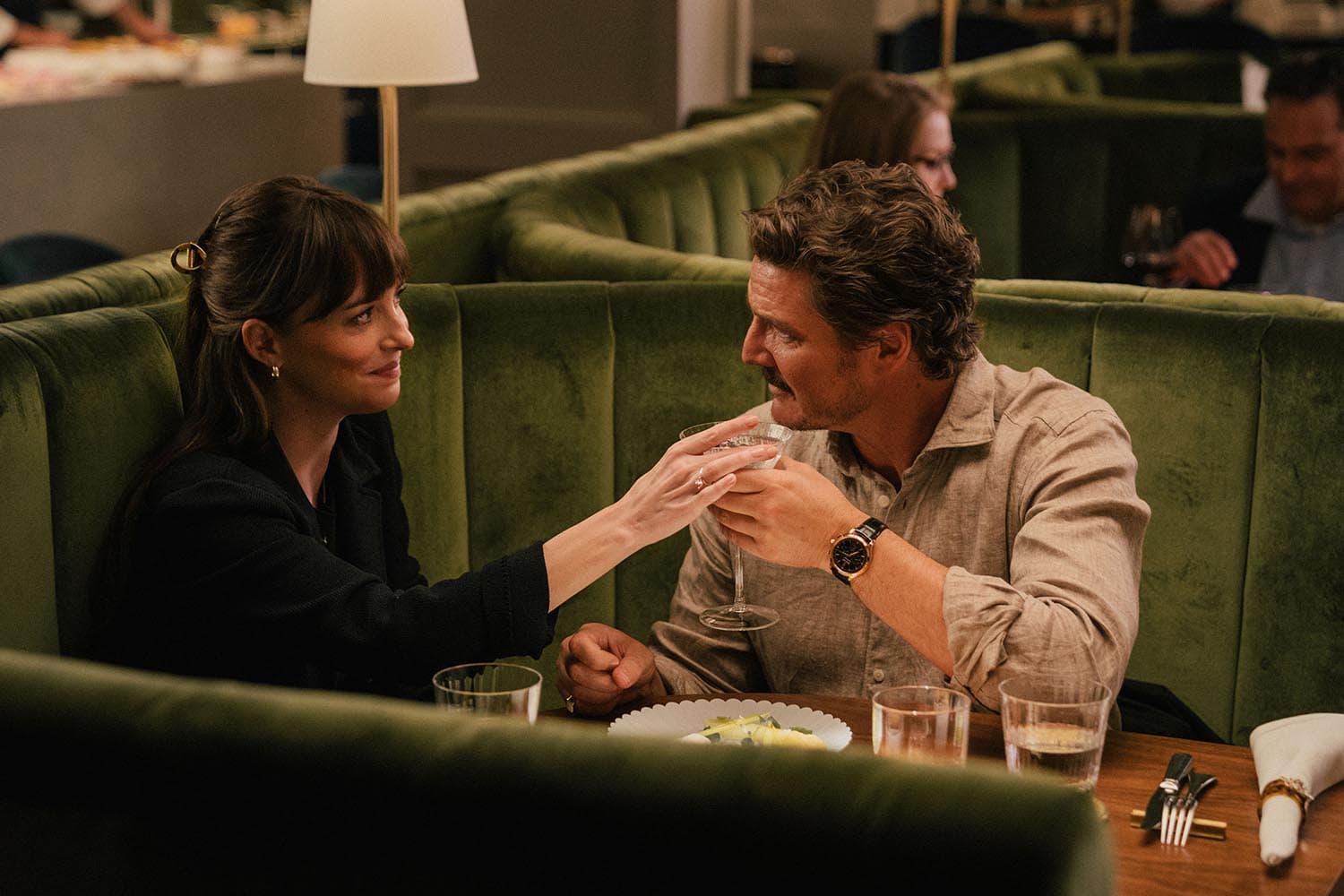
For her 2023 filmmaking debut, Past Lives, Celine Song drew on her own experiences as an immigrant from Korea. While her follow-up film, Materialists, is less in conversation with specific personal ordeals than the rom-com genre as a whole, it shares with Past Lives a focus on how one’s love life can be complicated by fixations on past relationships—on both the roads not taken and those that may potentially open up to us in the future.
As in Past Lives, the trio at the center of Materialists consists of a woman, Lucy (Dakota Johnson), and the two men whom she must eventually choose between. But the male suitors in Song’s sophomore feature are more purely paradigmatic, with Lucy’s new flame, a dashing, wealthy charmer named Harry (Pedro Pascal), pitted against the thoughtful, loving John (Chris Evans), the still-struggling actor and part-time caterer whom she left in the not-so-distant past. While Song intends to embrace the tropes of the rom-com and render them with more depth and sophistication, neither Harry nor John can ever quite escape their archetypal roots.
In perfect rom-com fashion, Lucy is a successful matchmaker who views relationships as math equations and marriage as a business transaction. In matching potential partners, her focus is almost exclusively on quantifiable qualities, such as net worth, height, age, political orientation, and desire for children. If these qualities help her understand her clients on a relatively superficial level, it’s clear that her methods work for some people, as we see, early in the film, her celebrating the ninth marriage that was the result of her matchmaking.
Upon meeting Harry, both Lucy and her co-worker Daisy (Dasha Nekrasova) comment that he’s a “unicorn”—a man who checks almost all the boxes of a stable, long-term partner. Financial security, good looks, and a great personality are the holy trinity of the dating world, at least in the exclusive Manhattan bubble in which Lucy and her co-workers operate, so Lucy is of course surprised when Harry sets his sights on her when, ostensibly, he could have any woman in the city. Given her age and income, the math doesn’t make sense to Lucy.
Lucy’s enjoyment of the creature comforts that dating Harry allows her makes more sense as flashbacks begin to inform us about her past relationship with John, whom she runs into at the same wedding where she meets Harry. While the two were in love, Lucy’s frustrations with their money problems hit a breaking point. Lucy admits she hates herself for allowing that to grow into a bitterness toward John, cuing the audience into the fact that she’s not merely a money-hungry careerist, but still struggles to learn exactly what she wants and needs from a partner.

It’s clear that Song is interested in the reverberations that online dating has had on modern romance. Countless interactions between Lucy and her clients show men and women alike spouting their wants, needs, and restrictions as if they’re reciting a shopping list. Lucy herself talks about the dating world as a “market,” reducing love or romantic connection to ranges on a statistical table, or a perfect partner carved out of the infinite data available at our fingertips.
It’s mainly across its matchmaking sequences that the film has compelling things to say about love and dating in the 21st century. Indeed, as its second half begins to focus more on Lucy’s dating dilemma, and how she’s forced to confront her firmly established beliefs and rules about dating, the film hews increasingly close to the narrative expectations of the traditional rom-com.
Materialists is beautifully lensed by Shabier Kirchner, who captures the unstained luxe-ness of Harry’s pricey condo and the upscale restaurants he takes Lucy to as lucidly as he does the ramshackle reality of John’s day-to-day life. But Song’s script works only in fits and starts, too often reliant on merely raising the subtext around the types of economic anxieties that affect relationships in numerous rom-coms to literal text. The central trio’s conversations become less entrenched in realism as the film goes on, with the characters sounding increasingly less like individuals in the throes of love and more like they’re espousing an authorial point of view.
A mid-film incident in Materialists that occurs to one of Lucy’s clients, Sophie (Zoe Winters), adds an unexpected edge to the film, briefly confronting the darker realities of blind or online dating. But when Song uses this trauma as a means to completely shift Lucy’s worldview, one is left to wonder how a 35-year-old woman so deeply involved in the modern dating world would need such an occurrence to shake up her views on what’s actually important in a partner.
As such, Lucy’s behavior in the film’s last act feels somewhat disingenuous, as if she’s just now begun to consider the importance of what Harry calls “intangible assets” of a partner versus the tangible ones that can be easily jotted down in a dating profile. As in some of the conversations about what spurs on attraction or emotional connection, Lucy’s behavior begins to feel not like it’s stemming from a fully realized character but rather in service of a narrative trying to make a larger point. And, unfortunately, as that point is presented with a certain grandiosity and self-importance, the fact that it can essentially be reduced to “for love or money” speaks to the scant difference between Materialists and the films it seemingly wants to interrogate.
Since 2001, we've brought you uncompromising, candid takes on the world of film, music, television, video games, theater, and more. Independently owned and operated publications like Slant have been hit hard in recent years, but we’re committed to keeping our content free and accessible—meaning no paywalls or fees.
If you like what we do, please consider subscribing to our Patreon or making a donation.