Medea persists in our cultural memory mainly as the embodiment of female vengeance, most remembered for her murder of her unfaithful husband, his new bride, and her own two children in response to her husband’s betrayal. But Euripides’s play is also the story of a stranger in a strange land, castigated by the people of her adopted home of Corinth for her supposed “barbarian” origins. Ulrich Köhler’s new film, Gavagai, zeroes in on this element of the text, using a fictional film adaptation of Medea as a locus for a complex treatise on hierarchies of race, gender, and power in the contemporary art world.
Gavagai’s first shot throws the audience headfirst into the film-within-a-film’s chaotic production, as Maja (Maren Eggert), the actress playing Madea, and the two young actors playing Madea’s now-dead children approach a Senegalese beach in a speedboat perfunctorily decked out in Ancient Greek-styled wings and garlands. No sooner have they landed than the film’s neurotic director, Caroline (Natalie Richard), rushes out to harangue the costume designer for giving the child actors life jackets (“Corpses don’t need life jackets!”).
Aside from serving as the location for Caroline’s film, Senegal happens to be the native country of Nourou (Jean-Christophe Folly), co-starring in the role of Madea’s husband, Jason. To complicate matters further, Nourou and the married Maja are involved in an off-screen affair.
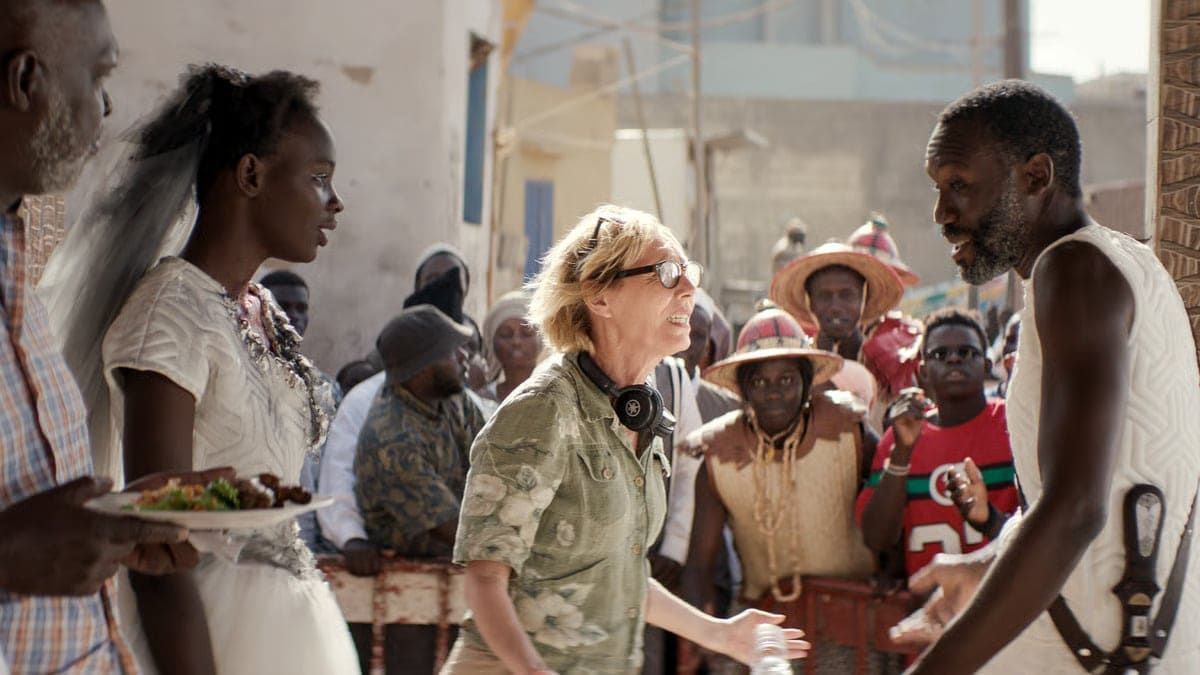
Caroline’s conception of the film involves a white woman playing Medea, while Jason and his fellow Corinthians are played by African actors. Whatever point about racism this is intended to make is immediately undercut by the conditions on the film’s set, where Caroline torments her actors and the African extras are refused access to catering. Nourou occupies a relative position of privilege here, as an established actor who has long since moved to France, but even that’s thrown into doubt when Gavagai shifts locations to Berlin for Medea’s festival opening.
The remainder of Köhler’s film spins out from an incident at the Berlin hotel where Nourou has been put up, in which a Polish security guard badgers the actor for smoking a cigarette before refusing him entry without seeing his ID. Maja is furious and demands that the guard be fired, while Nourou would rather forget the whole thing, and this sudden distillation of racial hierarchy leaves a fissure in their relationship that neither strategy will mend.
The rest of Gavagai plays out largely as a series of interactions that throw these power relations into sharp relief. Nourou is discriminated against for his race, but over and over we see him attended to by chauffeurs, stylists, bellhops—all people he wields a class privilege over. At a press conference , Caroline’s idea for the film is challenged by exceedingly hostile journalists, who object to the film’s positing of a white woman as equally susceptible to racism as people of color. Worst of all, perhaps, Maja no longer wishes to continue the affair once they’ve returned to Europe—to be that something, per Euripides’s play, that “he won in a foreign land.”
Indeed, Gavagai’s structure hinges on a similar, if better thought out, inversion to Caroline’s film: Nourou occupies the Medea figure in the story, treated as a foreigner and abandoned by his lover, while Maja is much closer to Jason. Kohler’s intertwining of his own film with the text of Medea is consistently illuminating, and though the film can be didactic, it’s rarely simplistic. Its title comes from a scenario proposed by the philosopher W.V. Quine, in which an English-speaking explorer encounters a native in the jungle, who points at a rabbit and shouts “Gavagai!” Does “gavagai” mean rabbit? Food? Kill? A deity represented by the rabbit? As Kohler’s film displays, we can rarely truly understand perspectives so foreign to our own.
If Kohler’s 2018 film In My Room is partly about the persistence of social niceties even after the literal end of the world, Gavagai examines how the prejudices we’ve supposedly left in the past still shape that world. The film’s autocritical nature makes the job of the critic difficult in assessing its success, which Kohler seems to humorously nod to with Nourou’s reaction to the film they’ve made: “too cerebral.” Kohler’s ideas are potent, but his film fits too neatly into the template of the festival fare he’s sending up to truly draw much blood.
The widescreen frames serve a mostly neutral aesthetic, and Kohler’s idea of a flight of fancy is to portray Caroline with the head of an elephant when a journalist brings up “the elephant in the room.” Compared to the radical textures of the 21st century’s greatest film on race and representation, Spike Lee’s Bamboozled, Gavagai feels stiflingly tame. As Kohler’s movie suggests, no matter how hard we try, we’re all a product of our environment.
Since 2001, we've brought you uncompromising, candid takes on the world of film, music, television, video games, theater, and more. Independently owned and operated publications like Slant have been hit hard in recent years, but we’re committed to keeping our content free and accessible—meaning no paywalls or fees.
If you like what we do, please consider subscribing to our Patreon or making a donation.