“At last!” reads the white-on-black text that opens Where to Land, as if heralding the arrival of writer-director Hal Hartley’s first film in over 10 years. Initially set to shoot in 2020 following a successful Kickstarter campaign, production on it was shut down due to the pandemic, extending what was already a six-year interval since Ned Rifle. With Hartley’s previous film closing out a trilogy begun in 1997, and the filmmaker now at age 65, Where to Land feels very much like his first late-career work.
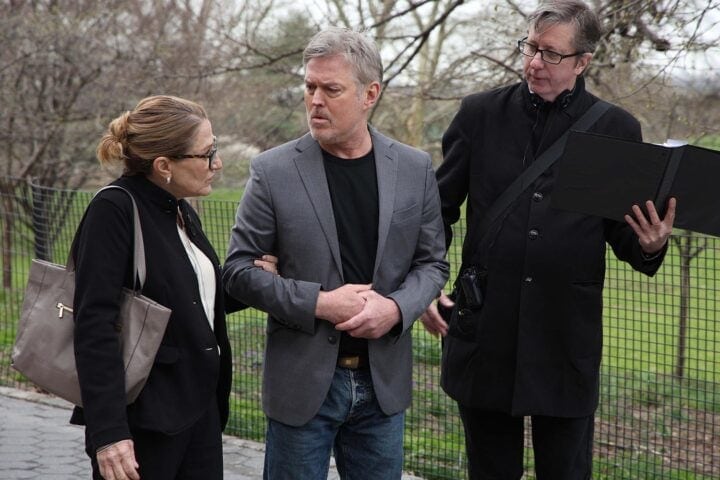
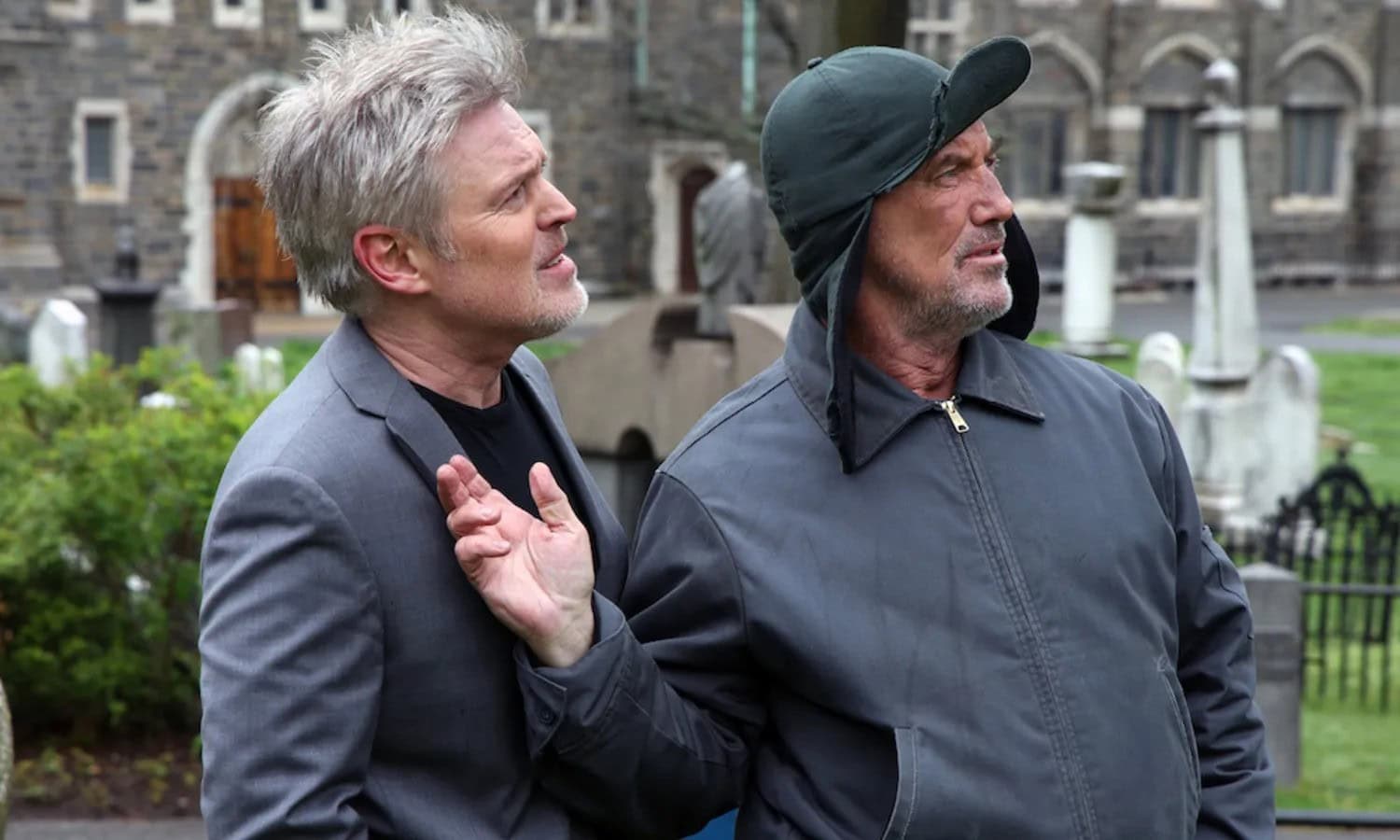
The film centers on a man, Joseph Fulton (Bill Sage), who feels like an obvious avatar for Hartley. Joseph isn’t dying, but, owing to a series of mundane misunderstandings, some people in his life think that he is. At 58, semi-retired from directing romantic comedies, he decides that he wants to become the assistant groundskeeper at a church cemetery near his apartment in the Upper West Side. This newfound interest in husbandry—“the care, cultivation, and maintenance of natural resources,” per the church’s head groundskeeper, Leonard (Robert John Burke)—comes not out of financial hardship, nor a charitable impulse. According to Joseph, he just wants to work with his hands, to be outside, and to feel tired at the end of the day.
But Joseph is also having his last will and testament drawn up, and his actress girlfriend, Muriel (Kim Taff), puts two and two together and begins to think he’s preparing for his imminent demise. This suspicion is seemingly confirmed when Joseph’s niece, Veronica (Katelyn Sparks), who works as his assistant, finds an unopened letter from the hospital on his desk.
Joseph is none the wiser, and goes about the course of his day as planned, commuting up and down the west side of Manhattan, drifting from the cemetery to a meeting with his lawyer (Gia Crovatin) regarding his will, and then to a bar where he meets with a young film scholar (Aida Johannes) who wants to interview him for a book about his work—all of which put him in a decidedly morbid state of mind. At home, following the instructions of his lawyer, Joseph carefully takes stock of his personal effects, seemingly mystified by the accretion of material objects that surrounds him—at one point wondering aloud, “How do we acquire so much stuff?”
Proceeding as a series of frank, contemplative discussions between Joseph and his various interlocutors—covering religion, spirituality, politics, and philosophy—Where to Land opts for quiet moments of connection, raising questions rather than giving definitive answers. The film’s wistful, sincere, and never maudlin contemplation of impermanence and mortality suggest an artist in a reflective mood, trying to imagine what the world will look like after he’s gone.

At one point, while talking with an elderly writer, Elizabeth (Kathleen Chalfant), Joseph laments a future where humans will have to fight each other for water, while she wishes she could be around to see it because “change is always interesting.” The film doesn’t indicate whether Joseph’s logical fear or Elizabeth’s engaged curiosity is the “correct” response.
Though Hartley’s plots have grown increasingly convoluted since the 2000s, Where to Land proceeds in a more gently anecdotal mode, recalling his hour-long day-in-the-life sketch Meanwhile from 2011 more than heady genre riffs like 2005’s The Girl from Monday and 2006’s Fay Grim. The film’s pace is relaxed, with Hartley’s typically mannered dialogue delivered in more naturalistic cadences than in the past, especially by such longtime collaborators as Sage, Burke, and Edie Falco as Joseph’s affectionate ex-wife, Clara.
As is his wont, Hartley eschews establishing shots and needless interstitial business. When Joseph finally opens the letter, the film cuts from him picking it up to him seated, reading it aloud. Jump cuts like this earned Hartley comparisons long ago to Jean-Luc Godard, and by now they feel fully integrated into his artistry, a tempo-related strategy rather than a stylistic tic.
This kind of tight rhythmic control is aided by Hartley’s own score. Discordant stabs of piano punctuate quiet scenes, while reverb-laden drums and layers of melodic MIDI loops underscore transitional moments. Hartley’s musical sensibility also informs how he has his actors move within his frames, arranging them like dancers in relation to each other and to the camera. (It’s no wonder that the filmmaker was given the opportunity to direct an opera several years ago.)
While it’s readily identifiable as a Hartley creation—featuring three of his favorite actors and the expected visual and musical trademarks—Where to Land isn’t a rehash or a revival. It feels of-the-moment without being topical, familiar but not stale. There’s something comforting about an artist so consistent in his predilections who still demonstrates growth over time.
Since 2001, we've brought you uncompromising, candid takes on the world of film, music, television, video games, theater, and more. Independently owned and operated publications like Slant have been hit hard in recent years, but we’re committed to keeping our content free and accessible—meaning no paywalls or fees.
If you like what we do, please consider subscribing to our Patreon or making a donation.