For a film ripped from the headlines of global politics, the most intriguing glimpses of reality in Ghost Trail ironically come from inside a video game. In several scenes that unfold within a war-themed first-person shooter, members of a secret European cell plot to find the Syrian war criminals who brutalized them in their home country. Part of this meeting location choice is practical, as the charged words in their chats are less likely to alert monitoring authorities since they feel contextually relevant. But darker psychological truths are revealed in this space as these survivors of violent atrocity become their most authentic, unguarded selves.
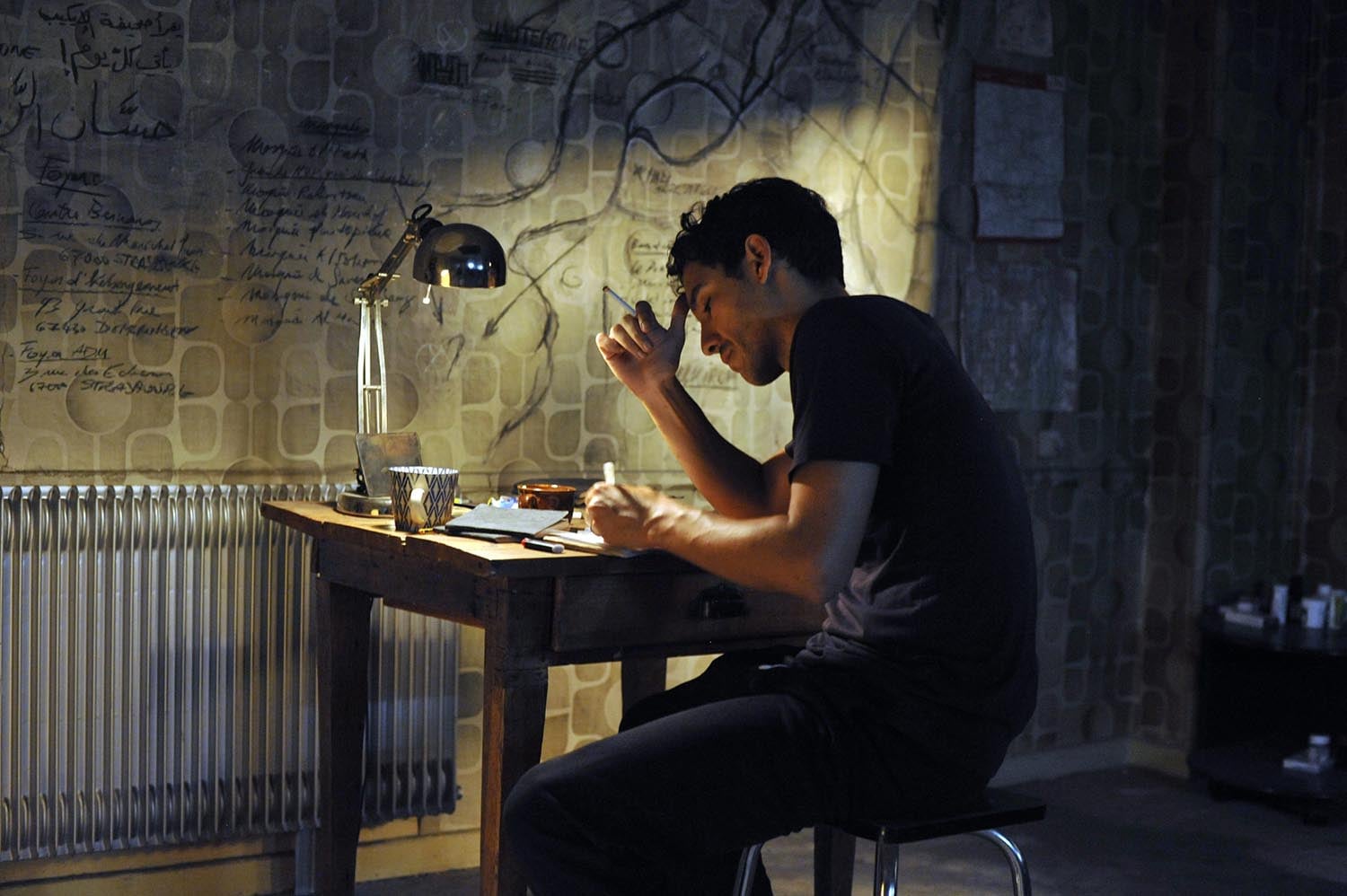
Hamid (Adam Bessa), the film’s protagonist, shows more of his true nature while connecting virtually with his fellow survivors. Inside the multiplayer shooter, roles shift as the members of the cell re-enact the bellicosity that disrupted their lives. Their role-playing may be a lie, but it’s honest for what Hamid and the other men confront about their pasts. Ghost Trail thrives in its depiction of their chatroom confabs, because only in this pixelated domain does director Jonathan Millet appear undaunted by presenting events in a straightforward fashion.
Millet, who co-wrote the film with Florence Rochat, worked heavily in documentary, and with Ghost Trail, his sophomore narrative feature, he often feels as if he’s working to counter that background, namely in his depiction of the concrete reality of Hamid’s life. The camerawork of Olivier Boonjing eschews verité in favor of neat compositions that demonstrate how the displaced Hamid gets swallowed by his new surroundings. The soundscape leans toward the subjective as well—to communicate the roiling inner turmoil of a traumatized man.
This tendency toward working against a documentary style also extends to the story itself. Working with co-writer Florence Rochat, Millet contorts real-life inspirations from cells like Hamid’s into the framework for a spy film. Our protagonist even has a handler in Nina (Julia Franz Richter), who helps his pursuit of Harfaz (Tawfeek Barhom), the torturer responsible for the scars along Hamid’s back. Ghost Trail plays out like a slow burn as Hamid stalks his target across national borders from Germany to France, shadowing his every move and studying his seemingly seamless integration into a local university’s culture.

To call the wait that goes into Hamid turning the tables on his tormentor a cat-and-mouse game would vastly overstate the action between the two men. Hamid mostly stalks his would-be prey and stews in his anguished indecision over how to serve justice. A reticent vigilante makes for a tough presence to center an entire movie around without becoming an anti-drama, and Ghost Trail suffers from Bessa’s milling about the frame. The man is a dramatically inert presence, draining the film of vitality, and not even the eventual face-off stemming from Hamid and Harfaz’s collision course can revive the actor’s somnambulant slouch of a turn.
Millet doesn’t coach a performance out of Bessa that can capture Hamid’s interior mystery and misery in the language of cinema. The fatigued energy of the actor’s turn does, in some part, reflect the physical toll of his character’s extended captivity in Syria. It’s in keeping with Millet’s desire for contradictions and challenges within his work to center this revisionist espionage caper on a timid, taciturn agent who’s nonetheless fueled by visceral revulsion of his target.
But the performance, like much of Ghost Trail, collapses under the weight of conceptual cleverness when exposed to forces outside its entropic force field. The limited range of motion stemming from the studied nature of Bessa’s performance chafes against the international spy persona that the film forces his character to assume. This second identity assumed by Hamid feels much like the film around him: unconvincing and unnaturally contorted into its shape.
Millet is noble in its avoidance of sensationalism and rendering of Syrian refugees as more than helpless victims. But his film falls short of its intentions because it spends so much time defining itself by what it isn’t supposed to be. Perhaps inevitably, Ghost Trail becomes as easy to see through as the spectral being hinted at in its title. Not all politically resonant films must blare their urgency, but it helps if they have more blood in their veins and fire in their souls.
Since 2001, we've brought you uncompromising, candid takes on the world of film, music, television, video games, theater, and more. Independently owned and operated publications like Slant have been hit hard in recent years, but we’re committed to keeping our content free and accessible—meaning no paywalls or fees.
If you like what we do, please consider subscribing to our Patreon or making a donation.