Living and working in Grand Rapids, Michigan, Joel Potrykus belongs to a diverse American tradition of eccentric, independent regional filmmakers ranging from John Waters in Baltimore to Joe Swanberg in Chicago to Kelly Reichardt in Western Oregon. As with those of his spiritual peers, Potrykus’s films exude a handmade quality that stems not only from their authentically non-Hollywood production locales, but also from their low-budget resourcefulness and friends-and-family-staffed production teams.
What most stands out about his work, from 2012’s Ape to, now, Vulcanizadora, is its relationship to time. Channeling the cynical, anti-conformist ethos of ’90s pop culture, Potrykus evokes the era of his teenage years with a light touch, to the point that we may wonder whether his characters are devoted nostalgists or actually living through the end of the 20th century.
Vulcanizadora revisits two characters—Marty (Joshua Burge) and Derek (Potrykus)—introduced a decade ago in Buzzard. When we left them, Marty was on the run after his check-fraud scheme collapsed, and Derek was living in his father’s basement (a realm known as the Party Zone) and still working at the mortgage company where he and Marty met.
In Buzzard, we’re invited to laugh at Derek’s loserish enthusiasm for collectibles and, perhaps, reluctantly admire Marty’s anti-corporatist subterfuge, even as we recoil from his sociopathy. It’s easy to imagine both of them, who subsist on Little Debbie Swiss rolls and Gatorade, showing up in Kevin Smith’s Clerks to lift something from the Quick Stop. But now, with Marty hollowed out from a stint in prison and living with his senile father (Bill Vincent), and Derek divorced and estranged from his son (Solo Potrykus), their slacker antics aren’t so funny anymore. These middle-aged men, defeated by life, are figures of pity more than of ridicule.
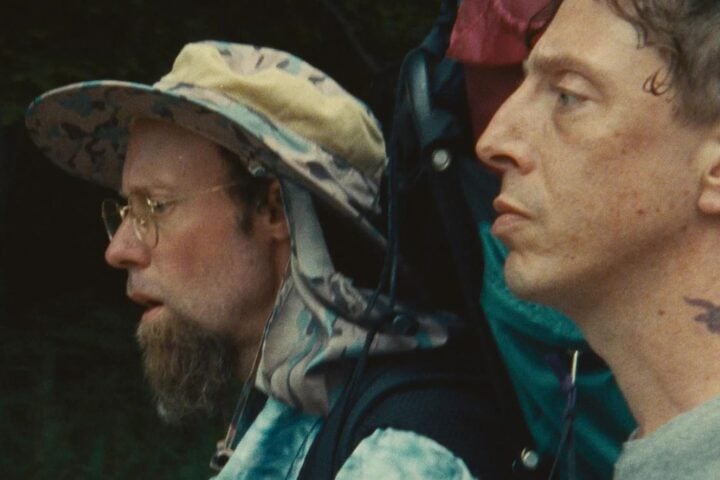
Still, as they embark on a camping trip in the woods at the film’s outset—trudging along, in profile, in a long take reminiscent of Gus Van Sant’s Gerry, only scored to heavy metal—Derek can’t be deterred from his quest to enact such time-honored male bonding rituals as walking like a samurai, poring over porno mags, taking a bottle rocket to the face, and dancing to Godsmack’s “Voodoo.” Marty, as Derek’s taciturn foil, isn’t having it, as their Party Zone days are over and he’s clearly preoccupied with other matters.

Burge’s big watery eyes tell us everything about Marty’s internal state as he stares down another possible conviction and prison sentence, this time for burning down a tire shop—which, he says rather convincingly, was an accident. Derek got him out on bail, and the pair have made some kind of pact, the details of which come gradually into focus, first when we glimpse a sinister piece of metal headgear that Marty has fashioned, then when he brings out a homemade M-80.
Ten years ago, Marty was a prankish imp who, in avoiding work, often expended as much effort as his undemanding but soul-sucking temp job required. Now, all of his misdirected creativity and glee at pulling cons are nonexistent, and Vulcanizadora is perhaps most memorable for the way that Burge frighteningly embodies this emotionally desiccated shell of a man.
But the film also marks something of a turning point for Potrykus as a writer-director—the kind that tempts critics to declare a newfound “maturity.” As the idiotic banter of Vulcanizadora’s first half gives way to a solo quest in the final stretch, we see Marty, unlike Potrykus’s other anti-social misfits, trying to take responsibility for himself. Burge mines bitterly comic irony from Marty’s efforts to own up to and make amends for his mistakes, his every attempt at confession thwarted in an unexpected way. Nobody, not even his father, will hold him to account.
Vulcanizadora is as much a warning as it is a reckoning. In projecting forward into the later lives of his amusing, troubling creations, Potrykus looks without flinching at the ultimate consequences of permanent adolescence, a frequent subject of light comedy but one rarely treated with any real weight. While Kevin Smith fawns over his beloved Gen X clerks in exceedingly self-mythologizing sequels, Potrykus’s latest effort stands as a model of serious, engaged filmmaking that grows richer and more poignant as time goes by.
Since 2001, we've brought you uncompromising, candid takes on the world of film, music, television, video games, theater, and more. Independently owned and operated publications like Slant have been hit hard in recent years, but we’re committed to keeping our content free and accessible—meaning no paywalls or fees.
If you like what we do, please consider subscribing to our Patreon or making a donation.