Alex Schaad’s Skin Deep is a film with a body-swapping premise that’s notable for its restraint. Though as fresh and conceptually far-reaching as a David Cronenberg film, it traffics in body ambivalence more than body horror, striking an eerie, wistful tone.
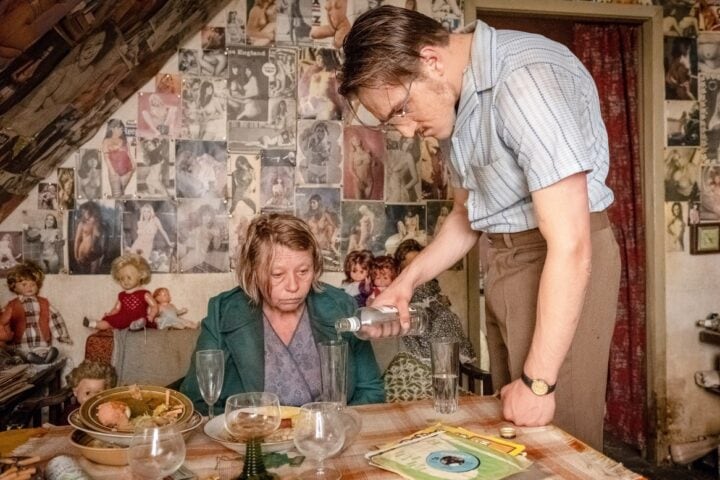
The story hinges on the interplay of various couples. The central of these, Leyla (Mala Emde) and Tristan (Jonas Dassler), travel by ferry to a remote and idyllic island where seasonal body-switching rituals take place. There they join Leyla’s friend Stella (Edgar Selge) in the initially jarring form of her elderly father, who recently died while inhabiting Stella’s aneurism-prone body. Leyla’s been suffering from chronic depression, so she and Tristan have decided to give the ritual a try, in the hope that a temporary shift in embodied perspective might help. They’re paired by lottery with another couple: Fabienne (Maryam Zaree) will swap with Leyla, and Mo (Dimitrij Schaad, who co-wrote the film with his director brother) will swap with Tristan.
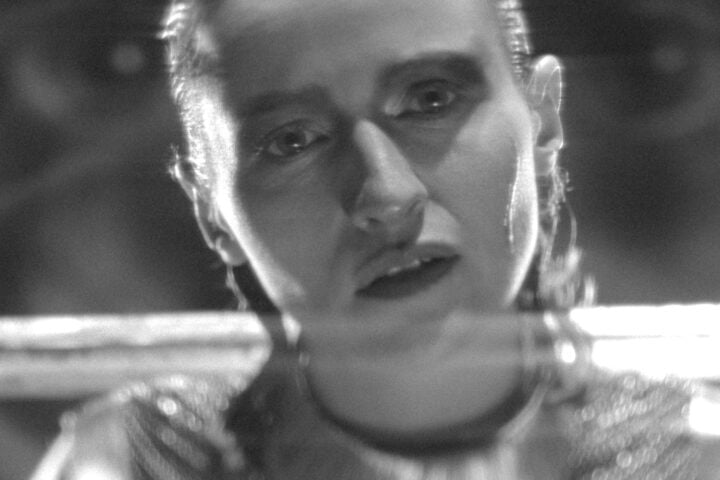
Films having trained audiences to see one actor as one character, the filmmakers find a couple of elegant solutions to the counterintuitive demand for tracking who’s who in this kind of narrative. Via intertitles that double as chapter headings, names and brackets help differentiate characters: “Leyla [Fabienne],” “Tristan [Mo],” and so forth. As the various pairings and configurations play out over the course of Skin Deep, this bracketing helps to convey the film’s concept of the body as a contingent envelope, paradoxically separable from, and constituent of, the self. In keeping with the ritual, participants also exchange “totems.” So, for example, playing the role of Leyla in Fabienne’s body (or “Leyla [Fabienne],” as the intertitle conveys it), Zaree wears Leyla’s necklace, supplying us with a visual aide-mémoire.
In Fabienne’s body, Leyla experiences instantaneous relief, while Tristan, in Mo’s body, experiences dysmorphia for the first time. Not only is the latter body out of shape relative to what Tristan is accustomed to, it lacks the muscle memory that he relies on to play classical guitar. Meanwhile, the oafish Mo revels in Tristan’s body, referring to it as a “Ferrari” at one point, and the happy-go-lucky Fabienne suffers from an unfamiliar gloominess in Leyla’s body. Tristan becomes so uncomfortable that he decides to abort the experience, much to Leyla’s dismay, since she’s barely had a chance to luxuriate in an existence free of depression. Unsurprisingly, the return to her own body provokes panic.
Skin Deep takes its somber, melancholic palette from an oil painting that’s its opening image, a depiction of nudes emerging from a pool. The film’s pastoral mise-en-scène is devoid of 21st-century technology, let alone the typical paraphernalia of science fiction. Not even cellphones make an appearance. This renders the film’s setting in time unpinpointable, almost outside of time—not unlike Ira Sachs’s Passages, in which the uncanny costume design conjures an era of fashion never before seen. It’s as if some paradigm shift has taken place in the world of Skin Deep, so all-encompassing that the characters never bother to mention it. Stripped of exposition and flashy set design, the film can devote its time entirely to interpersonal drama.

As it happens, the only science-fictional novelty in Skin Deep is an unnamed psychoactive substance implied by one brief shot of a mortar and pestle (the shape of which is echoed by a tent where the body-swapping ritual takes place), which presumably facilitates the transfer of consciousness between bodies. The device suggests intriguing parallels between body swapping, the therapeutic potential of radical shifts in perspective brought on by hallucinogens, the refreshing “change of scenery” we seek from a vacation, and the transcendence of religious ritual—all of which entail a reconstitution of the self on one level or another.
With their experiment prematurely aborted by Tristan, Leyla takes up an offer to switch bodies with a former alcoholic and longtime inhabitant of the island. Roman (Thomas Wodianka), the bereaved lover of Stella’s father, offers his recovered body to Leyla in an act of self-sacrifice. With this switch, Skin Deep delves into an intricate exploration of gender and sexuality, as Leyla enjoys a newfound exuberance within Roman’s male body and Tristan, back in his own body, comes to find that his love for her isn’t inhibited by her male-bodiedness.
At times, Skin Deep strays perilously close to making an argument in favor of physical determinism. The idea that Leyla’s depression stems wholly from her body—as distinct from mind—is reinforced when “Roman [Leyla]” relapses, as if his previous recovery had nothing whatsoever to do with willpower, or memory, or patterns of thought.
Other developments, though, offer a more dialectic perspective, such as “Fabienne [Leyla]” not spiraling into full-blown depression, unlike “Roman [Leyla]. At one point, “Leyla [Fabienne]” describes to Stella a drowning nightmare that she’s had for years and how, in Fabienne’s body, the dream no longer afflicts her. Stella says it should come as no surprise that her sense of self alters inside a different body, since consciousness is also tied up in hormones, age, culture, history, and more. After all, an act as mundane as smoking marijuana can alter their moods. This suggests that the self is an intermeshing of mind and body as we perceive them—at times an open struggle, at times a shaky compromise, and, in rare moments, harmony.
Perhaps the most intriguing parallel raised by Skin Deep, if indirectly, is that between body swapping and the experience of stories. After all, where do the pleasures of fiction come from if not in identification with the experience of another self—another body in another space and time—fleeting and partial though it is. The way the filmmakers see it, this may take the form of an escape from oneself, as in Leyla’s case, or a desire to understand the perceptions of another human being as if from within, as in the case of Roman (and, later on, Tristan).
Further, Skin Deep hints that all our relations involve a fictional back and forth with others—often most intensely so where romantic partners learn to share their selves, becoming, in a sense, participants of one another through total intimacy. As the film shows, it’s not impossible to recognize one’s suffering in another, and to take on that suffering in order to transform it.
Since 2001, we've brought you uncompromising, candid takes on the world of film, music, television, video games, theater, and more. Independently owned and operated publications like Slant have been hit hard in recent years, but we’re committed to keeping our content free and accessible—meaning no paywalls or fees.
If you like what we do, please consider subscribing to our Patreon or making a donation.