Along with many of his contemporaries in Germany’s Berlin School of filmmaking, Christian Petzold has made a career out of allegorizing the soullessness of his country’s neoliberal regime and the fascistic impulses preserved at its core. Petzold has certainly earned a break from diagnosing the ills of modernity, and in many ways his new film, Miroirs No. 3, is just that: a quietly haunting domestic drama that remains cloistered in its pastoral setting, with little to no reference to the world outside. And yet, in the film’s examination of that very desire—to retreat from the world and its complexities, and even oneself by extension—Petzold has crafted yet another sneakily trenchant commentary on How We Live Now.
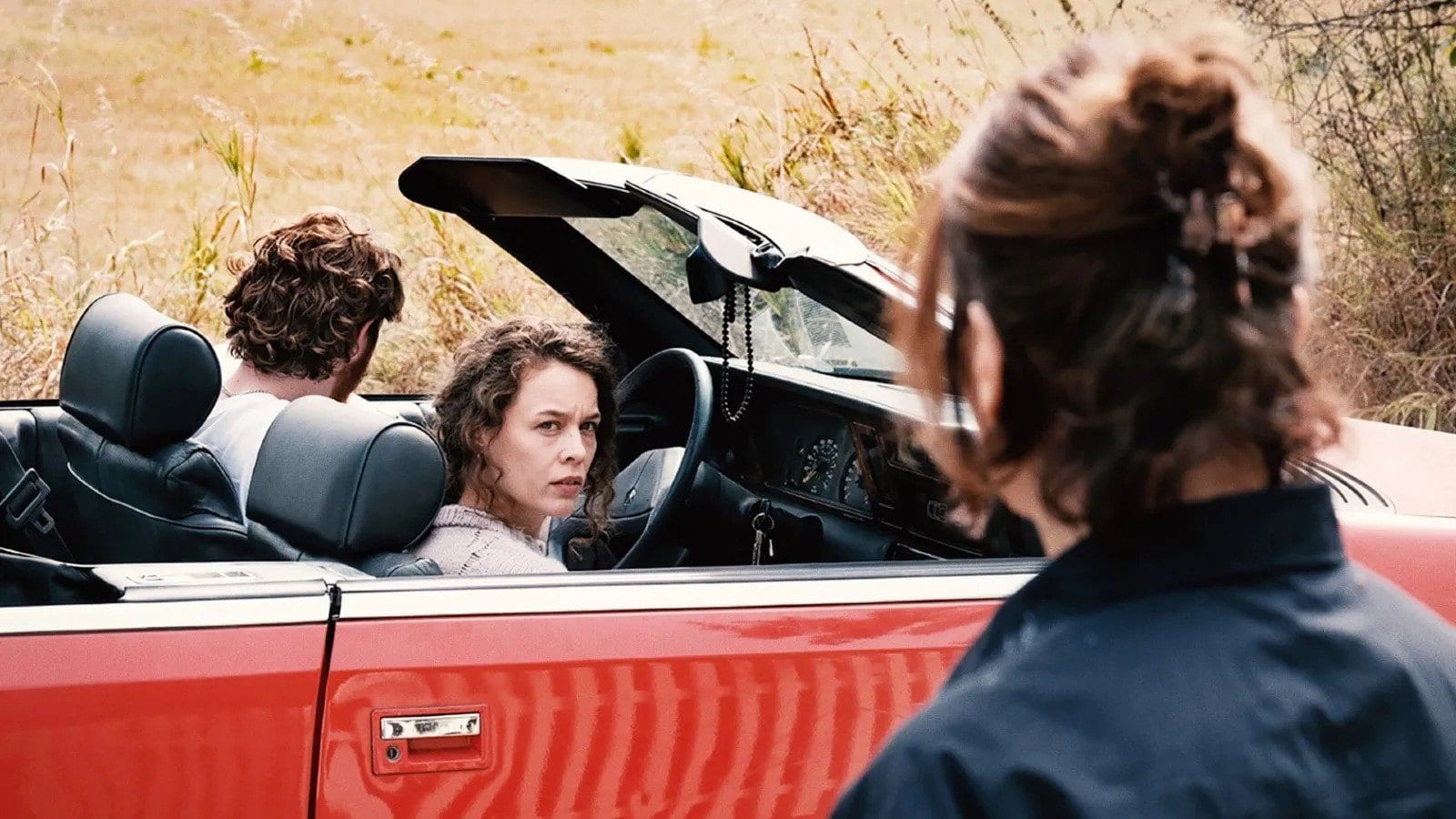
As in Petzold’s 2007 film Yella, Mirrors No. 3’s inciting incident is a car crash from which a woman escapes unharmed, leaving her partner and their rocky relationship behind to experience an identity crisis in unfamiliar terrain. The survivor this time is Laura (Paula Beer), a music student at university reluctantly tagging along with her musician boyfriend, Jakob (Philip Froissant), as he attempts to woo a producer over a weekend retreat in the country.
Laura is clearly unsettled from the film’s opening moments, and only more so after she makes fleeting eye contact with Betty (Barbara Auer), a mysterious older woman who witnesses the crash that leaves Jakob’s convertible upside down in a field, his head fatally smashed against some rocks. The woman brings Laura inside her house and calls the police, who after arriving and speaking to Laura tell Betty that Laura has made an odd request: Having refused to go to the hospital, she wants to stay at her temporary host’s home.
Betty accepts Laura’s request with a mix of befuddlement and eagerness for companionship. The arrangement seems mutually beneficial from the jump: Betty seems to relish caring for Laura, setting out labeled thermoses of coffee and tea at her bedside in the morning, while Laura takes to simple tasks like cooking and painting Betty’s fence with a renewed sense of purpose.
Petzold nicely captures the strange, tentative excitement the two women share, one somewhat dependent on brushing off the tragic circumstances that brought them together. Each has something to offer the other, just as they both clearly aren’t telling each other everything.
The details of Betty’s life slowly come into focus: Her husband, Eric (Matthias Brandt), and adult son, Max (Enno Trebs), live nearby and run a slightly shady-looking auto body shop just down the road. Something is clearly amiss here, and Betty mistakenly referring to Laura as “Yelena” is all it takes for Petzold to tip his hand as to the answer.
Anyone who views Miroirs No. 3 through the lens of a mystery will inevitably find it wanting. Yelena’s identity, and the reason for Betty’s immediate attachment to Laura, is more or less what you expect from the first invocation of the name of Yelena. Petzold is instead more interested in the characters’ unwillingness to acknowledge these elephants in the room: Laura never bothers to ask whose room she’s staying in, whose clothes Betty offers her to wear, why the family no longer lives together, or why Eric and Max are so antagonistic toward Laura and Betty’s relationship. But while Miroirs No. 3’s narrative revelations don’t come as a surprise, they do serve to puncture the idyllic illusion that these women have created together.
Eric and Max’s garage is mostly above board, apart from one service they offer: illegally removing the GPS systems from cars that allow them to be tracked around the globe. Some customers just want to be able to get away, they explain, and Laura seems to understand where they’re coming from. The film’s title comes from a piano piece by Ravel (later performed by Laura) subtitled “A Boat on the Ocean,” full of sweeping arpeggios meant to evoke rolling ocean swells. Grief comes in waves, as they say, but Laura has found calm in the storm, admitting that she feels no sadness over her boyfriend’s death. Another of Petzold’s allusions is just as revealing: Betty tells Laura the story of Tom Sawyer in relation to her painting the fence, a tale of the deceptive allure of simple living that Laura unfortunately doesn’t take to heart.
Like Undine and Afire before it, Miroirs No. 3 has been greeted as a minor Petzold work, and the film does earn the descriptor more than those two, whose small scale was confused with a lack of artistic ambition. Important as they are to Miroirs No. 3’s design, its predictability and self-containment simply aren’t as rich as something like Afire, where the anxieties of the larger world constantly defy the characters’ search for sanctuary. Petzold has undeniably bitten off less than he’s capable of chewing here, but his fine-tuned dramatic sense and facility with conflicting emotions make Miroirs No. 3 another worthy entry in his series of contemporary ghost stories.
Since 2001, we've brought you uncompromising, candid takes on the world of film, music, television, video games, theater, and more. Independently owned and operated publications like Slant have been hit hard in recent years, but we’re committed to keeping our content free and accessible—meaning no paywalls or fees.
If you like what we do, please consider subscribing to our Patreon or making a donation.