“They’re all wrenched from their contexts,” observes an archeologist about a room full of unsorted Neapolitan artifacts that Gianfranco Rosi’s camera surveys in Below the Clouds. That statement could just as easily apply to all the discrete scenes the director assembles into his documentary portrait of the area surrounding Mount Vesuvius, where the local life, like the landscape, feels as if it’s been cut loose from chronological time.
Below the Clouds channels the best of Frederick Wiseman in its mosaic-like rendering of the region of Italy that lives in the shadow of an active volcano. While Vesuvius has been dormant since 1944, the legacy of its explosive past in burying Pompeii weighs heavily on those who coexist with the volcano. Their collective psyche carries the knowledge that they will someday participate in the culmination of a cycle when its inevitable future eruption occurs.
The ongoing excavations of Pompeii inform this delicate dance with mortality. Advances in archeology led to the recovery of human remains from the ancient Roman city. To see these bodies, their shapes so eerily preserved by the solidification of the ash from Vesuvius’s explosion in A.D. 79, is to witness a tragic freeze frame of a life’s final moment.
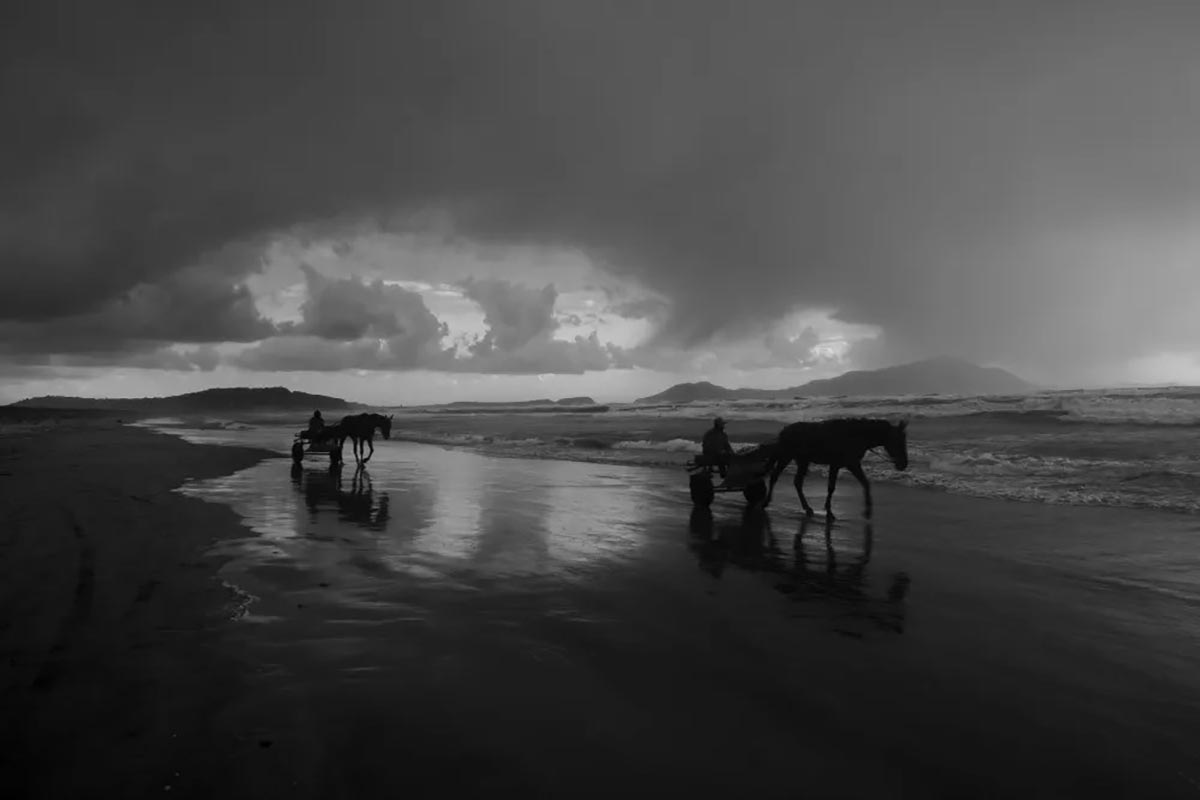
Similarly, Rosi’s long, languorous, often hushed snapshots of the area between Vesuvius and the Gulf of Naples conjure a sense of life here being suspended in time. His rendering of the local character demonstrates how the Neapolitan people conceive of their existence as akin to the transience of clouds blanketing their sky. Even if no one directly articulates a heightened awareness around the unpredictability of life here, it’s evident in wry juxtapositions. A help-line operator, for example, fields cranky complaints about horse-drawn carriages in one scene only to then have to guide a caller out of a harrowing episode of domestic abuse in the next.
In between images of native residents, immigrant laborers, and tourists are sequences where the camera sits inside sometimes empty train cars, further emphasizing Rosi’s impression of life in Naples existing in a liminal state. The film’s images can feel redundant, but the way the editing rhythms conjure an ethereal feeling that never conforms to linear or cyclical notions of time is purposeful. To borrow another phrase from the archaeologist about the room of relics that bears a spiritual kinship to Below the Clouds, “time is overlapped, mixed, abandoned.”
Rosi most vivid and haunting articulation of this vision of ephemerality is through a motif that’s created rather than found. Interspersed throughout Below the Clouds are sequences of filmic visions of Naples projected into an empty movie theater. Some are mythic backlot recreations of Pompeii’s splendor, while others are neorealistic glimpses of a nation’s faded post-war glory.
As Below the Clouds nears its close, Rosi uses his final visit to the theater to shift the camera’s attention away from the screen and to the decrepitude of the facilities. In the images projected on screen, he teases a possibility of preservation for both the region’s both real and imagined incarnations. But the theater itself, being a representative of the physical world in which those images have to exist, offers no guarantees of perpetuity. Especially with Vesuvius liable to blow again in the future, the sense of nothing being guaranteed becomes palpable in this space that, like Naples as a whole, already shows signs of being lost to time.
Since 2001, we've brought you uncompromising, candid takes on the world of film, music, television, video games, theater, and more. Independently owned and operated publications like Slant have been hit hard in recent years, but we’re committed to keeping our content free and accessible—meaning no paywalls or fees.
If you like what we do, please consider subscribing to our Patreon or making a donation.