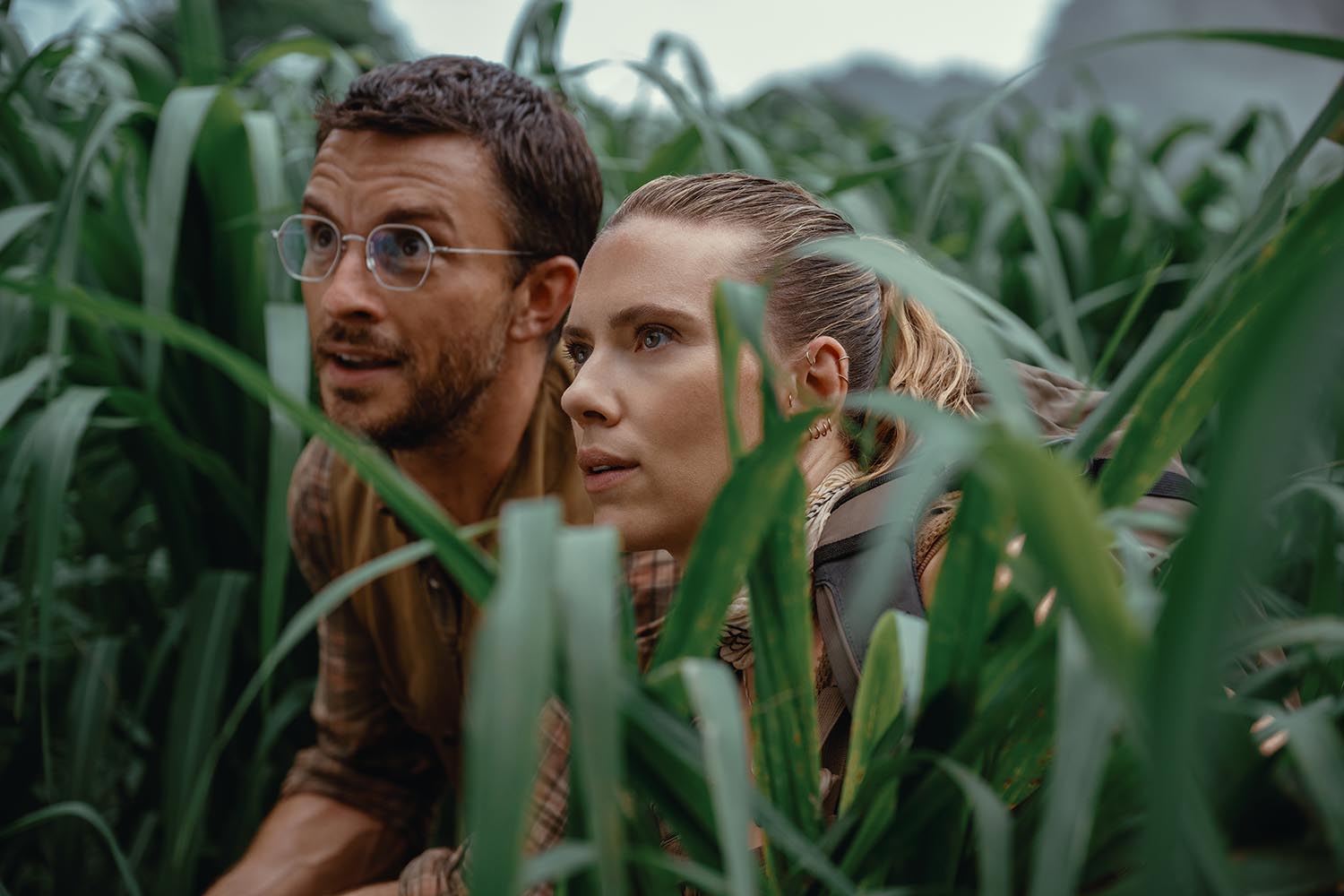
There’s a grating meta-ness to Gareth Edwards’s Jurassic World Rebirth that speaks to the filmmakers’ knowledge that they’re at the mercy of pressures to bring something new to a franchise that’s now on its seventh installment. That much is clear from the moment that paleontologist Dr. Henry Loomis (Jonathan Bailey) laments his natural history museum’s declining attendance, as the public’s interest in dinosaurs has waned.
And in case it isn’t, we also get a scene in which Henry learns from a slimy pharmaceutical rep, Martin Krebs (Rupert Friend), about InGen’s creation of mutant dinosaurs on the forbidden island of Ile Saint-Hubert in the Atlantic Ocean. Given its cynical vision of fickle and easily satiated audiences, it’s no wonder that Edwards’s film, as written by David Koepp, settles for offering little that’s outside the box aside from brontosauruses with extra-long tails and a behemoth mutant whose face looks more like a xenomorph than a dinosaur.
We do, at least, get a pretty pulse-pounding, sea-set sequence early in Rebirth that introduces us to an adventurous father, Reuben (Manuel Garcia-Rulfo), his two daughters, 11-year-old Isabella (Audrina Miranda) and 18-year-old Teresa (Luna Blaise), and the latter’s lazy boyfriend, Xavier (David Iacono). As the foursome fight to survive an attack by an enormous Mosasaurus, the sense of scale to the beast is all the more impressive given how the set piece highlights the helplessness of the family in the remote expanses of the open water.
Upon being rescued by a boat chartered by Krebs, the family is forced to join the vessel’s captain, Duncan (Mahershala Ali), Henry, and extraction expert Zora (Scarlett Johansson) and her team on a mission to collect blood samples from dinosaurs for a new heart disease medication. Edwards’s dazzling set piece picks up again as Duncan weaves the boat between several other large sea dinos who whack the vessel in every direction in an action sequence that actually feels as if it’s breaking some kind of new ground for the franchise.

But once the extraction team and civilian family hit dry ground, the film reductively treads a familiar trail. Set five years after the events of Colin Trevorrow’s Jurassic World Dominion, Rebirth proceeds as a gene splice of an adventure film and a family drama, dotted with incessant references to the original Jurassic Park, all while having little idea of what to do with the shipwrecked family once they quickly become separated from Zora’s team.
This B story is an embarrassment of clichés, from Xavier inevitably proving his worth and earning Reuben’s respect, to the traumatized Isabella bonding with a baby triceratops whose cuteness is comically at odds with the ruthless world around it. As for the A story, it sees Zora, with the help of Henry, wrestling with the morality of selling the collected samples to a pharmaceutical company rather than open-sourcing them. But most of the time the group is just hiking to higher ground to meet a rescue team and running into strange hybrid dinos.
It’s not surprising that the film ultimately leans into nostalgia, using a camera pan to reveal a field full of Brontosauruses while John Williams’s legendary score rises, having a Dilophosaurus show up to fan its neck, and, of course, including a chase scene involving a T-Rex. But as these scenes are anchored by paper-thin characters—Johansson and Ali’s performances are better than the material deserves but still fail to leave a lasting impression—they all fall flat.
Worst of all, this hoary adventure story is rendered soulless by the blatant product placement: Henry crunching on Altoids, Reuben scolding Xavier for eating too many of their bags of Doritos, and Isabella feeding Twizzlers to her little dino friend. After a while, you may wonder if the entire film was subsidized by the snack food industry. Rebirth even goes so far as setting its final action scene in a long-abandoned but still fully stocked convenience store. How meta: a franchise trying to distract us from how past its sell-by date it is with expired potato chips.
Since 2001, we've brought you uncompromising, candid takes on the world of film, music, television, video games, theater, and more. Independently owned and operated publications like Slant have been hit hard in recent years, but we’re committed to keeping our content free and accessible—meaning no paywalls or fees.
If you like what we do, please consider subscribing to our Patreon or making a donation.