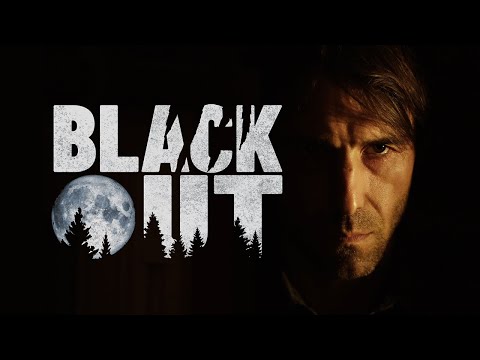
Like Depraved, a modern retelling of Frankenstein, Blackout finds writer-director Larry Fessenden once again toying with classic monster tropes. The new film focuses on a tortured artist, Charley (Alex Hurt), whose name is just a few letters removed from “Chaney.” Charley is dealing with a nasty case of werewolfism, which is the same affliction that plagued Lon Chaney Jr.’s character, Larry Talbot, in 1941’s The Wolf Man.
Where Depraved was a commentary on modern warfare, PTSD, and the pharmaceutical industrial complex, Blackout narrows its focus to the business of being a modern white liberal in a small town. Charley is concerned about the environment, and he’s disturbed at the racist groupthink stoked by a local real estate magnate, Hammond (Marshall Bell), who happens to be his former boss and the father of his ex-girlfriend, Sharon (Addison Timlin). At one point, Charley asks a former co-worker what Hammond has to do that’s bad enough to make everyone finally stop working for him. We all make moral compromises to survive, though Charley is making perhaps the biggest one of all, what with people’s blood literally being on his hands.
The film is unambiguous in that regard. Prior to our first catching sight of Charley, Blackout opens with a roving wolf’s-eye view of a presence slowly charging upon a man and woman having sex in a field, before a hairy, clawed hand slashes the innocent man’s throat. Fessenden then cuts to the motel room where Charley awakens, carefully showing not only the art that he’s drawn, but also the newspaper clippings of various grisly murders that he’s obviously committed. Right away the film distinguishes itself from so many other werewolf stories before it for not being about its protagonist’s discovery of and disbelief over his condition.
Across the film, Fessenden foregrounds Charley’s hypocrisies and how they inform his behavior while still cannily drawing our sympathies to him. Charley, who’s certainly not wrong about Hammond, is fully aware of what he does by the light of the full moon, and Fessenden paints a compassionate yet clear-eyed portrait of him. And contributing to that nuanced portrait is Hurt’s wounded charisma, which is evident even when he’s under mounds of makeup.
But as the scope of Charley’s violence expands, it’s clear how he’s made his guilt into everybody else’s problem. As Charley tries to get at Hammond through legal channels, a migrant worker, Miguel (Rigo Garay), is blamed for the killings, and that there’s no concrete evidence to send Miguel to jail can’t dissuade Hammond and his supporters of his guilt. Later, when Charley shows up at Sharon’s door while she has another man over, he may be in werewolf form, but it’s impossible not to view his arrival like that of a jealous ex, throwing doubt on his assertion that he has no control over his transformation. And when he quickly sketches out a drawing of a victim, it raises the question of whether he’s using the suffering of others as fuel for his art.
Blackout’s do-it-yourself, low-budget approach is unmistakable, but its compositions are painstaking and its editing choices are purposeful. Some of the film’s talkier scenes cleanly transition to voiceover, while its latter half thrillingly inches toward something resembling the psychedelic. Throughout, Charley runs across landscapes in lengthy, sidelong shots that give the film an ethereal charge of adrenaline, his movements so effortless that he seems like an extension of the natural world rather than a supernatural interloper.
Blackout’s sheer craftsmanship by and large papers over some of its stumbles. One depiction of a crime scene investigation is stiffly written but captured in a single take that doesn’t call attention to itself as the camera follows officers from an overturned car all the way back up a hill and to the road from which the vehicle descended. Elsewhere, Fessenden overstates a few of his themes, as when a crack about “white guilt” is dropped late in the film, long after it’s been made clear that Charley suffers from that particular curse. And though the story departs from Charley’s viewpoint on occasion, the other characters feel half-realized by comparison.
If the reach of Blackout sometimes exceeds its grasp, that same shortcoming is emblematic of just how many ideas Fessenden is juggling here. That richness is what allows the film to stand apart from so many other horror efforts that play out as prolonged trauma therapy sessions against flimsily arty backdrops. Charley’s struggles with alcohol inform Blackout’s title, though they’re almost incidental to the story given how much ground it covers, especially once the man implodes on his self-righteousness. As in his prior work, the far-reaching curiosity and fascinatingly conflicted nature of Fessenden’s perspective is still his greatest strength.
Since 2001, we've brought you uncompromising, candid takes on the world of film, music, television, video games, theater, and more. Independently owned and operated publications like Slant have been hit hard in recent years, but we’re committed to keeping our content free and accessible—meaning no paywalls or fees.
If you like what we do, please consider subscribing to our Patreon or making a donation.