In the three decades since the kids in Scream sat around explaining the rules of slasher movies, the genre has been deconstructed to the point where it can feel like there isn’t a whole lot left to subvert or satirize. And while some filmmakers are still finding fresh ways to reinvent it—most recently JT Mollner’s Strange Darling and Chris Nash’s In a Violent Nature—there’s also a lot to be said for not getting too cute about this stuff. Eli Craig’s Clown in a Cornfield works precisely because it plays things straight, offering a nod and a wink to the genre’s rules while adhering to them in order to deliver a simple, satisfying slasher.
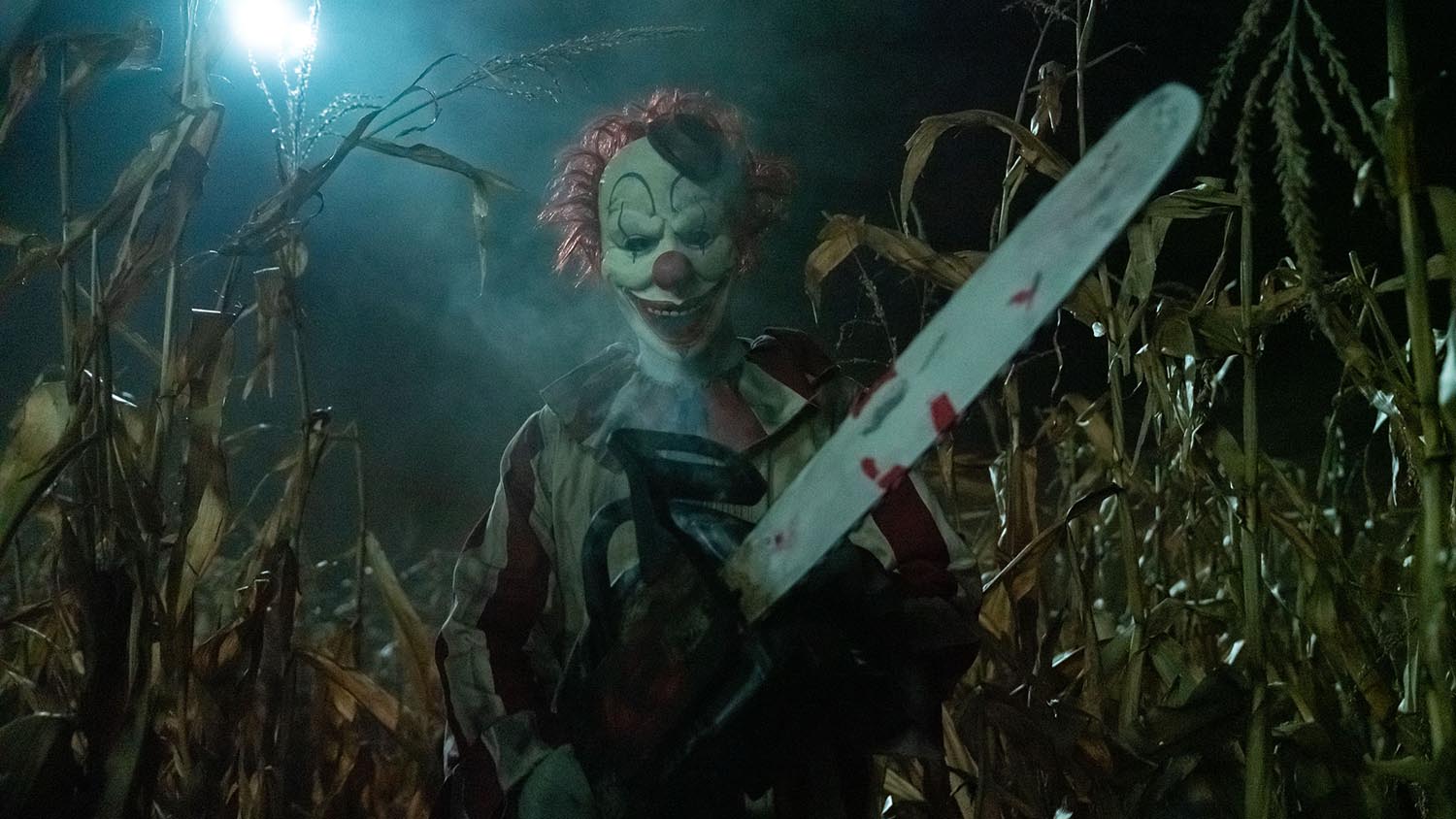
Based on Adam Cesare’s 2020 young-adult horror novel, the film begins with Quinn (Katie Douglas) and her father, Dr. Maybrook (Aaron Abrams), moving to Kettle Springs, Missouri. She quickly falls in with a group of local kids led by Cole (Carson MacCormac) whose affinity for elaborate pranks has made them a huge hit online and public enemy number one in their town. Their current project is a series of mockumentary videos in which they hunt down the town’s mascot, Frendo the Clown, with each video ending in a gruesome murder, complete with some impressive DIY practical effects. Naturally, it isn’t long before the real Frendo shows up, and suddenly the blood that’s spraying everywhere isn’t made of corn syrup.
Quinn and her friends make for a likeable group of sacrificial lambs. They do all the things that we expect teens in a slasher movie to do—trading jokes and sharing painful secrets before a crackling fire before then wandering off alone at an inopportune time—and they do it all in a way that actually feels authentic. MacCormac is a particularly good bit of casting, not only for his charming performance but because he bears a notable resemblance to Scream star Skeet Ulrich, who was cast in Wes Craven’s film in part because he looked like Johnny Depp, who broke out in Craven’s 1984 horror classic A Nightmare on Elm Street. It’s a subtle way to acknowledge the lineage of films that Clown in a Cornfield is proudly fitting itself into.
Aside from the occasional meta gag, the one place in which Craig’s film decides to be meaningfully subversive is the way it resolves a subplot involving Cole and a hulking, socially awkward boy named Rust (Vincent Muller), who walks Quinn to school on the morning after she arrives in town. The resulting twist is smart, sweet, and genuinely unexpected.
Of course, Clown in a Cornfield’s main priority is serving up gruesome clown murder. The kills here are creative, making use of everything from cattle prods to bench presses, and the film has an extremely firm grasp on the tone of its violence. The goriest incidents are played like devilish sight gags, evoking both horror and hilarity in a single jolting moment. One scene, in which Quinn and her friends try to stay quiet while hiding in the titular cornfield, contains one of the most perfect bits of visual humor to ever grace a horror movie.
At one point in the film, Sheriff Dunne (Will Sasso) becomes the latest in a long line of adult authority figures to chew out Quinn and her friends over their lack of respect for the town’s traditions. “That’s the problem with your generation,” he says. “You all think you’re so much cleverer than us.” Clown in a Cornfield never makes that mistake.
Since 2001, we've brought you uncompromising, candid takes on the world of film, music, television, video games, theater, and more. Independently owned and operated publications like Slant have been hit hard in recent years, but we’re committed to keeping our content free and accessible—meaning no paywalls or fees.
If you like what we do, please consider subscribing to our Patreon or making a donation.