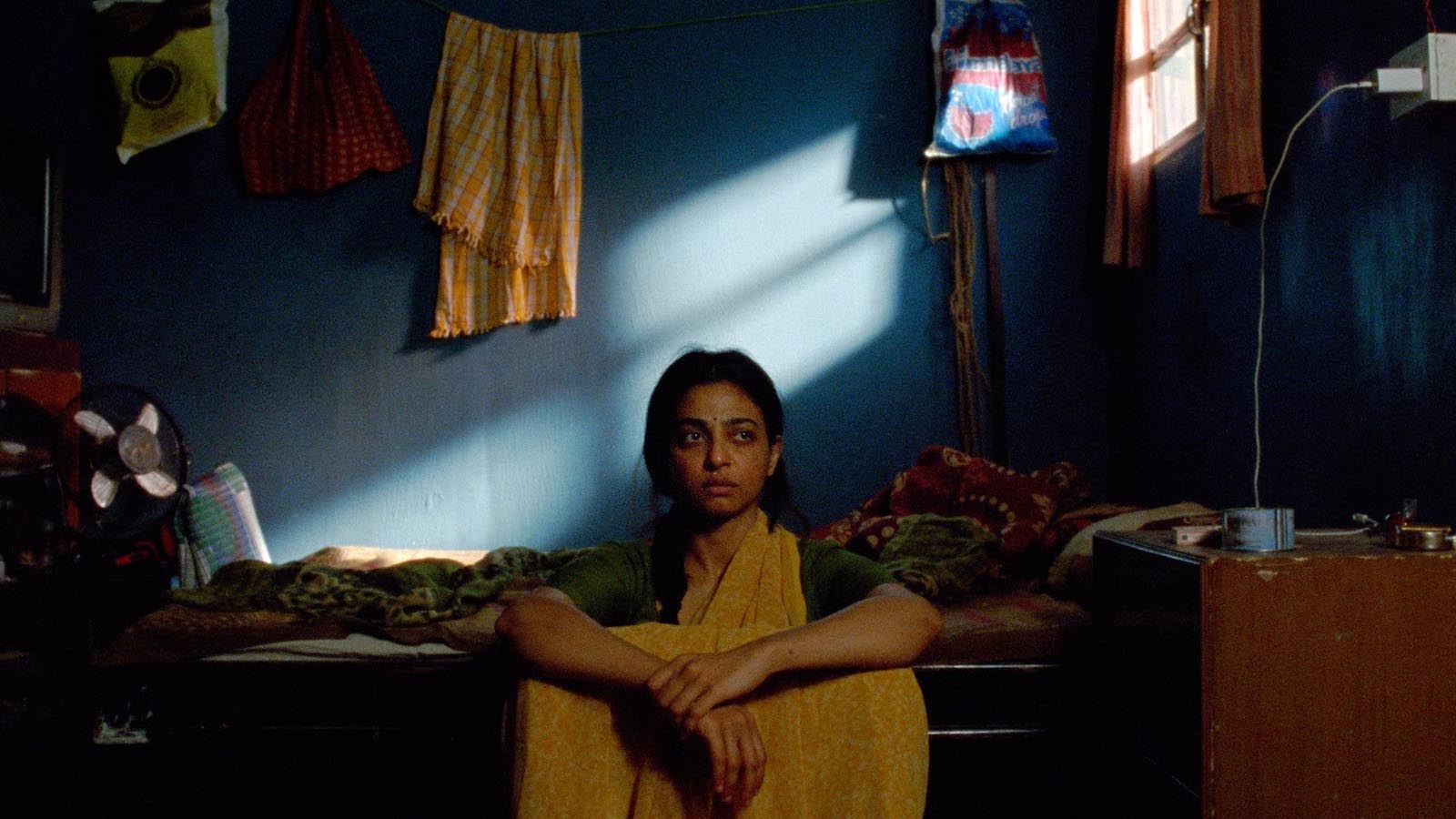
There’s a primordial power to swear words, and you can feel it every time that Uma (Radhika Apte), the ferocious protagonist of Sister Midnight, unleashes an expletive. She swears so emphatically that non-Hindi speakers can feel the full force of the words even if they’ve got the subtitles turned off. Bong Joon-ho once urged us to overcome that “one-inch tall” language barrier, but Uma blasts right through it. And, frankly, she has plenty to swear about.
Writer-director Karan Kandhari’s black comedy begins with Uma being shipped off to live in a dingy, single-room apartment in a strange new city with her new husband, Gopal (Ashok Pathak). Their marriage was arranged by relatives who wanted the pair out of sight and mind, and their life together doesn’t look promising. Uma doesn’t know the first thing about running a household, while Gopal flees in terror whenever she threatens to undress. They’re basically two strangers with no idea what they’re doing and no room to figure things out.
It makes sense that a film about a pair of stunted individuals playing house would draw inspiration from Wes Anderson, even if Uma’s noisy and disorderly corner of Mumbai is a million miles from the crisply kept spaces of films like The Royal Tenenbaums and The Grand Budapest Hotel. But Kandhari favors the same sort of flat compositions and neatly centered frames Anderson does, and they lend Sister Midnight the same sort of storybook feel.
In one gorgeous sequence, the camera glides beside Uma as she walks by a line of houses just like her own, each with their doors flung open, diorama-like, to reveal the dramas playing out inside. Uma’s world often isn’t pretty, but cinematographer Sverre Sørdal commits it to film in a way that’s never less than beautiful. The film’s comic stylings are also Andersonian, namely in Kandhari’s use of smash cuts and sound effects—like the whooshing sound of Uma whipping off her clothes as she dries to draw Gopal into bed, only to be met with a polite handshake.
There’s an unmistakable vivacity to the film, conjured in part by that fast-cutting visual style and a rocking soundtrack that melds Eastern and Western sounds, hopping freely between Sinn Sisamouth and Howlin’ Wolf. But Apte’s performance is the furious, beating heart of Sister Midnight. Over the course of the film, Uma swings wildly between fiery defiance and dead-eyed dejection, ready to throw down with her neighbors at a moment’s notice but totally overcome by a bag of chapati flour. And Apte plays each emotion loudly without ever losing its nuance.
There’s a pronounced difference in the way Uma swears at her husband versus the way she swears at her neighbors. We can tell, from the slightest shift in her tone or a softening of her eyes, that she curses them out because she doesn’t give a damn about them, but she yells at Gopal because she actually does—or, at the very least, because she’d like to.
As Sister Midnight progresses, it takes a more surreal turn. Unable to carve out any kind of real life for herself, Uma is gripped by bloodthirsty cravings. In these moments, it’s as if she’s trying to suck the lifeblood out of something, anything, before her own life is completely torn apart. The further these impulses take her, the harder it is to tell how much of what she’s experiencing is real versus some sort of psychosis, creating a dreaminess that feels at odds with the spiky, visceral reality of what came before. But the film ultimately arrives at a bloody, blackly comic climax that’s well worth the somewhat doddering path it takes to get there.
Since 2001, we've brought you uncompromising, candid takes on the world of film, music, television, video games, theater, and more. Independently owned and operated publications like Slant have been hit hard in recent years, but we’re committed to keeping our content free and accessible—meaning no paywalls or fees.
If you like what we do, please consider subscribing to our Patreon or making a donation.