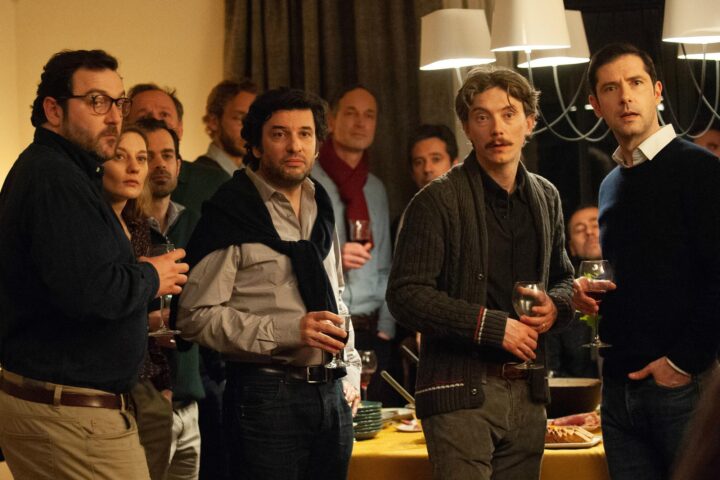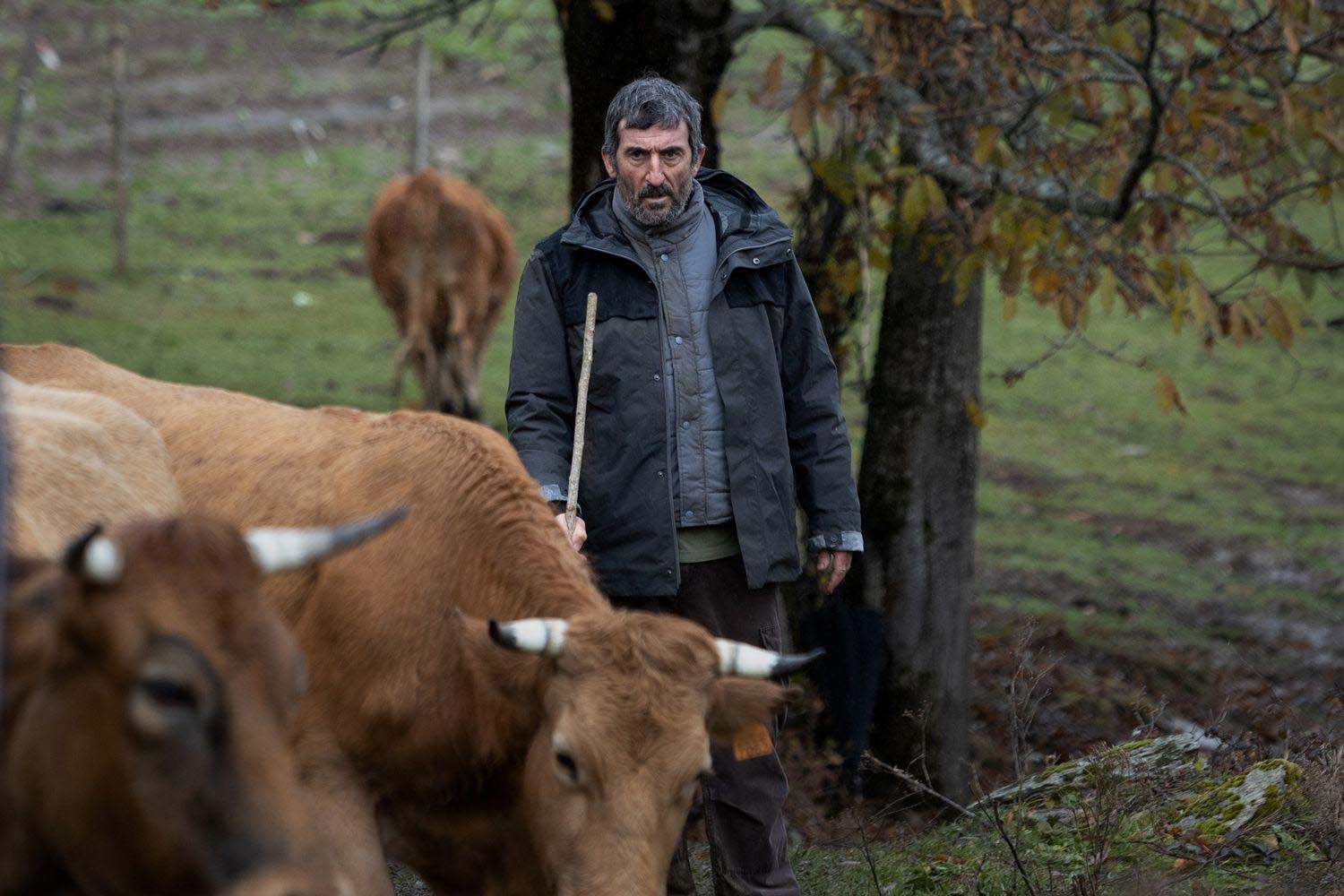
After a mesmerizing slow-motion sequence of men struggling to pin down a wild horse, Rodrigo Sorogoyen’s The Beasts dives into the bad blood between its characters, already on the verge of boiling over. The first scene with characters and dialogue takes place in a bar serving as the social heart of the unnamed Galician mountain village where the story is set. Men drink and play dominos around a table, but the mood is anything but relaxed, due in part to the film’s natural lighting, so thin it looks almost fragile. One of the men, Xan Anta (Luis Zahera), propped up at every turn by his younger brother, Lorenzo (Diago Anido), dominates the conversation with venomous gossip. We sense that this is a daily ritual.
From the outset, it’s clear that The Beasts is no cozy small-town drama, but something more akin to a rural noir, peopled with petty, embittered characters ruled by tradition and instinct. The bar scene establishes the film’s penchant for meandering dialogues that amass tension until, without warning, they erupt into conflict. It’s no accident that the game of choice is dominoes and not, say, chess, for it alludes to how the film’s plot is structured—as a cascade of chain reactions with its origins in a hazy past, where every attempt by at resolving disputes only exacerbates them. Even the horse-wrestling sequence turns out to be one such domino.
But the bar scene also exhibits the film’s most audacious feature: its willingness to switch protagonists. For much of the scene’s duration, Xan suggests that he’ll be the central focus of The Beasts. And, then, a character referred disparagingly as “Frenchy” (Denis Ménochet) leaves in discomfort and the camera unexpectedly follows him out instead of remaining with the conversation. Though up to this point the camera has centered Xan, Sorogoyen has subtly prepared us, by opening in media res, to identify with Antoine who, as an immigrant, finds himself in over his head in this village with its opaque rules and deep-seated grudges.

For the time being, at least, Antoine becomes the film’s protagonist, and we learn how he and his wife, Olga (Marina Foïs), immigrated to Galicia two years prior from France to begin a new life as organic farmers. Both are educated and well-traveled, putting them at odds with villagers set in their ways and suspicious of outsiders. He’s already made himself an enemy of Xan by voting against the installation of wind turbines, which would have come with a lump sum for the villagers. But The Beasts is even-handed in its representations. Antoine may be the central character, but he’s not entirely sympathetic, especially in his dismissive treatment of Olga.
Likewise, Xan may be vile, but complexly so, as he shows real love for his family. His belief that Antoine is the tip of the spear, whether intentionally or not, of a coming gentrification that threatens to turn his home into a resort for wealthy tourists, isn’t without basis. He nicknames Antoine “Toñito the Conquistador,” connecting him ironically with France’s invasion of Spain during the Napoleonic era, as if Antoine were still culpable for historical transgressions.
Enmity between the two rapidly festers, as neither man is willing to back down from the conflict, to the brink of absurdity. And in a brief, evocative sequence that finds Antoine paying a visit to some wind turbines in the neighboring community, it’s hard not to think of Don Quixote tilting at windmills, unable to distinguish reality from his chivalric delusions.
What throws Xan over the edge more than anything is Antoine’s attempt to film him. The Beasts suggests that film’s vaunted documentary power has its obscene side, as an ocular weapon, for Antoine’s vigilante surveillance is hardly objective, and only ever escalates the domino-like effect of the collision course that they seem to be on. This leads inexorably to the most dramatic pivot in The Beasts, when Olga and, to a lesser extent, her daughter, Marie (Marie Colomb), become the protagonists. The film, then, is as much about the beastliness of Xan and Antoine’s outmoded machismo as it is about the perseverance and fortitude of women in opposition to it.
All this action unfolds against a mountainous backdrop as bleak as it is savagely beautiful. Even so, the film can tend to rely overly on its rustic, picturesque setting and the intricacies of its plot, coming off more as a vehicle for Sorogoyen and Isabel Peña’s screenwriting than visual ideas. It has a distinctive look but one that remains static over two-plus hours. Viewers may find themselves hankering for more sequences like the opening, which explicates the story’s themes of stagnation and brutality without a single line of dialogue, only the image of a horse’s nostrils flaring in slow motion, framed by the men’s tattooed arm muscles.
Since 2001, we've brought you uncompromising, candid takes on the world of film, music, television, video games, theater, and more. Independently owned and operated publications like Slant have been hit hard in recent years, but we’re committed to keeping our content free and accessible—meaning no paywalls or fees.
If you like what we do, please consider subscribing to our Patreon or making a donation.