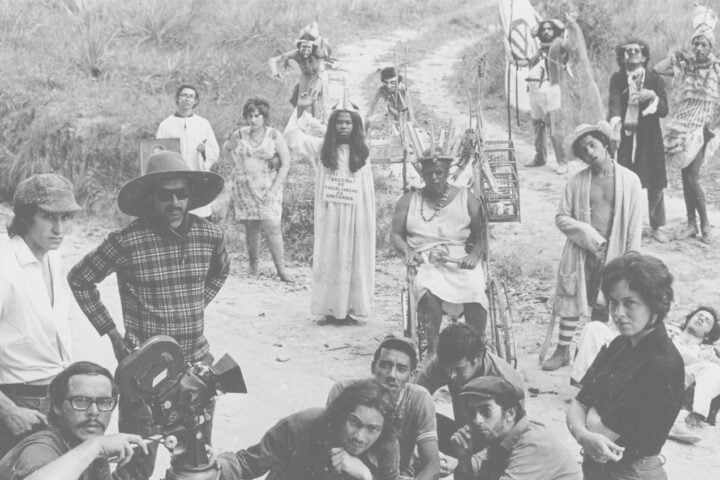
The first installment in a loose trilogy that includes 1967’s Entranced Earth and 1969’s Antonio das Mortes, Glauber Rocha’s Black God, White Devil nonetheless stands alone as a benchmark for the difference between polemic and propaganda. If Rocha’s Italian contemporaries Sergio Corbucci and Damiano Damiani devised the Zapata western to turn the traditional western inside out—critiquing rather than valorizing imperialism—then Black God, White Devil might be called a Lampião western, after the folk hero of Brazilian social banditry who casts a long shadow over the film. More than allegorizing third-world revolutionary and decolonial struggles, Rocha stages a mythmaking intervention into Brazilian history.
As its English title suggests, Black God, White Devil is a film of two halves, each of which slots into a separate western subgenre, and could probably satisfy as a film in its own right. Taken as a whole, though, the film incites a dialectic greater than the sum of its parts. Shot in black and white and set in the sertão, Brazil’s arid inland “backcountry,” the film makes the most of the landscape, with skeletal cacti framing or even foregrounding the action in many shots. This accentuates the poverty of its protagonists in contrast to the riches of the antagonists.
The film’s first half follows a young cowherd, Manuel (Geraldo Del Rey), who flees with his wife, Rosa (Yoná Magalhães), to the mountain hideout of Monte Santo after killing a rich landowner and joins the ragtag followers of St. Sebastião (Lidio Silva), the “black god.” Modeled after Brazilian religious leader Antônio Conselheiro, Silva’s renegade preacher whips his followers into a millenarian frenzy, promising them a utopian island “that doesn’t exist” carried “inside their souls.” Manuel becomes an all but zombified holy warrior, ignoring Rosa’s entreaties to escape with her from the drought-hammered sertão. Local authorities commission bounty hunter Antonio das Mortes (Maurício do Volle) to assassinate Sebastião, but he doesn’t quite make it in time: After Sebastião orders Manuel to kill an infant in order to “cleanse” the skeptical Rosa with the “blood of the innocent,” she turns the blade on Sebastião.
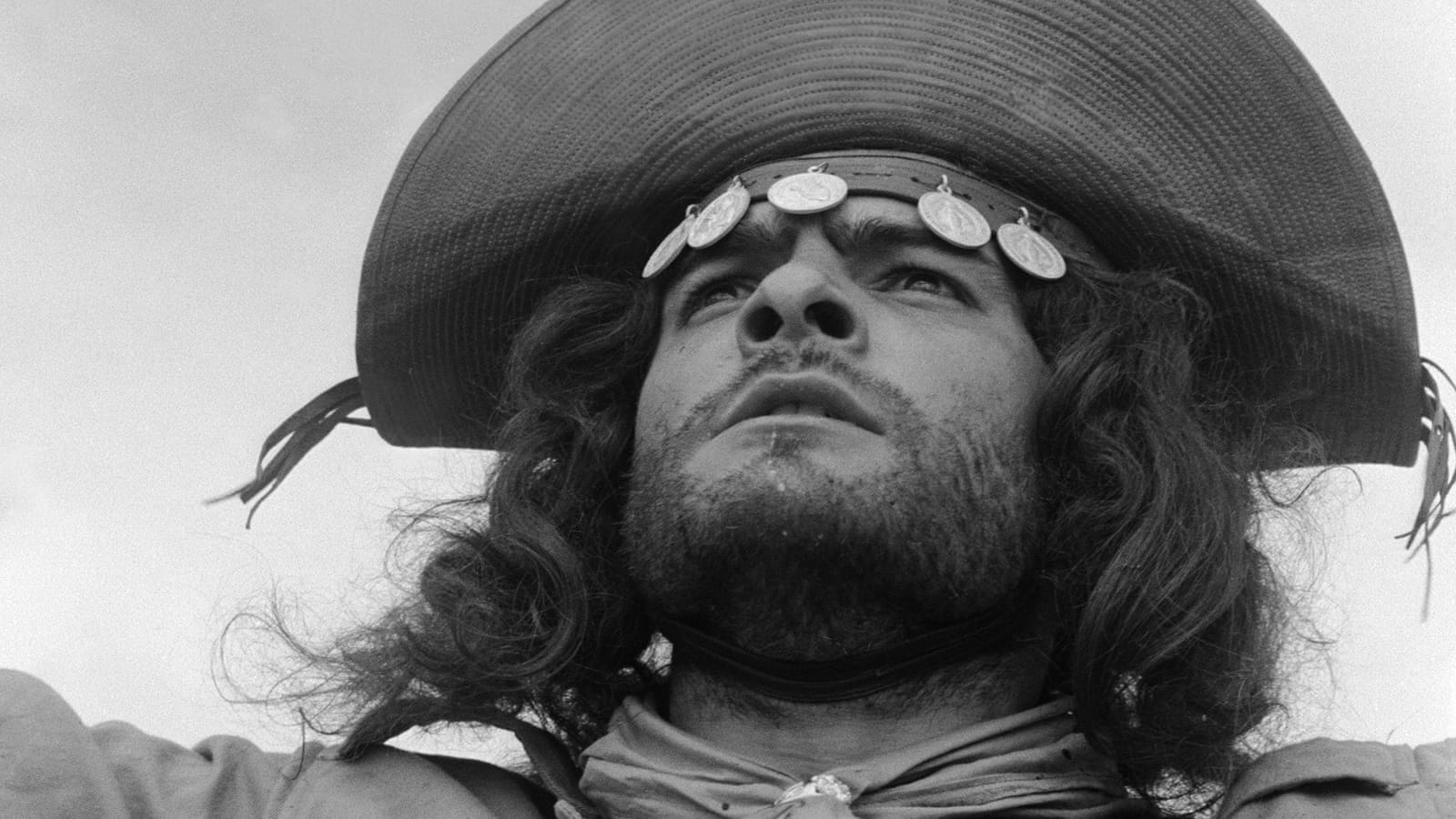
Black God, White Devil’s second half sees Manuel and Rosa, led by the bard Blind Júlio (Marrom), joining the bandit gang of Corisco (Othon Bastos). The charismatic yet volatile “white devil” seeks revenge at all cost for the murders of Lampião and the legendary bandit leader’s wife, Maria Bonita. Down to the leather hat with upturned brim and a band of coins across his brow, costuming makes Bastos into a dead ringer for the Lampião we know from photographs. In a fit of orgiastic violence, they terrorize the local landowners, and this time, Rosa participates enthusiastically, entranced by Corisco’s wife, Dadá (Sonia Dos Humildes). Meanwhile, Antonio das Mortes closes in for the climactic duel demanded by the genre.
Reminiscent of Pier Paolo Pasolini’s Gospel According to St. Matthew, the film’s first half takes at face value the promises of liberation theology and works through their implications. In one especially memorable scene, Manuel crawls up Monte Santo’s hundreds of steps on his knees, bearing a massive stone over his head, as Sebastião prods him onward with a cross. The reference here to Camus’s The Myth of Sisyphus is impossible to miss.

The futility and absurdity of penance implied by this image, combined with Rosa’s unexpected rebellion against Sebastião, exposes the contradictions of a revolutionary movement that preaches blind, ascetic subservience to some celestial hierarchy. On the other hand, the film’s second half brings to light the hypocrisy of a revolution predicated on vengeance, renewing cycles of bloodshed until the oppressed lose all claim to bettering the world.
Counterintuitive as it sounds, Black God, White Devil is practically a musical. Taking the place of voiceover narration, a smattering of folk songs fills in backstory and comments on the action, as if the film were composed of the images running through Blind Júlio’s head as he transforms living history into myth with his guitar. The bard’s small but crucial role in the film would seem to be a nod to the importance of oral tradition to cultures of resistance, and specifically to the Tropicália movement nascent in Brazil at the time of filming. In the transition between the film’s two halves, a song addresses the audience directly, asking us to “pay close attention now.”
Visually, Rocha’s mythmaking impulse takes the form of close-ups and pans on the body of Corisco, transforming him into a larger-than-life antihero, a fragmented colossus. This is hardly the only instance of unconventional editing. Earlier, when Antonio das Mortes massacres Sebastião’s followers, Rocha draws on the famous Odesa staircase sequence of Sergei Eisenstein’s Battleship Potemkin, syncing the rifle shots with rapid, disjunctive cuts from slightly different camera angles, seeming to multiply the bounty hunter into an army.
Admittedly, Black God, White Devil addresses itself to an audience already acquainted with Brazilian history and revolutionary theory, such that many viewers might be left baffled by some of the more recondite references. Knowing these references, though, isn’t indispensable to enjoying the film, which after all continues a tradition of smuggling radical ideas into popular genres. Rocha’s influence on recent class-conscious Brazilian films like Kleber Mendonça Filho and Juliano Dornelles’s satirical western Bacurau is unmistakable.
Throughout Black God, White Devil, Rocha riffs on Eisenstein’s theory of dialectical montage, if mostly in its approach to genre and plot structure. In the end, the film exhorts the oppressed to take matters into their own hands and dispense with both gods and devils, as well as hints toward a third, more humanistic approach. By depicting revolutionary fiascos in a critical yet sympathetic light, Rocha calls on us to imagine what we’d want a revolution to look like, rather than having it spoon-fed to us by those claiming to represent a power beyond ourselves.
Since 2001, we've brought you uncompromising, candid takes on the world of film, music, television, video games, theater, and more. Independently owned and operated publications like Slant have been hit hard in recent years, but we’re committed to keeping our content free and accessible—meaning no paywalls or fees.
If you like what we do, please consider subscribing to our Patreon or making a donation.