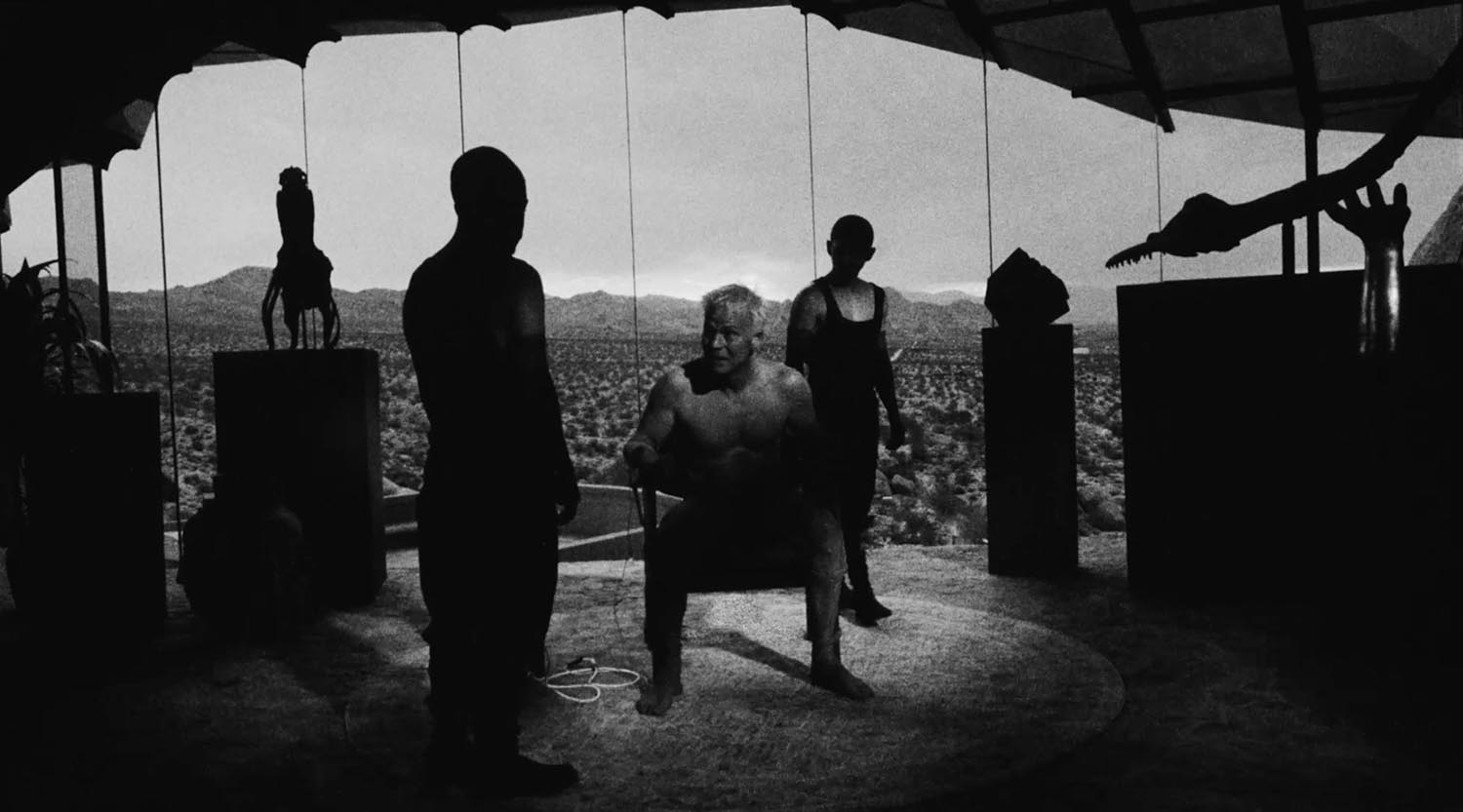
Writer-director Eddie Alcazar has undoubtedly infused Divinity with a distinctive look—so much so that the story’s attempt at an excoriation of spectacle and empty pleasure comes off as little more than a reluctant swipe. The style, dialed up from minute one, grows monotonous, all the more so since the film treats substance as an afterthought.
Divinity is a science-fiction tale of the cautionary, finger-wagging variety. In what seems like an alternate version of the 1990s, an aging, laughably naïve scientist (Scott Bakula) aspires to better the world and take the place of God by developing an immortality drug. But the man dies before he can begin testing on humans, and his son, Jaxxon (Stephen Dorff), takes over the family business. Displaying none of his father’s qualms when it comes to harvesting fetal tissue, Jaxxon puts the drug on the market. And as promised by a salvo of pornographic TV commercials, it grants users physical and mental regeneration, superhuman strength and sex appeal, with intoxication as a bonus, but at the cost of being able to procreate.
Apparently these unlocked potentialities are sacrilegious, because a pair of angelic brothers (Moises Arias and Jason Genao) descend from heavens to show Jaxxon the hubris of his ways by forcing him to take an overdose of his father’s drug, turning their victim into a golem of sinew and pain and rage. Meanwhile, in a travesty of Wim Wenders’s Wings of Desire, they sample the pleasures of earthly existence with the aid of escort Nikita (Karrueche Tran). She, unlike most of the inhabitants of this world, refuses the drug out of a desire to have children and, despite their flatly sadistic personalities, falls in love with one of the barely differentiated brothers.
Produced by Steven Soderbergh, Divinity was supposedly made without a script—an admirable but in this case miscalculated risk. The improvisation, instead of bringing a spark of vitality to the screen, more often results in stilted or redundant dialogue, aggravating an overall sense of incoherency and underdevelopment, particularly in terms of character.
The acting never quite rises above the intentionally artificial, tongue-in-cheek preamble to a softcore sex scene between Jaxxon and an unnamed woman (Emily Willis) near the beginning of the film. Except that, everywhere else, sincerity makes the acting unintentionally artificial. Not only does the sex scene undercut the film’s satire of sexual commodification by indulging the same thing, it makes the rest of the story feel as beside the point as it so often is in porn.

This incoherency extends to the film’s moralism, which condemns the nonconsensual harvesting of stem cells, but also the choice to forgo childbirth in favor of pleasure, while at the same time finding a righteousness in coerced drug-intake. Whether this is reactionary on purpose is hard to tell. Without a script, it may just have shaken out that way. Regardless, moralism loses its edge when aimed at cardboard cutouts. No matter how meticulous the world-building, it crumbles when the characters who inhabit that world lack complexity.
Aside from affection the only rationale for why Alcazar’s film is shot in black and white is to reflect a caricatured, if confused, good-versus-evil concept of morality. Too hard a look at the style, though, finds a blend of influences diluted by each other. The satirical hyper-sexuality is all Paul Verhoeven. The reproductive hand-wringing is a spin on Alfonso Cuarón’s Children of Men. And as for the boutique body horror, who else but David Cronenberg?
What ends up being most intriguing and distinctive about Divinity are the influences it takes from other mediums, particularly video games, including a stop-motion fight sequence that recalls the Tekken and Street Fighter games. That and the emphasis on environmental storytelling through commercials (even if Verhoeven got there first with Starship Troopers).
At times, Divinity borders on critiquing neoliberalism’s reduction of life to marketized wish-fulfilment, namely its prioritization of the self in the present at the expense of a collective future. There’s the intriguing suggestion, too, that authentic pleasure is a function of mortality. But the stylish fetishization of retro technologies and aesthetics, like cassette tapes and ’90s computer interfaces, comes straight from the neoliberal playbook—selling history back to us as nostalgia. Throughout Alcazar’s sci-fi whatsit, style overcompensates for these spasms of philosophy and blunts whatever critical edge they might otherwise have had.
Since 2001, we've brought you uncompromising, candid takes on the world of film, music, television, video games, theater, and more. Independently owned and operated publications like Slant have been hit hard in recent years, but we’re committed to keeping our content free and accessible—meaning no paywalls or fees.
If you like what we do, please consider subscribing to our Patreon or making a donation.