Natalia López Gallardo’s debut feature, Robe of Gems, refuses to go down smooth. If its images make no concessions to audience comfort, that only sharpens López Gallardo’s vision of a Mexico numbed by horror and corruption. A Bolañesque waking nightmare, the film insists that we come to terms with it rather than straightforwardly enjoy it.
After the collapse of her marriage, Isabel (Nailea Norvind) and her two children, Vale (Sherlyn Zavala) and Benjamín (Balam Toledo), hole up in her mother’s villa in the countryside. It’s there that they reconnect with their domestic worker, Maria (Antonia Olivares), who suspects her missing sister of being kidnapped, and Isabel tries to help find out what happened. Meanwhile, the local police chief (Eugenia Salazar) goes through the motions of an investigation, even as she struggles to keep her teenage son, Adàn (Juan Daniel García Treviño), from falling in with criminal elements, who appear to have a hand in a spate of local kidnappings.
While it’s heavy on atmosphere—lassitude, decay, malaise—Robe of Gems isn’t light on plot exactly. It’s just that what’s going on feels like an aggravated disorder that may only be diagnosed from vague and contradictory symptoms. Throughout, the viewer, like the film’s characters, may catch a glimpse of the wider social breakdown, long-since irreversible and immune to understanding, that underlies the kidnappings and the violence.
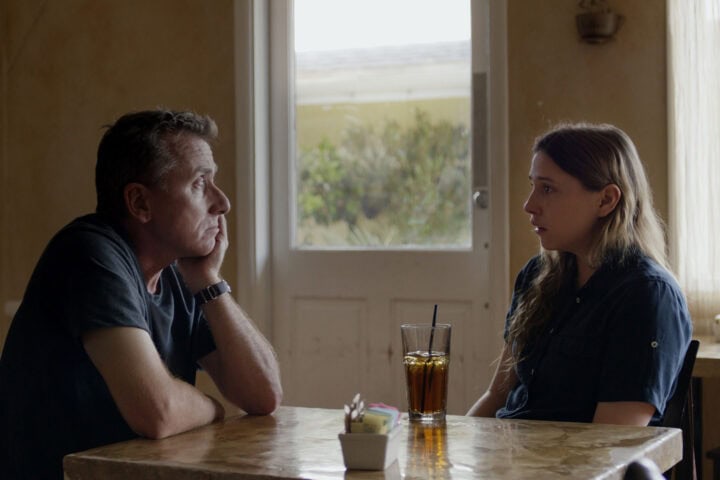
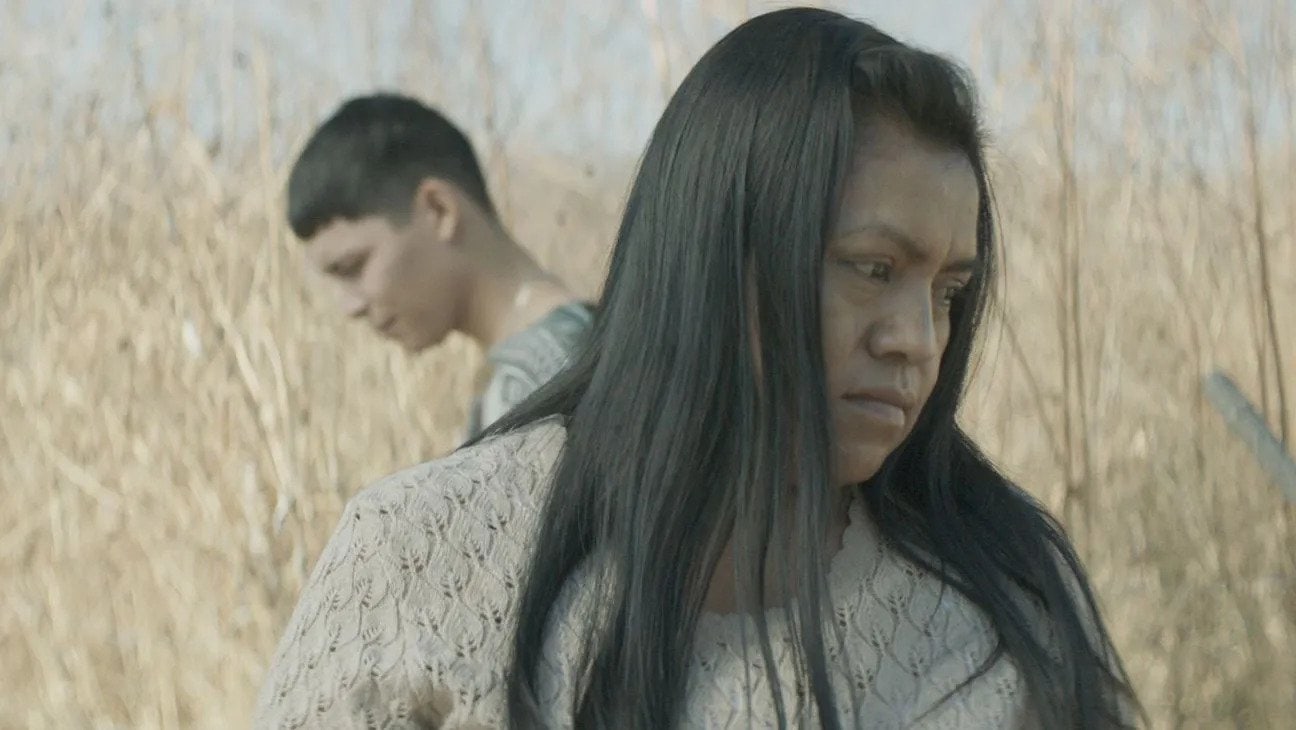
López Gallardo brings to bear an array of formal devices that haven’t yet become tropes, enabling Robe of Gems to elicit a deeper unease than many horror films—less acutely, perhaps, but in ways that linger. Static long takes, discontinuous and compositionally asymmetrical, make up the bulk of Robe of Gems. In a few of these, a shift in the light is the only perceptible movement. In scenes of dialogue, often the character speaking is out of frame. And architectural features, such as columns, fences, and windowpanes, obstruct a clear view of the action. Alternatively, López Gallardo will frame in close-up what a character does with their hands—embroidering, splitting wood, picking at a salad—thereby withholding their facial expressions.
Similarly, the lack of establishing shots keeps context at a remove, making it difficult to tell where a given exchange is taking place, or how locations connect to each other. In several of the film’s claustrophobia-inducing POV shots, a character’s anxious breathing will be audible over the soundtrack, but whose perspective the camera inhabits can’t be determined.

Such techniques trap us in the tunnel vision of characters who cannot, of the sake of their own sanity, look directly at their situation, and who talk around the barely submerged dysfunctionality and terror of their lives. The gaze of Robe of Gems is by and large averted, downcast, deliberately frustrating the voyeuristic way films have trained us to watch them. The pervasive sense of disjunction, dislocation, and confusion that results isn’t pleasant, but it forces us, like the characters for whom denial is a matter of survival, to not see.
If the dominant approach among experimentally inclined artists in recent years has been to smuggle avant-garde techniques into digestible genre frameworks, López Gallardo takes the opposite tack. Robe of Gems inhabits a difficult modernist formal idiom and sensibility—beautiful but menacing, not unlike the dilapidated villa where Isabel and her family attempt to rebuild their lives—the better to scrutinize modernism’s failed promises.
The sense of structural decay and impending collapse reaches a fever pitch in one sequence near the end of the film, where Isabel is left alone in her living room, hemmed in by the many art objects intended to authenticate her comfortable bourgeois lifestyle. The camera zooms in on the back of her head while cicadas produce an eerie drone, punctuated by drops of water leaking into a basin. Then a cut frames her face in close-up, but it’s out of focus, leaving only the background distinct, as her breathing catches—impossible to say whether she’s laughing or crying. And all the while, the leak rachets up in tempo until the tension is almost unbearable.
Since 2001, we've brought you uncompromising, candid takes on the world of film, music, television, video games, theater, and more. Independently owned and operated publications like Slant have been hit hard in recent years, but we’re committed to keeping our content free and accessible—meaning no paywalls or fees.
If you like what we do, please consider subscribing to our Patreon or making a donation.