
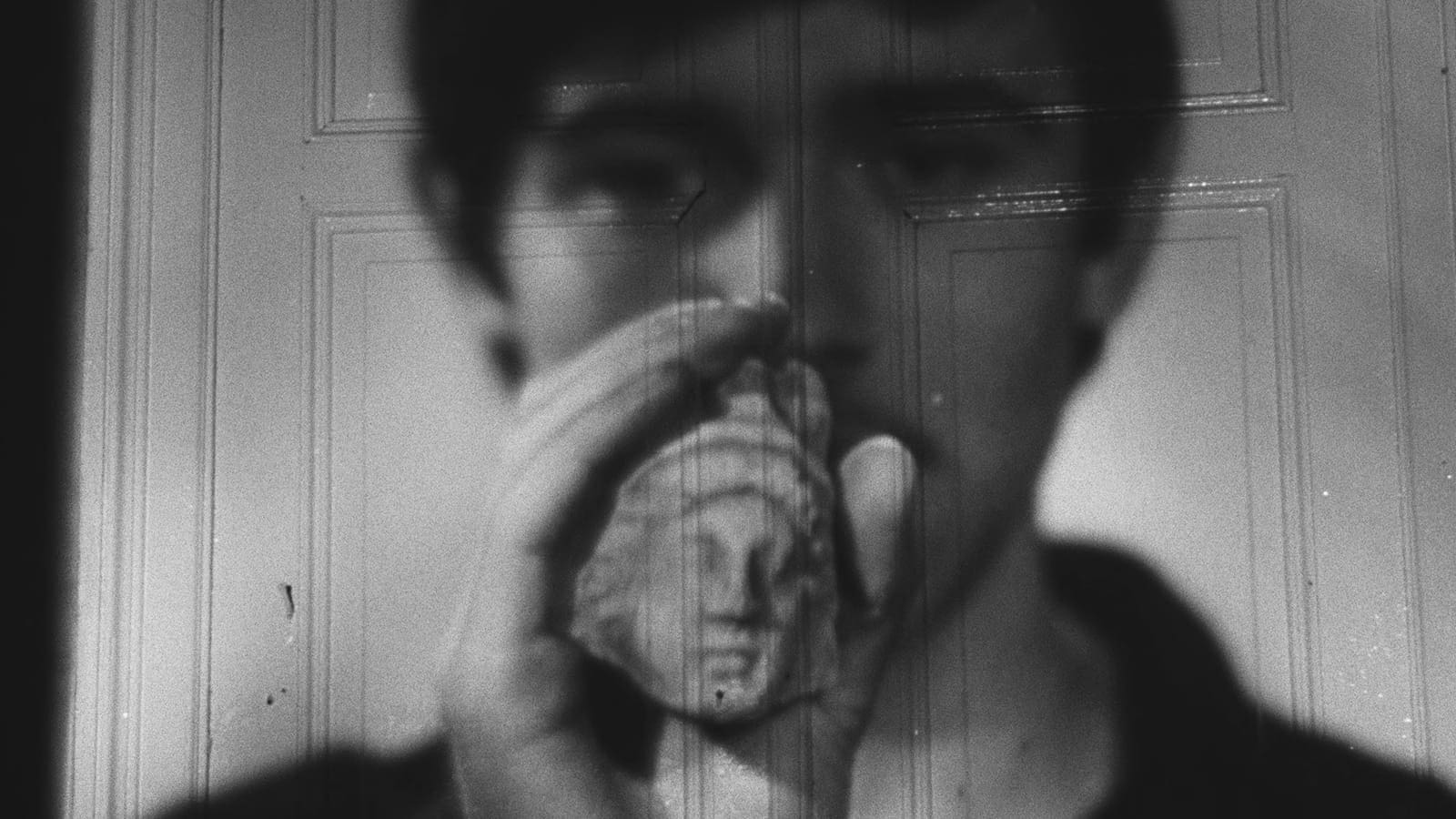
Made in Russian at Odesa Film Studio in the aftermath of de-Stalinization, Kira Muratova’s Brief Encounters and The Long Farewell nonetheless faced censorship for ignoring the precepts of socialist realism. They make for fruitful viewing as a diptych, sharing in certain themes, motifs, and, above all, a rulebook-shredding attitude to cinematic form. Neither overtly criticize Soviet life, yet they smuggle in a discontent that’s detectable less by what they condemn than by what they frame instead: the domestic, the psychological, the interpersonal. What’s surprising isn’t that they got banned, but that Muratova managed to get them made at all. Now especially, watching these two films feels like something of a miracle.
Brief Encounters, from 1967, tells the story of Nadya (Nina Ruslanova), a young woman who leaves her village to work as a housekeeper for Valya (Muratova), committee member to a provincial Odesa district, and her husband, Maksim (Vladimir Vysotsky), an itinerant geologist. Through flashbacks more suggestive than explicit, it’s revealed that Nadya and Maksim previously met during her time working at a teahouse visited by Maksim’s team. Meanwhile, another series of flashbacks dole out the joys and tribulations of Valya’s faltering marriage.
Muratova, though, doesn’t treat the love triangle as a mere scaffold on which to hang the film’s cinematic flourishes. Rather, her impressionism ushers us into the subjective memories and experiences of her female leads—in contrast to Maksim’s pointedly opaque inner landscape.
Still, the film can occasionally feel like a vehicle for promoting Vysotsky, a popular anti-establishment singer-songwriter, somewhat hampering Muratova’s insistence on women’s interiority and agency as a subject worthy of serious examination. More of gypsy-wannabe than geologist, Maksim spends much of Brief Encounters strumming a guitar and singing Vysotsky’s signature songs—even in the midst of spats with Valya—rather than prospecting for rare metals. Despite the intensity of the interpersonal drama at its center, the film strikes a contemplative, summery tone, buoyed by ambient sound effects (a clock ticking, crickets chirping, and so on).
The Long Farewell also explores a marriage, this time already dissolved, but does so indirectly, through the strained relationship between a mother, Yevgenia (Zinaida Sharko), and her adolescent son, Sasha (Oleg Vladimirsky), who’s considering leaving home to live with his father in the Caucasus. It’s Sasha’s interiority that Muratova emphasizes this time around, so that the 1971 film isn’t only about the attenuation of motherhood, but a subtly critical look at the concretion of masculinity as a tortuous severance from maternal influence.
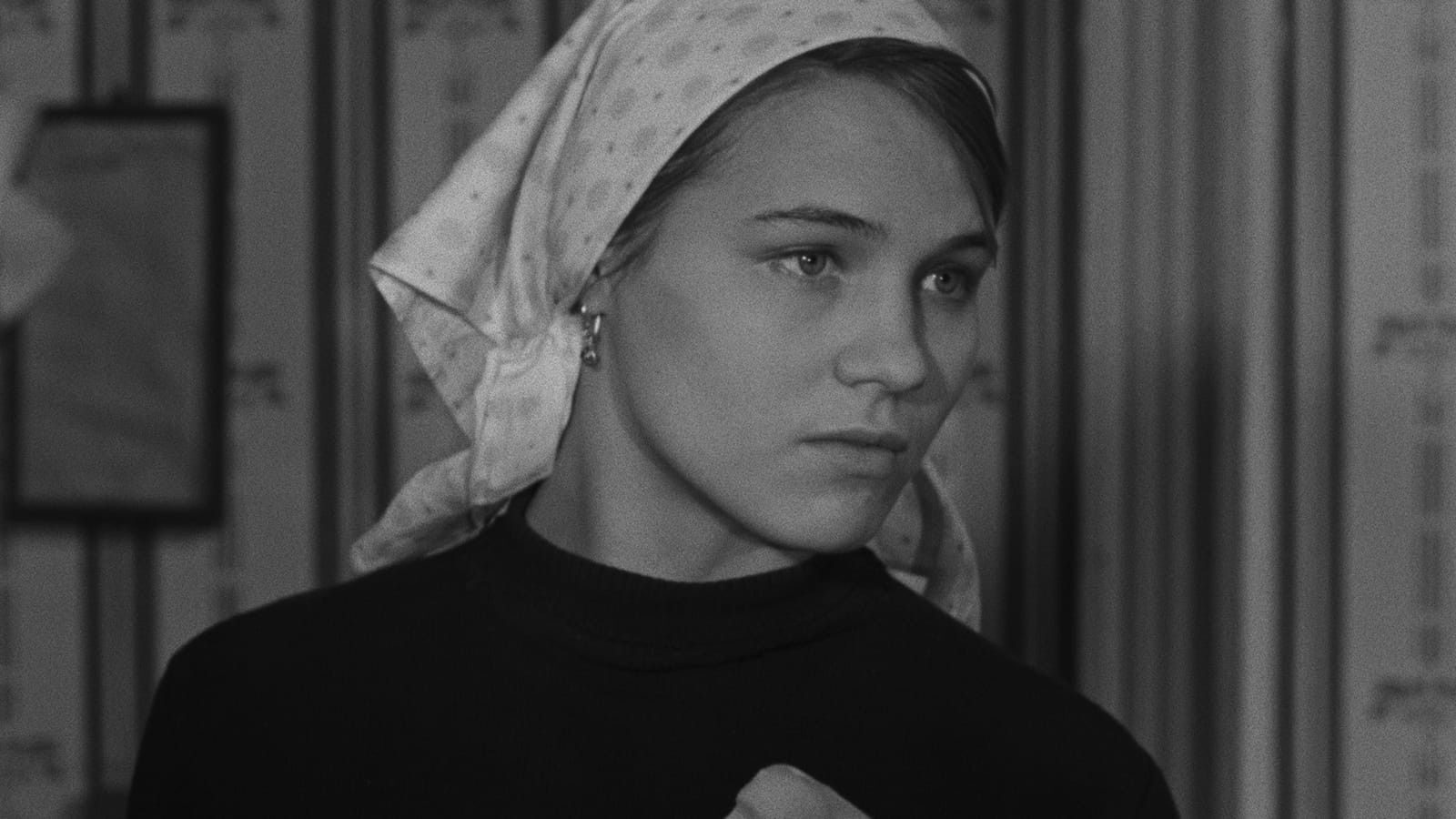
The film additionally explores the effects of absence on the psyche and the complications of communicating over distances spatial, gendered, and generational. Not only the modern paraphernalia of telephones, telegrams, and letters, but also, by extension, the delicate Soviet system for tying its vast empire together come under scrutiny.
While Brief Encounters and The Long Farewell tell stories that transcend Soviet conditions even as they comment on them, it’s how Muratova goes about telling them that really got her in trouble, and which sets her apart as a filmmaker. With each flashback in Brief Encounters, Muratova finds novel means of transitioning between past and present, as in a sequence that cuts from Nadya and Valya inspecting a newly built apartment, to a shot of Nadya in close-up as behind her two distant figures stroll along a road. She goes out of focus as the background comes into focus, revealing the figures to be Nadya and her friend Lubka (Lidiya Brazilskaya) in the past, hitchhiking their way toward a new life. It’s as if the camera movement, together with the inversion of background and foreground, has transferred us, gently, inside Nadya’s memory.
The Long Farewell dispenses jolts of subjectivity even more daring in their break with cinematic convention, particularly in the film’s Woolfian opening scenes. On a visit to the seaside, Sasha has a series of interactions with a girl his own age, Masha (Tatyana Mychko). In one sequence, we get a shot of Sasha leaning motionless against a bow and arrow, everything above his nose cropped by the frame (shades of Sergei Parajanov’s ritualistic tableaux in The Color of Pomegranates). The shot is followed by a close up of Masha with a silk ribbon between her teeth. In a series of rapid cuts, we see the same shot, repeated but at slightly different intervals, of her turning away with a coy smile as Sasha approaches to hold her hair in place.
Throughout the sequence there’s a total lack of sound effects or music. The discontinuous editing borrows from techniques developed by early Soviet avant-garde filmmakers, namely Segei Eisenstein and Dziga Vertov, but Muratova puts them to other ends, as she reproduces a person’s obsessive re-living and processing of a barrage of sensation.
As with The Long Farewell’s editing, its camerawork draws attention to itself without becoming self-indulgent, always operating in the service of conveying and honoring subjectivity. The film’s many close-ups and caressing movements evoke the pleasure of sensation in and of itself, with attention lavished on the textures of things (from dog fur to silk ribbons to crumbling plaster), experiences that are perpendicular to mere plot development.
Across her films, Muratova derives what can only be described as a synesthetic effect from an audiovisual medium. Her treatment of the camera recalls the cinécriture, or “cinema writing,” of her French New Wave contemporaries (Agnès Varda’s 1958 short L’opéra-Mouffe in particular springs to mind), who sought to find a film equivalent to literary prose style. It’s immediately recognizable and personal, turning narration itself into character without the need for overbearing meta techniques like hyper-referentiality or films-within-films.
Muratova’s intransigent experimentalism should be viewed not just as a rebuke to the Soviet blinkeredness of her own time, but an impetus for today’s filmmakers to reinvigorate cinematic language in ways of their own devising. Even in independent film, which has congealed into more of a genre than a methodology, far too many films fall in step with the prevailing trend for unobtrusive, almost apologetic camerawork and editing, one by one turning the medium into a featureless, impersonal bloc in thrall to market dictates. If what we want is a culture that’s vibrant and not anemic, forward-looking and not mired in nostalgia and cynicism, we can learn from the work of Muratova, who found ways to express herself in almost impossible conditions.
New 4K restorations of Brief Encounters and The Long Farewell will open in New York at Film at Lincoln Center on August 25.
Since 2001, we've brought you uncompromising, candid takes on the world of film, music, television, video games, theater, and more. Independently owned and operated publications like Slant have been hit hard in recent years, but we’re committed to keeping our content free and accessible—meaning no paywalls or fees.
If you like what we do, please consider subscribing to our Patreon or making a donation.



Great review of two incredible films. Kira Muratova is one of the unsung geniuses of world cinema, and I hope that these restorations will renew interest in her work, which is often bizarre and abrasive but never less than compelling.