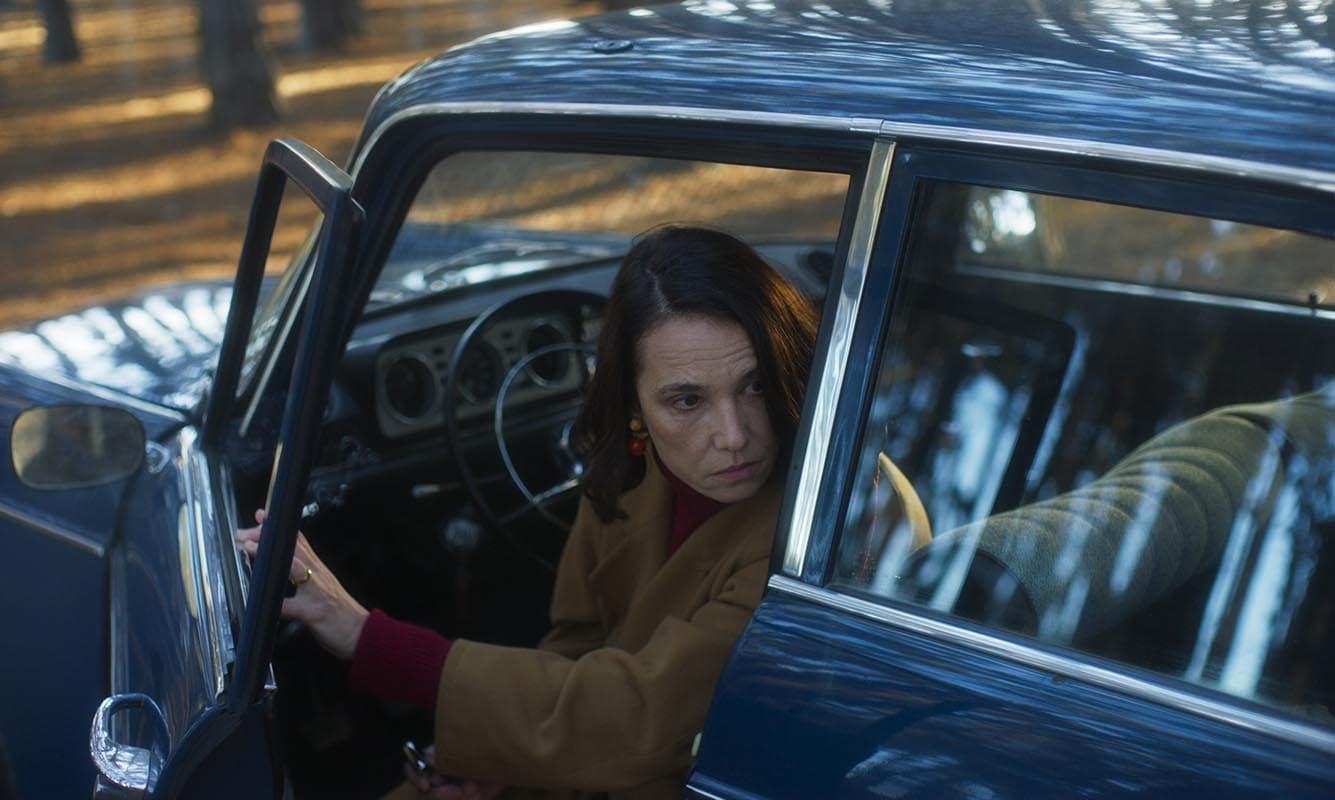
It’s said that just because you’re paranoid doesn’t mean they’re not out to get you, but in the case of Carmen (Aline Küppenheim), the protagonist of Manuela Martelli’s Chile ’76, paranoia may be a self-fulfilling prophesy. After all, as its title indicates, the film is set during Augusto Pinochet’s right-wing military dictatorship, three years after the coup that toppled Salvador Allende’s democratically elected left‐wing Popular Unity Government.
Carmen is a young grandmother, wife of a hospital administrator (Alejandro Goic), and former Red Cross nurse. She lives a complacent bourgeois life, insulated from anti-communist suspicion but not from her own neuroses, which she self-medicates with a steady intake of pills, alcohol, and cigarettes. When she and her family pay a visit to their seaside vacation house, the local priest, Father Sanchez (Hugo Medina), recruits her to secretly nurse a communist insurgent, Elías (Nicolás Sepúlveda), as he recovers from a gunshot wound.
A visual motif that runs through Chile ’76 is the blending together of contrasting colors. In the opening sequence, Carmen directs a paint store clerk to increase the ratio of blue to red for the shade with which she intends to repaint the vacation home. In a later scene, she beats red food coloring into the whipped cream for her granddaughter’s (Ana Clara Delfino) birthday cake.
These moments allude to, among other things, Carmen’s attempt to lead a double life as a clandestine nurse with communist sympathies and the devoted bourgeois housewife who orders around her maid, Estela (Carmen Gloria Martínez). This is also supported by the predominance of mirrors and reflections across Chile ‘76. Irrespective of what it symbolizes, though, this motif parallels Martelli’s approach to sound design, which is perhaps the film’s most striking aspect.

For much of Chile ‘76, the music imparts a foreboding to scenes of Carmen’s stylish seaside milieu and family life that would otherwise come across as idyllic. Brazilian percussionist Mariá Portugal’s amelodic soundtrack, generated with analog synthesizers, channels everything from noir to sci-fi to dystopian moods. Effects evoking foghorns or electronic seagulls are interspersed with sharply descending pitches that make the blood run cold. And the initial tension between sound and image echoes those starkly contrasting paints before they’re mixed.
While not as radically disjunctive and surreal as the sound design from Mark Jenkin’s recent Enys Men, the interplay between sound and image in Chile ’76 is more dynamic. Over the course of the film’s second half, the music comes into alignment with increasingly unsettling images, as Carmen’s involvement with Elías and his dissident comrades deepens. This impressionistic blending grants the viewer indirect access to the protagonist’s paranoid state of mind.
Sound and image attain homogeneity in a scene where Carmen, out past the state-imposed curfew, gets stopped at a police checkpoint. She manages to play it cool and they let her pass, but when she gets back to the vacation house her frayed nerves get the better of her. Martelli memorably conveys Carmen’s distress in how she shoots the shadowy vestibule, accenting its geometries with uncanny blue and sickly yellow hues, as abstract in appearance as the soundtrack’s synthesized waveforms. If Carmen’s escapade begins as a fantasized return to youth, when she was a glamorous and independent nurse, the perceived danger of her situation drives her to attract the attention of the secret police. For that matter, the line between paranoia and guilt at betraying her bourgeois upbringing can be tricky to discern.
Martelli pinpoints the intersection between individual and authoritarian paranoia that, in seeing saboteurs and insurgents around every corner, drives a populace to take up the very conspiratorial activity that it fears. Chile ’76 may be a period drama but, in its depiction of how mutually exacerbating paranoias distort the collective psyche and transform fictive fears into real horrors, it bears a none-too-comfy relevance to our own uneasy times.
Since 2001, we've brought you uncompromising, candid takes on the world of film, music, television, video games, theater, and more. Independently owned and operated publications like Slant have been hit hard in recent years, but we’re committed to keeping our content free and accessible—meaning no paywalls or fees.
If you like what we do, please consider subscribing to our Patreon or making a donation.