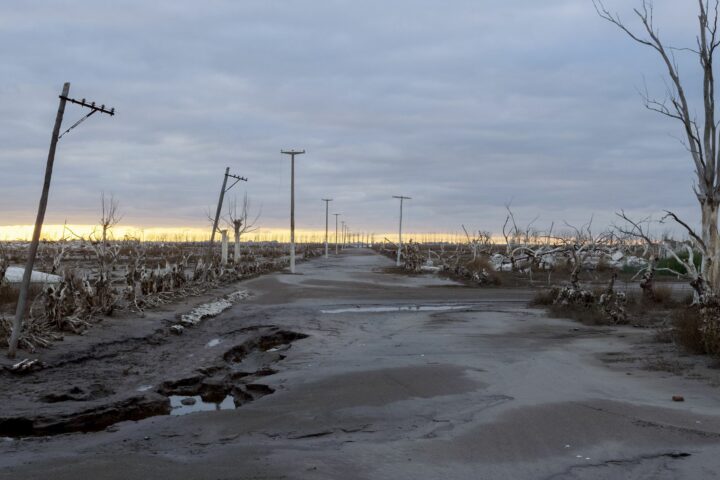
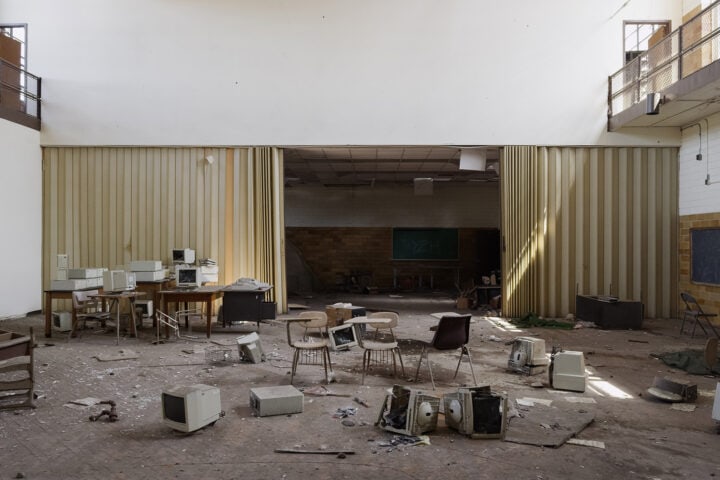
As archaeologists who study middens know, you can learn as much about a culture from what it discards as you can from monuments built to challenge eternity. Matter Out of Place enacts a pre-emptive archaeology by examining how cultures as disparate as Albania and Nepal, Switzerland and the Maldives, dispose of their garbage. And if the adage “out of sight, out of mind,” uttered by a landfill researcher early in the documentary, holds true irrespective of locale, Nikolaus Geyrhalter aims to put it squarely back in sight, back in mind.
Consisting largely of long takes sans music or commentary, the film uncovers the paradox that trash, so apparently devoid of meaning or use-value, needs little commentary. It speaks for itself, and ominously, of the entropy that mocks civilized pretensions. It’s hard not to see something apocalyptic in the teetering ziggurats of refuse that are so painstakingly inserted into the film. With static camerawork that accentuates the artfulness of his shot compositions, Geyrhalter finds in garbage a sublimity, disturbingly beautiful in its sheer magnitude.
The film comes dangerously close to turning a social and ecological crisis into an aesthetic object for our disinterested contemplation, walking a tightrope between the mesmerizing and the tedious. Take the five-minute shot of an industrial compactor mulching mattresses, cushions, a laundry basket, cardboard, Styrofoam panels, and so on. Though ironically reinforcing its themes, chunks of the film can feel extraneous, as empty as the objects it parades before us, so that viewers may find it more interesting to think about than actually watch.
Much garbage biodegrades so slowly that it doesn’t really, in terms of a human timescale, go anywhere. It “disappears” only insofar as we displace it, and Geyrhalter shows us some truly tortuous displacement processes throughout Matter Out of Place. In Nepal, we watch a bulldozer belching gouts of diesel exhaust as it pushes a caravan of garbage lorries, one by one, up the muddy slope that leads to a landfill. In Greece, a troupe of scuba divers scours the ocean floor, loading plastic debris into sacks equipped with floatation devices to take them to the surface, where a freighter waits to collect them. Some of these processes are so sophisticated, in fact, that it raises the question of just how much trash is generated by trash disposal.
In the absence of voiceover narration, montage substitutes its own form of commentary. By juxtaposing, for example, fields of burning garbage in the Maldives with waste treatment plants of staggering size and complexity in Switzerland, Geyrhalter implies that eco-friendly modes of disposal are in fact a luxury. At the same time, the documentary’s global perspective compels the audience to recognize that since all trash has to go somewhere, we may be entering a new era of colonialism where trash gets exported to the very places whose raw materials and labor were extracted to create the wealth that produced it in the first place.
This is presented so convincingly that it sabotages what feels like a tonal shift toward optimism in Matter Out of Place’s concluding segment, which shows the almost joyous, utopian trash-pickup ritual that takes place after each year’s Burning Man festival in Nevada. The film’s opening title card reformulates the festival term MOOP, or “matter out of place,” as “any object or impact not native to the immediate environment.” In light of Matter Out of Place’s own unspoken thesis, the words “native” and “immediate” feel naïve. Admirable in theory, the festival’s “leave no trace” policy looks untenable from a global point of view, if those traces simply reappear where people don’t have the wherewithal to deal with them.
What the film leaves out of the picture tells us something of its politics, as it focuses so intently on the displacement of trash that its actual generation feels conspicuously missing. We don’t see the monolithic quantity of waste produced by corporations, which outweighs the amount that’s produced by ordinary people, and this leaves the impression that some impersonal consumer-in-the-abstract is to blame for throwing away so much and promptly forgetting about it.
Geyrhalter points no fingers, and while that may be admirable from an artistic, formal perspective, from an activist one it’s self-defeating. Matter Out of Place at best endorses a trash-collecting voluntarism that seems, on its own, pathetically insufficient to stave off the glacial creep of empty containers that threatens to bury us alive.
Since 2001, we've brought you uncompromising, candid takes on the world of film, music, television, video games, theater, and more. Independently owned and operated publications like Slant have been hit hard in recent years, but we’re committed to keeping our content free and accessible—meaning no paywalls or fees.
If you like what we do, please consider subscribing to our Patreon or making a donation.