The story behind Keith Jarrett’s 1975 live album The Köln Concert is nearly as well known as the music. The pianist arrived in Cologne, which the Germans know as Köln, tired and with an aching back after an eight-hour drive from Zurich, the piano he was given to play on was broken and out of tune, and he didn’t even manage to get a proper meal in before the show. These circumstances produced one of the most mesmerizing, transcendently beautiful (and best-selling) solo piano recordings ever—a testament to the adaptive ingenuity and keenly attuned mental and physical concentration of an historically brilliant jazz improvisor.
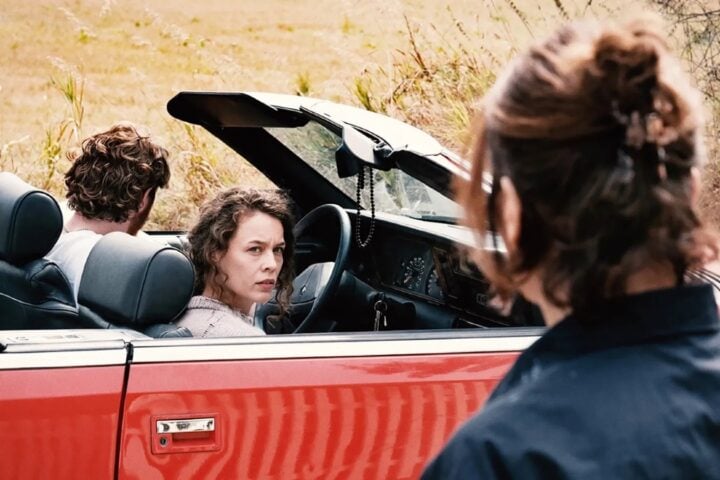
Dramatizing these events in Köln 75, writer-director Ido Fluk focuses our attention not on Jarrett (John Magaro) but on Vera Brandes (Mala Emde), the concert’s 18-year-old promoter. The film’s opening narration, metaphorically equating Jarrett’s performance with Michelangelo’s painting of the Sistine Chapel, announces the story about to unfold as “about the scaffolding”—which is to say, the practical supports that allowed a grand artistic expression to take place. This approach makes for an unusual biopic, mainly following the action behind the scenes and setting the stage for the celebrated performer we’d expect to find at the film’s center.
Moreover, Jarrett’s own music is never heard. A scene in which Vera watches him perform for the first time sees Magaro mimicking the physical gyrations and vocal ejaculations for which Jarrett is well known. When we finally reach the climactic event, the performance is inaudible, covered up by the film’s soundtrack. Unable to obtain permission to use Jarrett’s actual recordings, the filmmakers work around this conspicuous absence, creating within an imposed limitation just as the pianist had to 50 years ago at the Oper Köln.
Going well beyond the most famous concert of her career, Köln 75 offers a full biographical sketch, beginning when Vera is a 16-year-old whose assertiveness earns her an invitation from sax player Ronnie Scott (Daniel Betts) to organize his European tour—something she has no experience doing. Before long, Vera becomes a notable figure in her own right, a teenaged “Jazz Bunny” responsible for booking some of the most high-profile jazz artists in the world. All of this happens under the nose of her dentist father (Ulrich Tukur), a particularly nasty and vindictive patriarch of Nazi-era vintage whose office she uses to make calls at night.
For the first hour or so, the film seems caught between traditional storytelling and more documentary-minded intentions. Beyond the inconsistent use of voiceover, Vera is prone to breaking the fourth wall as if she were Ferris Bueller. And then there’s jazz critic Michael Watts (Michael Chernus), who tells us he’s about to become an integral part of the story even though his character is mainly employed for expositional purposes. At several points during Köln 75, Michael steps in to provide background and context, educating us about Jarrett’s time in Miles Davis’s band or the construction of the Oper Köln.

This didactic device—which felt intrusive, condescending, and disruptive in Adam McKay’s The Big Short, and is equally incongruous here—reaches its apex and nadir when Michael offers a condensed history of jazz improvisation in order to establish the originality of Jarrett’s artistry. The sequence, a long take that incorporates film projections and a live trio demonstrating different jazz styles, is technically thrilling, but it’s musicologically flimsy, if not laughable.
Yet, to the film’s credit, this passage crucially contextualizes Jarrett as not simply a cranky eccentric (well-known as he is for insisting on complete silence from the audience), but as someone undertaking an especially demanding pursuit: completely improvised, unaccompanied performance, spontaneous composition arising moment-to-moment.
Unfortunately, for a film mainly about an assertive young woman making her way in a culture ruled by men, Köln 75 becomes far more compelling after Jarrett finally makes his entrance. Prickly, demanding, yet humble before the creative muse, he demands more screen time than he gets, Magaro’s sensitive performance ironically semi-thwarting the film’s oblique conception.
There’s a stretch in the middle of the film, during which Michael hitches a ride with Jarrett and ECM producer Manfred Eicher (Alexander Scheer) to Köln, that recalls The End of the Tour, James Ponsoldt’s film about the writer David Lipsky tagging along with David Foster Wallace on his Infinite Jest book tour. Without over-mythologizing Jarrett’s mysterious artistry, the film mines subtle comedy from Michael’s thwarted efforts to draw out insights from his subject. Every time Michael elicits a gem for the profile he’s writing, he’s told, “You can’t use any of this.”
Köln 75’s narrative momentum fully kicks in on the day of the concert. First, the stakes are raised when Vera promises her mother (Jördis Triebel) to give up her new career if the show is a failure. Then, with the logistical chaos of trying to sell tickets, promote the concert on the radio, and get the piano tuned (or replaced), the film’s energy becomes chaotically propulsive, a handheld camera chasing Vera as she hustles around the city on foot, her desperation growing as the clock ticks down to curtain time. There’s a wonderful moment when two piano tuners (Michael Meichßner and Jürgen Rißmann) are seen working on the instrument in the wings of the Oper Köln while a performance of Alban Berg’s opera Lulu is in progress on stage.
Of course, little of this means anything without the resulting magic that Köln 75 takes for granted. Naturally, for lacking the genuine article (Jarrett’s own monumental outpouring), the filmmakers have to lean on tearful audience reaction shots and earlier Ken Burns-ian insertions to get across the significance of that one single night’s performance. Such calculated and predictable moves cheapen the story of the firebrand who helped make it happen.
Since 2001, we've brought you uncompromising, candid takes on the world of film, music, television, video games, theater, and more. Independently owned and operated publications like Slant have been hit hard in recent years, but we’re committed to keeping our content free and accessible—meaning no paywalls or fees.
If you like what we do, please consider subscribing to our Patreon or making a donation.