
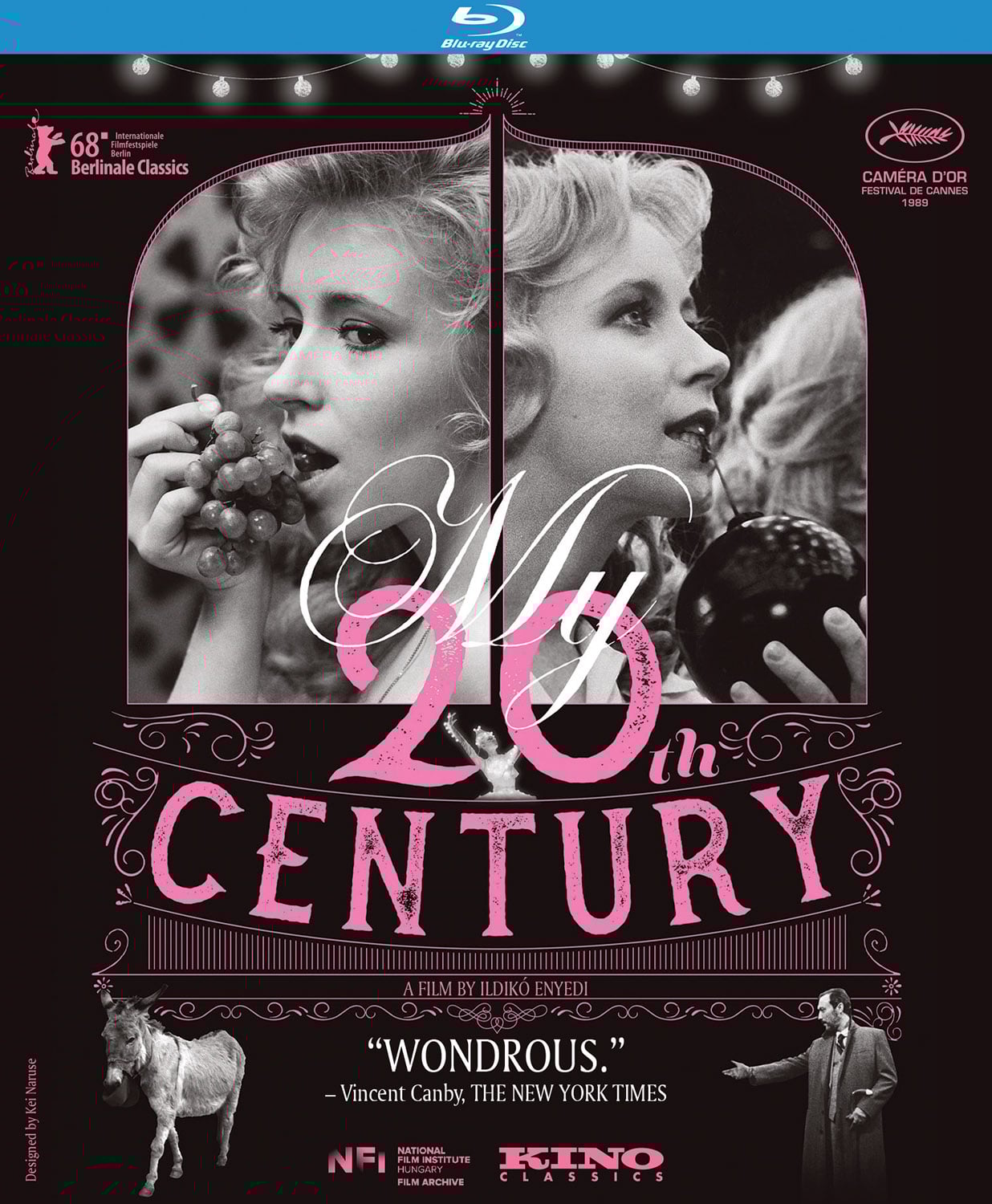
 Writer-director Ildikó Enyedi’s My 20th Century begins not at the dawn of the 1900s, but 20 years earlier at Thomas Edison’s (Péter Andorai) laboratory in Menlo Park, New Jersey, where he’s showing off his latest invention: a light bulb. As a crowd gathers around a tree strung up in light bulbs, close-ups of people’s awed faces testify to a world irrevocably changed. Indeed, as Edison later sits alone, the stars above him begin to whisper in a futile attempt to get his attention, aware that they now face competition with artificial light for the dreamy stares of humans. Giving up on the inventor, the stars then turn their focus to far-away Budapest, where a woman is giving birth to twin girls.
This magical-realist opening prefigures the whimsy of Enyedi’s approach to Hungary’s turbulent 20th-century history. The twins, Dóra and Lili (both played in adulthood by Dorota Segda), are soon orphaned and, in early childhood, abducted and separated by two men who find them on the street. When the film leaps forward to the year 1900, Dóra is a socialite drifting through palatial rooms on the arms of Hungary’s wealthiest men. Riding in a glitzy compartment on the Orient Express where the champagne is free-flowing, she’s oblivious to the fact that her long-forgotten sister, now an anarchist, is on the same train. The camera regards each woman in the same woozy fashion, but Enyedi visually delineates the insulation of the Old World’s upper class and the mounting defiance of the poor, as the overcrowded rear cars feel stuffy compared to the richer compartments’ atmosphere of joie de vivre.
The dichotomy between Dóra and Lili, who constantly traverse the same areas but never intersect, naturally illustrates the widening gyre between an insurgent populist movement and a dying aristocracy’s final years on the eve of World War I shaking Europe to the core. Heavy stuff, but My 20th Century is filled with diversions that range from the generally satirical to the borderline surreal. A psychology professor gives a lecture denouncing feminism as a mental disorder before drawing sexual organs on a blackboard with arrows leading from breasts to wombs to chart the process of stimulating a woman, almost as if he were sketching a battle plan. A caged chimp at a city zoo gives a monologue on the perils of his curiosity when he’s around humans in the wild, while a dog escapes the hell of a laboratory experiment and seems to run the length of Hungary as he sprints toward freedom.
Early on, before their separation, Dóra and Lili share a dream of being reunited with their dead mother in a Lotte Reiniger-esque shadowplay that replicates Christian imagery of a donkey bearing the children to their Mary-like mother, and a donkey appears toward the end to lead the sisters toward reunion. Such images break the film away from simply correlating its characters to history by delighting in more free-associative connections.
Indeed, if one considers the scene of Edison showing off his light bulbs in relation to the old nickelodeon film that plays over the credits of a soldier humorously sticking his head into a misfired cannon as he waves a torch dangerously close to the gun’s wick, My 20th Century could be seen as a general celebration of the possibilities of cinema. Even Segda’s dual casting is a testament to the movie magic that Enyedi indulges while exploring a transitional period in Hungarian and, indeed, world history. The metaphorical dimensions of the twins are compounded by their being seen through the confused perspective of a man, Z (Oleg Yankovskiy), who unknowingly becomes the lover to them both. While Z can’t understand how the woman he loves keeps vacillating between radical revolutionary and glamorous sellout, his ability to square these two wildly divergent identities into one perceived person speaks to the film’s subtler illustration of how the various strains of sociopolitical angst make up the fuller, insoluble portrait of Hungary as it teeters on the precipice of far-reaching change.
Image/Sound
Sourced from a 4K restoration, Kino’s transfer brilliantly captures the film’s blazing use of on-screen light. The exaggeratingly pulsating light bulbs are rendered in all their blinding luminescence, never washing out the sharp contrast of the black-and-white cinematography. The only flaws here are endemic to the archival footage prominently featured throughout, such as the scratches and other debris that cannot be fixed. Even then, these defects are in sync with the film’s magical-realistic flourishes. The audio track is fault-free, boasting evenly mixed dialogue that’s never overpowered by the surround elements.
Extras
A brief video introduction from Ildikó Enyedi is included on this release, as is a longer interview with the director in which she details how she wrote and made the film. An audio commentary by the director and cinematographer Tibor Máthé delves more into the technical aspects of the film’s look. Throughout, Enyedi keeps the film’s “meaning” as entirely opaque as the final product. An accompanying booklet contains an essay by TIFF programmer Dorota Lech that places the film in context of both social and cinema history and also analyzes how the slippery dream structure both obscures and elucidates its themes.
Overall
Ildikó Enyedi’s playful rumination on a turning point in Europe’s history as well as the possibilities of filmmaking gets a gorgeous transfer from Kino.
Since 2001, we've brought you uncompromising, candid takes on the world of film, music, television, video games, theater, and more. Independently owned and operated publications like Slant have been hit hard in recent years, but we’re committed to keeping our content free and accessible—meaning no paywalls or fees.
If you like what we do, please consider subscribing to our Patreon or making a donation.


