The second season of Star Trek: Strange New Worlds exudes even more of the breezy freshness of a sharply written, back-to-basics TV series than its first season. Increasingly, showrunners Akiva Goldsman and Henry Alonso Myers are solving the puzzle of how to make the hoary old Star Trek format new again. A welcome shift away from rigidly serialized storytelling has greatly benefited this prequel series, allowing it to cast off the chains of cause and effect that bind together each episode of Discovery and Picard.
As in the halcyon Star Trek days, each episode of Strange New Worlds explores a new, pulpy sci-fi scenario played for thrills, yuks, or, yes, sometimes heavy-handed progressive grandstanding. The writing this season nails the middle ground between the silly-but-sometimes-smart space operatics of the original series and the warm surrogate-family vibe of The Next Generation. Plots that alternate their focal points channel that Next Gen sense of a crew who all have quirks and conflicts worth building episodes around. (This season even brings in a deliriously fun Carol Kane to play the USS Enterprise’s new chief engineer.)
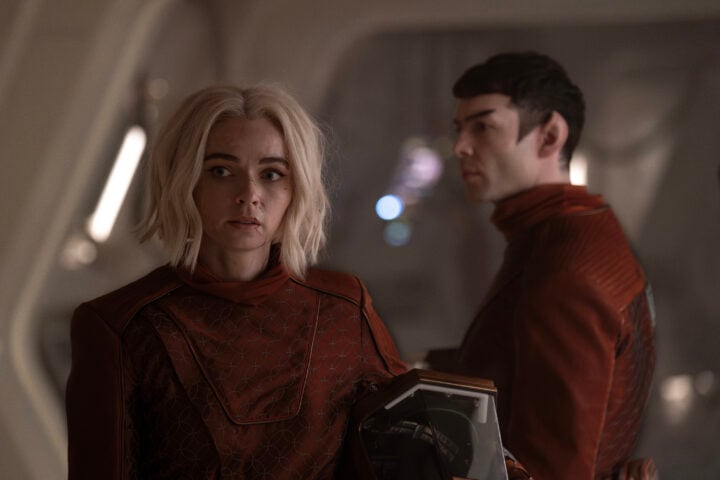
Signaling Star Trek’s commitment to ensemble storytelling from the outset, Strange New Worlds sidelines series lead Captain Christopher Pike (Anson Mount) for most of the first episode, “The Broken Circle.” Somewhat awkwardly assuming the captain’s chair, the young Lieutenant Spock (Ethan Peck) leads the rest of the Enterprise crew on an unsanctioned mission to a mining planet on the border with the Klingon Empire. It’s a fast-moving episode that manages some excitement despite—or maybe because of—the unintentional goofiness of much of its action. Like most of the six episodes made available to press, the story is probably best viewed as scaffolding for better acquainting us with characters like La’an Noonien Singh (Christina Chong), Nurse Chapel (Jess Bush), and Dr. M’Benga (Babs Olusanmokun).
If the plot of “The Broken Circle” sounds familiar, that’s because, like so much of the series, the scenario is clearly calculated to resonate with specific episodes of previous Star Trek shows. Indeed, what Spock and company find on the planet—a conspiracy to ruin the tenuous peace between the Federation and the Klingons, along with some Klingons perfectly happy to drink bloodwine with them once they prove their mettle—certainly will not shock any Trekkies.
While such a course correction can be refreshing, there are downsides to being so derivative. Aping the “Court Martial” episode of the original series, “Ad Astra per Aspera” sees First Officer Una Chin-Riley (Rebecca Romijn) stand trial for coming from a society that uses genetic engineering, a big no-no in the United Federation of Planets. The episode gives us some classic Star Trek allegory about legalized discrimination, but an allegory built around the argument that the law shouldn’t discriminate based on cultural identity doesn’t pack much punch in 2023.
It doesn’t help that Romijn, though the most recognizable name in the cast, has yet to find a distinctive take on this legacy character. Other legacy inclusions, though, stand out, and it feels that in its second season, Strange New Worlds is beginning to claim ownership over them—even its version of recurring character James T. Kirk (Paul Wesley). Actors like Wesley and Peck have to channel, to some degree, the thoroughly established versions of their characters, but Bush and Celia Rose Gooding, playing Chapel and Ensign Uhura, are given much more latitude.
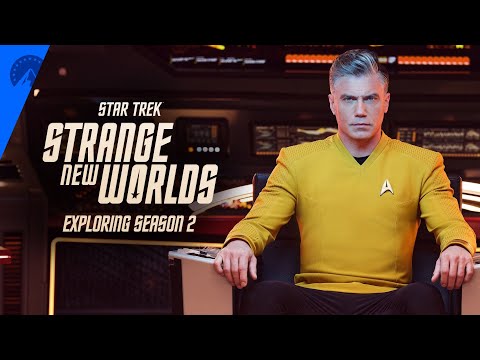
One almost forgets that Mount’s Pike is a legacy character. Played as a disgruntled misogynist by a compelling Jeffrey Hunter in the 1966 pilot, and as a stern father figure by Bruce Greenwood in the J.J. Abrams’s Star Trek and Star Trek into Darkness, Pike’s characterization has always been determined by the aims of the given series he appears in—and by the era. We are evidently in the era of the hot divorced dad, as the salt-and-pepper Mount captures the energy of a middle-aged man who’s kept in shape, has learned to listen, and loves to cook.
Not letting his midlife crisis—which takes the Trekian form of having advance knowledge that he’s doomed to be horribly disfigured in a future accident—interfere with his relaxed but engaged mien, Pike faces up to his own mistakes in episodes like “Charades” and “Among the Lotus Eaters.” His personal coping with the responsibilities of leadership joins the budding, hesitant romance between Chapel and the betrothed Spock as the show’s primary arcs, emphasizing that its mission of exploration mostly concerns character.
What’s perhaps lost in that mission throughout Strange New Worlds is Star Trek’s ambition to be the thinking person’s space opera. The show’s updated classic scenarios with modern, genuinely appealing characters certainly rescue the franchise from the doldrums of grimdark narrative arcs and fashionable moral ambiguity. Still missing, though, are episodes that extract questions from the drama that are worth lingering on. Ones like “Among the Lotus Eaters” and “Tomorrow and Tomorrow …” serve up familiar motifs like feudal planets and time-travel romances but aren’t very interested in providing food for thought.
Previous Star Trek shows raised questions not easily answered in 50 minutes, such as whether military force can be used for good, whether the historical narrative of human progress is defensible, and whether androids are also people. While it’s growing ever-more proficient at spinning a yarn, Strange New Worlds also continues to play it safe, making it the most entertaining live-action Star Trek property in decades but also among the least challenging.
Since 2001, we've brought you uncompromising, candid takes on the world of film, music, television, video games, theater, and more. Independently owned and operated publications like Slant have been hit hard in recent years, but we’re committed to keeping our content free and accessible—meaning no paywalls or fees.
If you like what we do, please consider subscribing to our Patreon or making a donation.