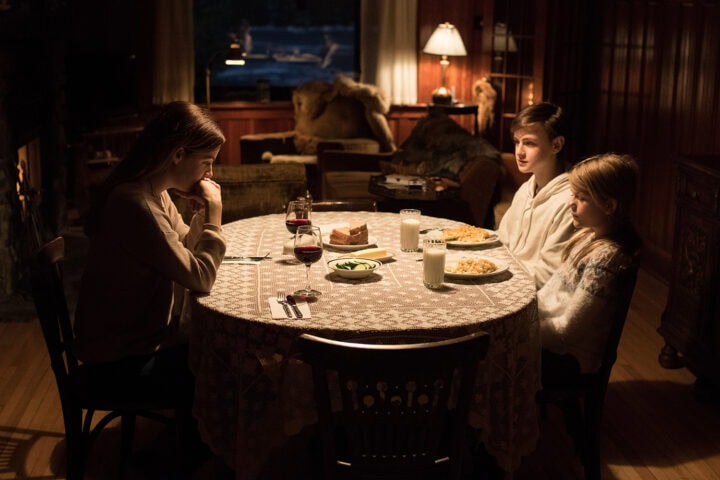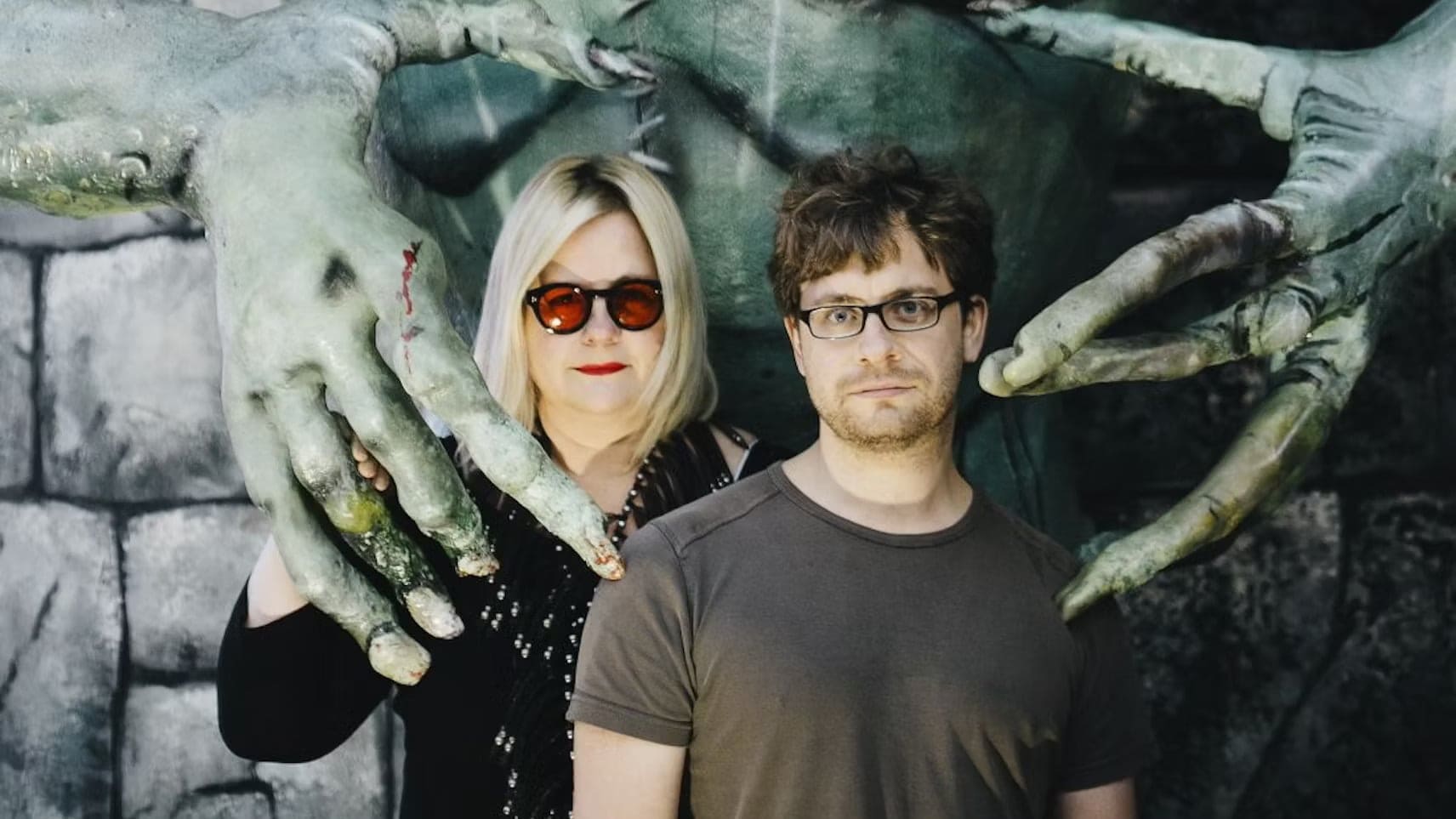
Given that the previous two films by the Austrian aunt-nephew directing duo of Veronika Franz and Severin Fiala are 2015’s Goodnight Mommy and 2020’s The Lodge, it’s only natural to watch their latest feature, The Devil’s Bath, with the constant expectation of some terrifying other shoe to drop. But while there are plenty of stomach-churning sights and sounds here, the scares come less from the filmmaking and more from society itself in this tale that examines the 18th-century phenomenon of suicide by proxy.
It may not be a horror film, but this gripping historical drama feels entirely in keeping with Franz and Fiala’s previous work. What ties their films together is an astute analysis of the strange brew of emotions women face when forced to enact rigid roles of gender performance. For Anja Plaschg’s Agnes, that confinement comes in the form of a loveless marriage, extensive responsibilities on her small farm in the Austrian countryside, and a strict religious culture that downplays the extent of her depression as something stemming from the devil.
With no remedy in sight for her melancholy, Agnes begins contemplating suicide by proxy. Since the church’s teachings enforced that taking one’s life guaranteed damnation, many people at the time pursued a loophole to achieve the same ends. By killing a baby they believed was otherwise pure of sin and guaranteed salvation, they sought justification for an act that would guarantee capital punishment for themselves. Franz and Fiala’s film never seeks to excuse or exonerate this unholiest of two-for-one entry deals into heaven. Instead, their patient lens looks to explain how such a horrifying act has deeply human roots.
I spoke with Franz and Fiala ahead of the Shudder release of The Devil’s Bath. Our conversation covered how Agnes’s struggles relate to the present world, what their historical research contributed to the film’s texture, and why they believe they made a deeply feminist work.
Editor’s Note: The first question discusses the ending of the film.
I feel like we have to start with the final scene in The Devil’s Bath, which is such an unexpected and emphatic capper on the film that’s otherwise so intensely locked into the subjectivity of Agnes. What led you to broaden your gaze and leave us with the image of how the village reacted to suicide by proxy?
Severin Fiala: As Agnes is leading a very quiet life without much fun, we somehow laughed at the absurdity of the whole thing ending in a huge party inhabited by the same people and the same musicians who also came to her wedding. That absurdity somehow spoke to us.
Veronika Franz: The other point was that it’s true to history. Because they had no other distractions at that time, executions would be village fairs with clowns, beer, and dancing.
SF: The whole phenomenon the film is talking about is a rather difficult, contradictory one—and very hard, I think, for audiences to wrap their heads around. We also wanted to leave the audience with an ending that’s emotionally difficult to comprehend. We could say, “Is it unhappy or a happy ending?” The character gets what she was hoping to achieve throughout the film, and for her, it’s actually a happy end. But still, I think, it’s sad. The whole village is having this huge party and really enjoying the tragic end of this woman. It makes the audience also aggressive in a way, which, in its contradictions, seems interesting.
VF: In Austria, we don’t have executions anymore. But still, if you have Catholic funerals, there’s the tradition of having a kind of a party afterward. At least, you share a meal, and I think this is also a tradition here in the States. At least it’s in the movies! [laughs]
Does the thin line between tragedy and spectacle feel like a historical precursor to society’s attraction to horror cinema?
SF: I’ve never thought about it like that, but it’s a very good and very interesting question. I think what’s different is that horror cinema has the power to confront an audience with pieces of society. Those films can hurt you, but still, you know it’s fake and you’re safe. There, you went for the spectacle of actually seeing somebody die. There might be some relation, but we like our horror cinema best when it doesn’t actually kill people!
I might as well wrap back to the beginning of the film now. It was striking how the audio cuts out at the moment of infanticide as well as during a later scene of death. I’ve read you have a philosophy of violence where “if it could happen in the real world, show it.” How does sound play into your conception of violence in cinema?
SF: Sometimes it comes out of an approach to film what we feel is realistic. So if you would hear the baby hit the stone and it’s realistic, then that’s something a movie would do. But you would not ever actually hear it. We shot on this actual waterfall, and it’s loud—
VF: So loud!
SF: We could not even communicate, even by shouting at each other, because the waterfall is deafening. You would never really hit the rocks, so I think that was due to a certain sense of naturalism. When it comes to the murder that occurs later in the film, the screams are actually loud if the film is watched at a proper audio level. The sound is basically destroyed. It’s too loud. The screams start to crumble, which is greatly adding to the pain that the audience feels in this moment because it’s a physical way of making the audience feel even more unpleasant.

VF: Generally, when it comes to sound, we are fans of silence and not adding too much artificial sound or sound effects. When we shoot the movie, we really try to protect the original sound as much as possible. Later in finishing the movie, we try to use the original sound. The second murder, there’s nothing dubbed. It’s original sound.
SF: Like Veronika said, we like silence. I think it’s also about doing something that’s unexpected. In most films now, they overdo the sound design or the sound layers because they don’t want the audience to feel bored. Actually, with us, it sometimes does the opposite because it’s just too much and always the same. It tires us. These moments of silence are very unexpected. At those moments, you’re not sure how to feel and react. Those moments are interesting to us.
VF: We were really surprised when we saw A Quiet Place. We really like the movie, but we were surprised at how loud it is! [laughs] There’s nothing quiet about it.
SF: It could have been really thrilling if it was super silent throughout the movie, with no soundtrack and nothing. It’s just called A Quiet Place, but it’s not.
You like to work in an improvisational manner with your actors. How does that change in a period setting?
SF: It’s more difficult, certainly, but we tried to prepare our actors like David [Scheid], who plays the husband, and Maria Hofstätter, who plays the mother-in-law. They went together to some very rural farm to work and spend time together because Maria comes from a farming background. She’s very knowledgeable about language and how they spoke back then. They trained together and tried to get into that space. We are trying to make everything like the houses and the costumes as real for the actors as possible. They were also actually living in those houses. They were wearing the costumes for weeks and weeks in order to get them to feel everything was basically normal. Same with the language.
VF: We gave them a short vocabulary book where we put together old words we found.
SF: For us, it was more important that it felt natural than that the language was 100% accurate. I think it should feel lively. There’s nothing gained if people think they’re watching a museum piece. They should be able to relate to the characters and the way they talk and behave. Even if there are slight words or things that are not 100% accurate, we would ignore that if it felt alive.
VF: You have to be aware that nobody knows how the farmers spoke at that time. We have these court protocols, and there was a writer who wrote their words down. We have an idea of how they talked, but there are no written sources about how farmers at that time spoke. We decided to give them a strong rural dialect. Even Germans wouldn’t understand them because it’s very Austrian. That’s what we decided, because the rural dialect wouldn’t change much for centuries.
SF: More important than these accuracies or inaccuracies for us was is that the film is something that still is relevant today. It’s about depression, which is still a huge issue and taboo in many areas of the world. It talks about a woman suffering from perfectionism, and always thinking she can never be good enough, which is also something that’s very common. It’s about the pressure that was put on our characters by religious dogmatism and the church. Those have shifted, of course. At least in your county, and in ours, it’s not the church anymore. But it’s different forces that put pressure on people to always function. And, if they don’t, it’s still a taboo to talk about people who are not functioning.
VF: [Non-functioning people] are then outsiders.
SF: We haven’t gotten much better at accepting people who are different. We always talk about it, but we just divide people in smaller and smaller groups. You have to be part of this group or that group, and you must never go from this group to a different group. Still, I think the ultimate goal would be to just accept every other human as a being that’s as important as yourself.
VF: It feels strange because there are more groups now, but it’s more black and white! [laughs]
SF: It makes life unnecessarily difficult, we feel. People mean well, but I think that’s what our films also talk about. It’s not that there’s one evil person whose fault the whole thing is. It’s just a society that puts pressure on people. And then those people all mean well—sort of—and try to navigate through a pressure that they cannot control. The whole social construct is beyond them. In this construct, they try to behave as well as possible, but they still hurt each other. I think that’s as true nowadays as it was in the 18th century.
Do you see your films—at least the previous three narrative films—as part of a larger conversation with each other?
SF: I think we’ll always go after what we’re interested in, and naturally, the same issues and things seem to come up. The aspects with society, as I said before, are putting pressure on everybody. This is creating tragedies without anybody specifically being evil. This is a reoccurring theme because it’s still going on, and nothing has changed for the better in the world we live in. So we still need to talk about it.
VF: We always think about families because it’s the smallest cell of society. You can look at it very closely and carefully to try to understand what’s going on.
SF: You can talk about society in an easier and more abstract way, in a sense. It just strips away everything unnecessary, we feel.
You mentioned some of the historical texts, or that there wasn’t necessarily a ton for rural life. But there were texts of the interrogations of people who took place in the suicide by proxy, and that the interrogators were oftentimes really obsessed with determining what the motives were. Was that something that you hoped that the film could provide a little bit more of the why?
SF: I think what we wanted to say, and hope the film does too, is that there is no why. Or, at least, there is no why that’s a one-word answer. For the reasons we gave before, there is like no one whose fault this whole thing is. It’s how society treats the people living in it.
VF: We also wanted to paint a truthful picture of what it means to have depression. It might have a final trigger, but there are lots of reasons for this disease. There’s not one “why.” It came to my mind that we consider it a feminist film because it also talks about women not only being victims maybe of their times, but also being murderers. We think this is interesting. But we have been asked by feminists why, if there were also men who did that, why [depict only] women? Besides the fact that there were more women, two-thirds, we find it more complex to tell something about feminism. And we’re not interested in this one picture of women who can be bosses or who can be successful. Of course they can. Of course, they should be in movies…
SF: …but they should be allowed shades of grey as every relevant movie character is. I think it’s not feminist to just show women as heroes or victims. Everything in between and all the shades of gray are necessary to be truthful. At least, that’s how we see feminism in films.
That ties back to what you said earlier about the dangers of overemphasizing easy, individualistic solutions in the face of society-wide problems. Another shared commonality between our countries is knowing the experience of people who use that kind of language and the dangerous path it can lead us down.
SF: Yes, exactly, that’s very scary. We’re living in scary times because people who use the language seem to mean well. I think we need to be aware of that. If somebody tells you, “You need to be either that or that or that, otherwise you’re not relevant or not allowed to do what you set out to do,” that’s always a dangerous tendency no matter from which political direction it comes. I think we all need to accept all other human beings as equally important, free, and talented as we are. That’s the only way of living together.
Since 2001, we've brought you uncompromising, candid takes on the world of film, music, television, video games, theater, and more. Independently owned and operated publications like Slant have been hit hard in recent years, but we’re committed to keeping our content free and accessible—meaning no paywalls or fees.
If you like what we do, please consider subscribing to our Patreon or making a donation.