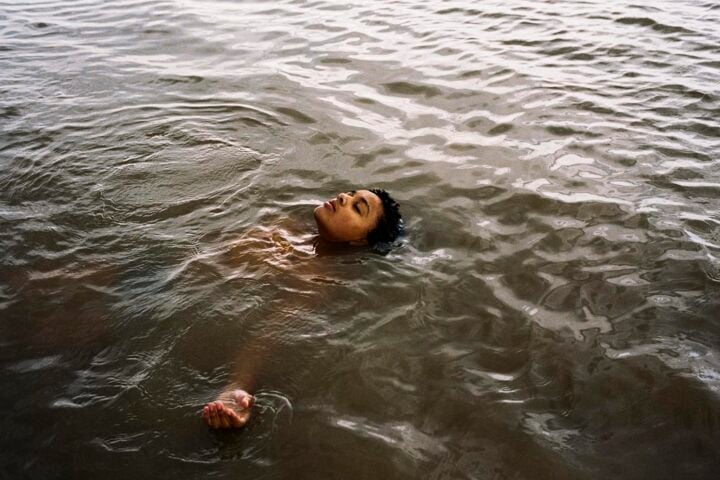
With Cow, Andrea Arnold plays up cinema’s remarkable ability to express senses such as smell and touch out of its inability to provide a direct experience of them. From the start we’re in the domain of the viscous. The very first sequence captures the birth of a calf, swaddled in an organic mantle of milky film, pulled from the mother out into the camp of horrors otherwise known as a dairy farm that will be its home. The calf is so stunned by the discovery of the world that it looks as though it may already be dead.
But not so fast. Automated contraptions, cages, and burning irons await this and other animals. The viewer remains in the haptic register of gooey and grimy substances (dripping udders, slimy tongues, soiled skin, muddy hooves) throughout, as the camera rarely leaves the vicinity of cows’ bodies, particularly their faces. And all the while, humanity is reduced to that which—slowly and almost perversely—only invades, instrumentalizes, and kills.
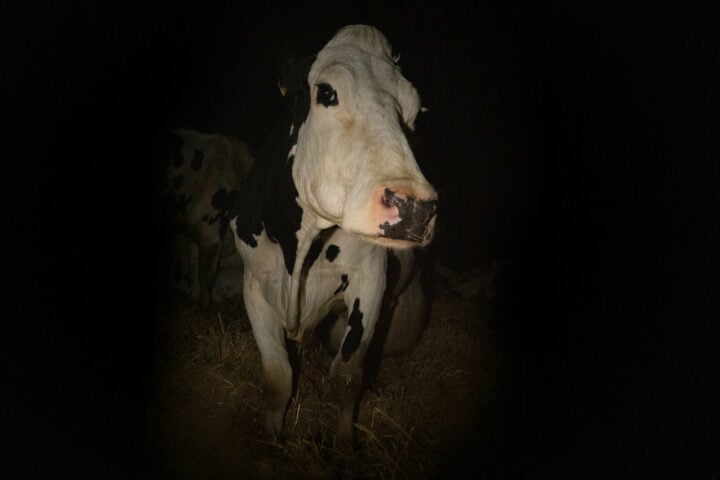
The focus on the cows’ bodies, which tend to take up the entirety of the frame, along with the traces of their violent relations with their environment, brings out the animals’ sensibility, perception, sentience. The presence of human beings is felt through their disembodied voices and the naturalized cruelty of their actions. At one point, a man sticks a thick needle into a cow and says, “Good girl.” Arnold builds the portrait of beings trapped in the most horrific forms of waiting—for death, surely—little by little, avoiding the animal rights didacticism of many well-intentioned but less than cinematically compelling documentaries.
Throughout, the lingering camera gaze, whether fixed or moving, is interested in one thing and one thing alone: a cow’s face, which stares back at the lens and, at times, moos at it. In the process, a kind of affective connection is formed between animal and the cinematic apparatus—the kind that the slickest drone shot would, of course, never manage to capture.
In Cow, the camera has character, a vision, and maybe even an argument, though it’s one that we aren’t completely sure of. Or, in any case, it’s one that doesn’t beat us over the head. Unlike films that are much more obviously interested in delivering a useful message through the recognition of an animal’s torment, such as Victor Kossakovsky’s Gunda, Arnold’s more mysterious documentary forces us to keep looking and find out what exactly the cows want to tell us through the placidity of their gaze and, by extension, the camera’s own.
Since 2001, we've brought you uncompromising, candid takes on the world of film, music, television, video games, theater, and more. Independently owned and operated publications like Slant have been hit hard in recent years, but we’re committed to keeping our content free and accessible—meaning no paywalls or fees.
If you like what we do, please consider subscribing to our Patreon or making a donation.