Deadpan stoicism has become the default mode of the Greek Weird Wave. Though equally strange, the wavelengths of the films by such proponents of the movement as Babis Makridis, Athina Rachel Tsangari, and—before vaulting to Hollywood’s big leagues—Yorgos Lanthimos don’t always align. But there’s a sense of cold, wry detachment that informs the way in which these works probe the friction between human nature and nurtured civility.
The Greek Weird Wave movement’s films are inseparable from their constituent tropes. Many of them set out to concoct visions of a society where human society is seen merely as unhinged, irrational, or paradoxical. That’s not an untrue observation, but it doesn’t help that the experimental potential afforded by absurdism squanders itself so easily by way of uninspired and hackneyed reiterations of the tropes and conventions that define the movement.
Arcadia, Yorgos Zois’s second feature following 2015’s Interruption, isn’t simplistic. Indeed, it lays the groundwork for a sleight of hand from the get-go in ways that both unnerve and impress, but it’s sense of narrative withholding outlives its usefulness as a conceit for the way it gates a correspondingly intense sense of emotional intensity from the audience.
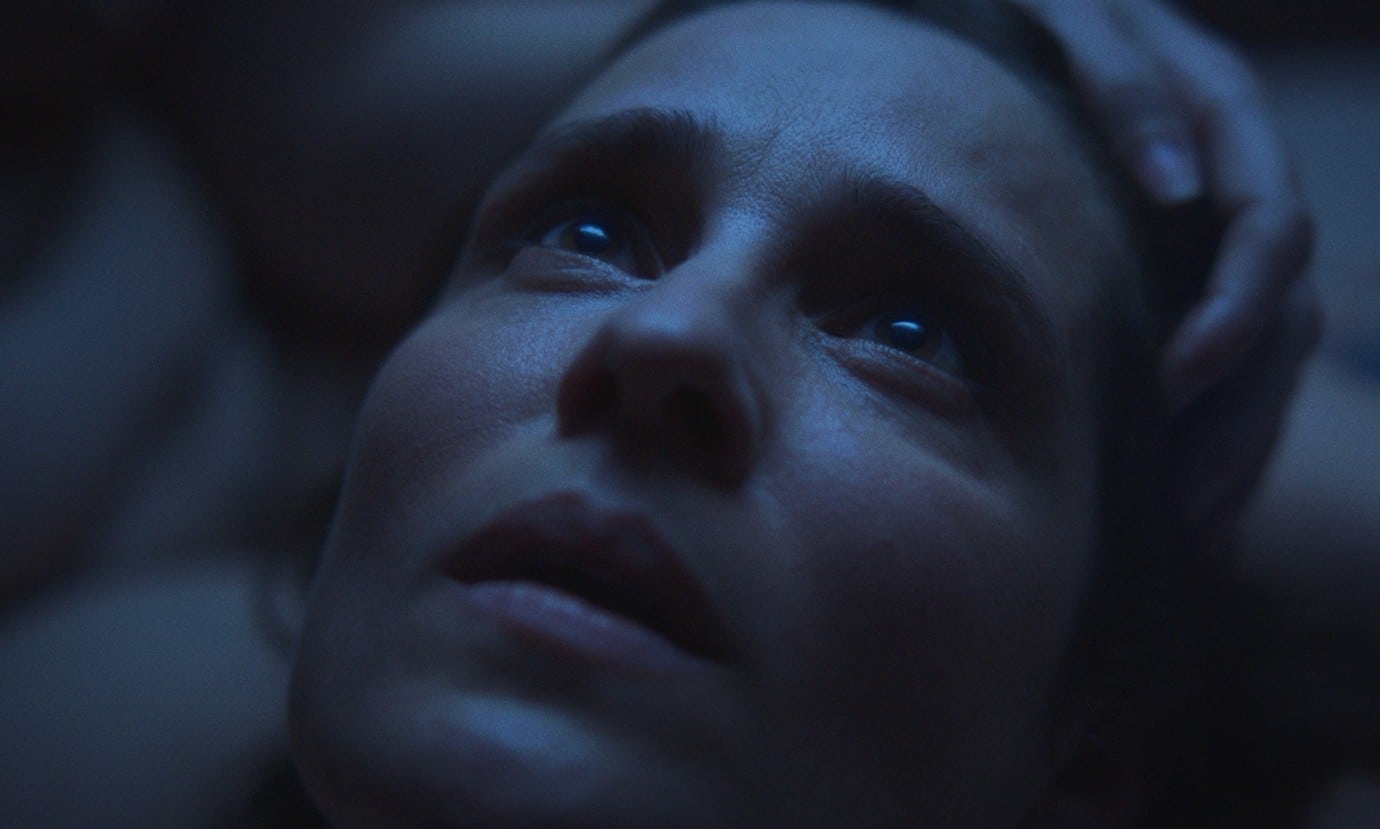
The world of Arcadia, which takes its name from the titular mountainous region of Greece, feels close to our own, but the blue-gray sheen of its palette is an immediate tip-off that we’re also in the realm of the uncanny. The film opens with a couple traveling to destinations unknown. The woman, Katerina (Angeliki Papoulia), lies asleep in the backseat of a car, while the man, Yannis (Vangelis Mourikis), drives in silence. Their faces are gripped by mute sorrow, and as Konstantinos Koukoulios’s camera homes in on Katerina’s sleeping visage, she awakens, gasping, and it cuts immediately to a shot of Yannis retching outside the car.
After arriving at a hospital, the couple stand before a person’s body in the morgue, but the camera is positioned in such a way that we don’t see the body’s face. Outside in the hallway, a policeman (Vangelis Evangelinos) addresses the couple but only Yannis responds to him. The fact that Katerina doesn’t is an odd touch, but credible given the already established silence that lingers in the air between her and Yannis, rendering their grief even more plausible within the scene’s context. Arcadia’s muted palette sharply contrasts its characters from their surroundings, foregrounding them as figures sunk deep in a shared depressive torpor.
Once the origins of this torpor is revealed, we understand the film to take place in the realm of the metaphysical and supernatural. Arcadia is a symbol of harmony and pastoral simplicity in Greek mythology, but as envisioned by Zois’s film in a modern-day context, it’s a place defined by a disquieting stillness. Here, the living and the dead live side by side, and when Yannis and Katerina play a visit to a coastal tavern in the wake of their shared tragedy, both attempt to come to terms with the inexpressible isolation it has wrought for them. Throughout their stay, numbness and stasis reign despite their best efforts to arrive at some semblance of truth, but that truth, the film implies, has no use for a world shorn of meaning.
In Arcadia, it’s the living who haunt the dead, rather than the other way round. The dead here are projections of those who cannot let go. And once we know as much, and notwithstanding its psychoanalytic implications, the film proceeds as a straightforward meditation on how grief, prolonged and without resolution, works to sap souls quite literally out of people’s bodies.
Zois imagines the tavern in the vein of the river Lethe, where the dead are denied oblivion and have their memories restored; those still alive and haunted by the past, meanwhile, try to drink their sorrows away. In literary visions of the pastoral, the specter of death often haunts idyllic landscapes. “Et in Arcadia ego” uttered Death itself in Virgil’s “The Eclogues,” but Arcadia reconstitutes its titular dominion as a space for the dead, intruded upon by those still living.
Much of the film’s intrigue stems from this metaphysical conceit alone, drawing the viewer into its oneiric world by virtue of arresting juxtapositions: between the living and the dead, between freedom and between inhibition, and between holding on and letting go. But Arcadia banks on juxtaposition alone without quite delving into more fertile terrain, risking little and failing to develop its themes beyond basic talking points. The result is a work devoid of the pathos that made, for one, Andrew Haigh’s All of Us Strangers so piercingly memorable.
Even if settling for mundanity were the goal here, Zois eschews kitsch for overbearing solemnity, acute emotion for the inoffensively ambiguous. The way the story hinges on a conceptual fulcrum and seeks to preserve the audience’s surprise above all else effectively means that the screenplay by Zois and Konstantina Kotzamani makes little room for psychological interiority. The film’s great realization, perhaps, is that trying to rationalize death proves almost as difficult as exorcizing it, but equally conspicuous here are Arcadia’s most enervating scenes, which project onto the living paroxysms of melancholia and little else.
Since 2001, we've brought you uncompromising, candid takes on the world of film, music, television, video games, theater, and more. Independently owned and operated publications like Slant have been hit hard in recent years, but we’re committed to keeping our content free and accessible—meaning no paywalls or fees.
If you like what we do, please consider subscribing to our Patreon or making a donation.