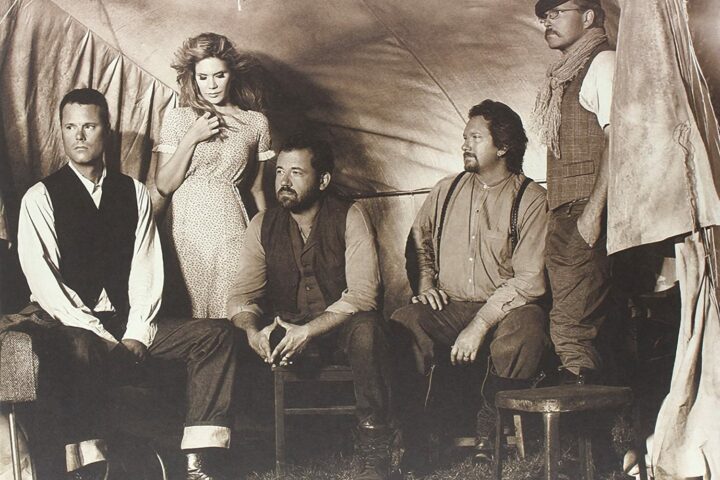
When Robert Plant and Alison Krauss met by chance in 2004, they were amazed to discover how perfectly the Led Zeppelin singer’s desert-rock grit complemented the contemporary bluegrass icon’s delicately exact soprano. Raise the Roof employs many of the same elements as the duo’s critically acclaimed 2007 album Raising Sand—blissful harmonies, gender-swapped covers of love songs, hazy folk atmospherics—but with an increased attention to the cultural history of the songs they’ve selected.
Contrary to what the album’s title might suggest, Plant and Krauss’s default mode on Raise the Roof is to slow down, swapping the expected runs and wails of soul and blues for the gauzy, serene harmonies that they honed on Raising Sand. The consistency and plaintiveness of their approach render the album cohesive but at times less dynamic than its predecessor.
Whereas New Orleans soul singer Betty Harris’s impassioned performance gives weight to the lovelorn lyrics of her 1968 song “Trouble with My Lover,” Krauss’s hushed timbre draws attention to the flatness of lines like “I feel so helpless/I can’t help myself.” Compare this cover to Raising Sand’s quiet and wistful “Stick with Me Baby,” where the dreamy intimacy of Plant and Krauss’s vocals brilliantly undercut the defiance of the Everly Brothers’s lyrics.
Most of the time, though, Raise the Roof’s arid serenity works, and it unifies songs drawn from a wide variety of musical traditions. On Raising Sand, this historical interest was most evident on “Sister Rosetta Goes Before Us,” a direct tribute to rock pioneer Sister Rosetta Tharpe. Whereas that album consisted of songs mostly by prominent American rock, country, and folk musicians, Raise the Roof digs deeper into folk and rock traditions, highlighting songs by English and Scottish folk musicians from the 1960s and ’70s, as well as lesser-known black American blues and soul artists dating back nearly a century.

The oldest song covered here, Elvie Thomas and Geeshie Wiley’s “Last Kind Words Blues,” was originally released in 1930. It’s haunting not only for its tragic lyrics, but also because it illuminates just how little is known today about the pioneers of rock and Americana. As part of Led Zeppelin, Plant drew inspiration from the blues, though the ethics of the band’s espousal of the blues canon are still hotly contested, while Krauss is known primarily for her renditions of traditional bluegrass songs. Raise the Roof’s thoughtful song selection reaches beyond their immediate musical legacies, revealing the roots of their influences.
This principle informs the structure of the album as a whole, which consists almost entirely of love songs, save for opener “Quattro (World Drifts In).” The foreboding Calexico cover has the broadest thematic scope of all the songs on Raise the Roof, with lyrics about loneliness and moral disorientation. It’s also the closest that the album gets to overt political commentary before Plant and Krauss pivot sharply to a cover of “The Price of Love.” The song hews closely to the signature misty sound of Raising Sand, replacing the bluesy drama of the Everly Brothers original with subdued tension.
Raise the Roof stays on this course until “Searchin for My Love,” which is a welcome change of pace due, in part, to Plant and Krauss’s retention of the Bobby Moore original’s Motown-style backing vocals. While the ’60s soul style might have clashed with the cover’s country guitars, Plant’s gravelly vocals and Krauss’s precise harmonies imbue the song with a tender beauty. Even the darkly imagistic Plant original “High and Lonesome” fits well next to the Krauss-led Merle Haggard ballad “Going Where the Lonely Go,” forming the album’s emotional peak. Raise the Roof could have emphasized the differences between its many musical differences, but instead, Plant and Krauss unify them.
Since 2001, we've brought you uncompromising, candid takes on the world of film, music, television, video games, theater, and more. Independently owned and operated publications like Slant have been hit hard in recent years, but we’re committed to keeping our content free and accessible—meaning no paywalls or fees.
If you like what we do, please consider subscribing to our Patreon or making a donation.