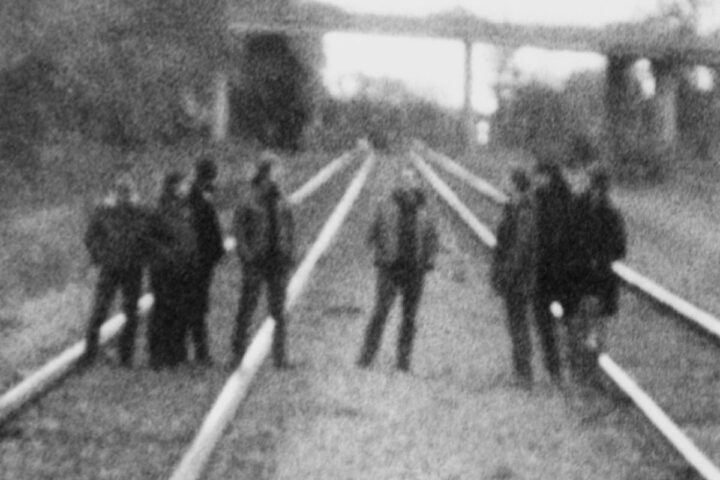
Spitting in the face of the “lone genius” myth that continues to plague art discourse, Swans is a far more collaborative entity than they’re usually credited for. The ever-shifting band can be compared to a brotherly pact of sorts, one forged between whoever happens to exist within frontman Michael Gira’s orbit at the time—or, more accurately, the musicians tasked with interpreting and executing his uncompromising vision.
This communal approach has allowed for much musical flexibility, but since its reformation in 2010, Swans has largely stuck to baroque, 10-plus-minute compositions that start off in D minor, get increasingly louder, then peter off with a few minutes left to spare. Which, to be clear, has produced some of the most bracing rock music of the past few decades, specifically the awe-inspiring one-two punch of 2012’s The Seer and 2014’s To Be Kind. But after those seismic releases—along with 2016’s drone-heavy The Glowing Man and 2019’s leftfield Leaving Meaning—you may wonder what territory Gira and company really have left to cover.
The Beggar doesn’t offer an immediate answer to that question, as it proceeds in the same white-knuckle way as the group’s last four releases. It is, though, defined by the quality and craftsmanship that’s expected of Swans. “Los Angeles: City of Death” kicks off with a fraught rhythm section that slowly intensifies throughout the track’s turbulent three minutes, and ends with Gira’s ghoulish instructions to “run” from encroaching evil. Gira clearly understands the transcendent power of blunt-force repetition, and at the end of “The Parasite,” he muses with an otherworldly menace, “I wonder how we got here, I wonder if I care/I wonder if your breathing is stealing all the air,” before repeating “breathing in, breathe us in.”
As a bit of a reprieve from the overwhelming doom and gloom of tracks like “Why Can’t I Have What I Want Any Time That I Want?”—which opens with an especially devilish Gira querying, with several pauses added for dramatic effect, “When will time…erase…this stupid smile…from my face?”—the jingly “Michael Is Done” and “Unforming” move toward the stylings of Gira’s more folk-oriented band Angels of Light. Their inclusions prove that Gira is a formidable songwriter in really just about any guitar-centric context. On the former, he weaves a free-associative tale of Michael, the personification of “grid on the sun” and “the hate in the love,” while on the latter he reflects on his mortality: “There’s someone inside me, but it’s not really clear/It seems that I’m changing, but I’m not really here.”
What stops The Beggar from reaching true greatness is how it stands in the shadow of Swans’s recent albums. “Paradise Is Mine” starts off ominously enough but ends up following the same basic chord progression as 2014’s more electrifying “A Little God in My Hand.” Likewise, the nearly 44-minute “The Beggar Lover (Three),” a track that follows in what’s now become a Swans tradition of inserting a massive behemoth somewhere in their albums’ midsections, suffers in comparison to similar tracks like “The Glowing Man” and “The Seer.”
Those earlier songs are precise exercises in mounting pressure followed by a cool-down. “The Beggar Lover (Three),” on the other hand, peaks early—in this instance, that’s the 13-minute mark—with a gonzo, high-pitched musique concrète section that sounds straight out of a horror movie, while the rest of the track’s remaining half-hour feels too fragmented to ever command the sense of epic-ness that its drawn-out runtime strives for. Like so much of the material on The Beggar, its grandiosity has become slightly predictable—which, for a band of this stature and artistry, might just also be the most damning critique one could lob their way.
Since 2001, we've brought you uncompromising, candid takes on the world of film, music, television, video games, theater, and more. Independently owned and operated publications like Slant have been hit hard in recent years, but we’re committed to keeping our content free and accessible—meaning no paywalls or fees.
If you like what we do, please consider subscribing to our Patreon or making a donation.