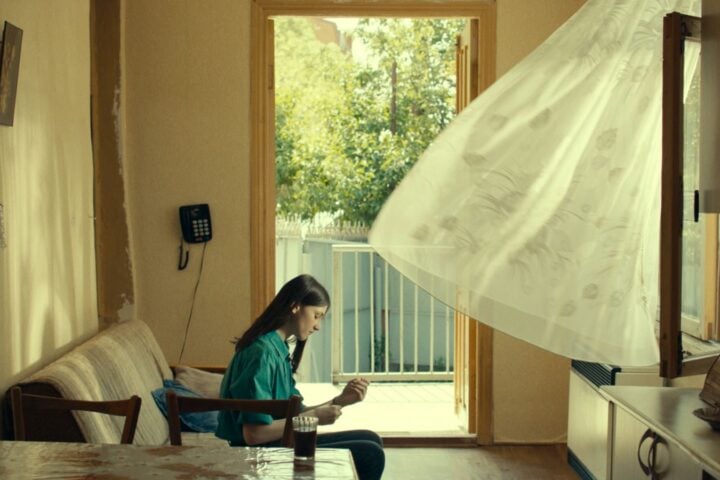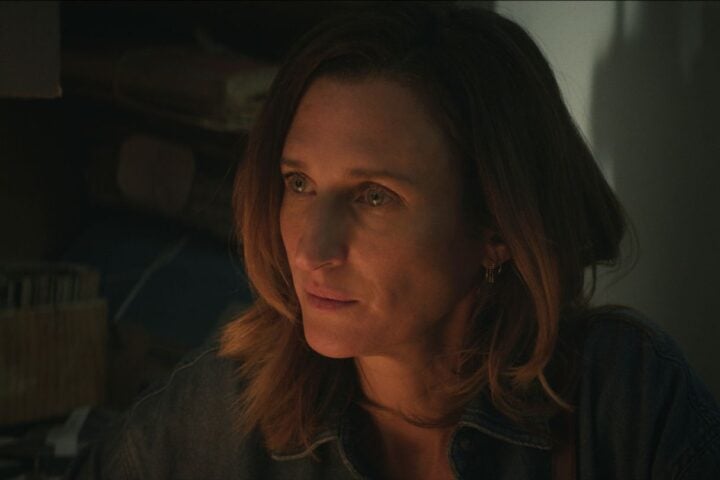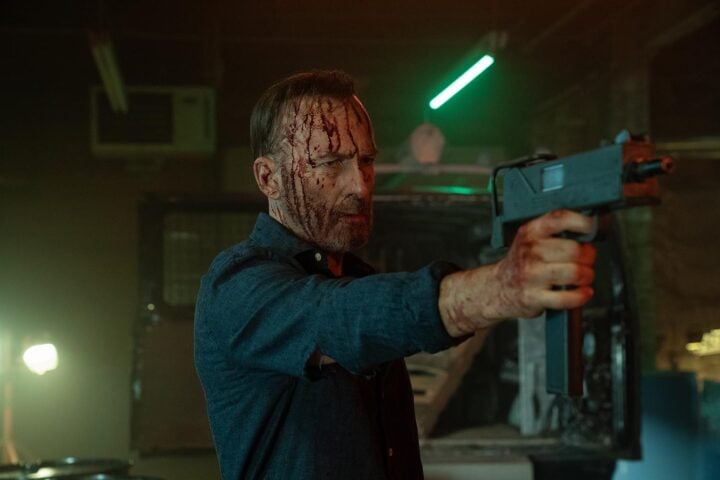
Alexandre Koberidze’s 2021 film What Do We See When We Look at the Sky? made thrifty use of one of cinema’s earliest and most mind-expanding special effects: our own imagination. The film literally, by use of title cards, asked audiences to close their eyes and simply accept that the two main characters had magically changed their looks to be unrecognizable. This game of pretend is admittedly a great way to keeping a budget in check, and it thankfully added a bizarre, childlike charm to the film’s already elliptical magical-realist narrative. Now, with Dry Leaf, Koberidze deploys an even more mischievous gambit.
Lisa, a photojournalist, was supposed to travel around the Georgian countryside and take pictures of rural football fields, but her editor at Skhivi, a sports magazine, hasn’t heard from her for some time. Most editors have resigned themselves to working with writers prone to disappearing in the middle of an assignment, but, then, her editor isn’t her father. Her parents have received a letter telling them not to worry about what will be a prolonged absence. Her father, Irakli (David Koberidze), comforts himself with the knowledge that Lisa has disappeared before in an adolescent’s bid for independence, but, just in case, he sets off to follow her trail.
After this half-hour-long setup, the majority of Dry Leaf’s remaining two-and-a-half-hour runtime is dedicated—beyond fixating on roads, flora, sunsets, goalposts, fields, mountains, and fog—to short vignettes of life in small Caucasus villages while Irakli and Lisa’s friend Levan (Otar Nijaradze) wander around looking for any clues to Lisa’s whereabouts. And while Lisa’s disappearance has made Irakli a bit anxious, the fact that over half of the people in the film, including Levan, are literally invisible doesn’t seem to bother him much.
Disembodied voices of children lead Irakli to another field while shots of an empty passenger seat fill the screen when the bodiless Levan speaks. These aren’t ghosts, nor does any character even mention that these people are invisible. They’re just like anyone else, but their non-presence adds to the sense of barrenness of Koberidze’s magical-realist world.
Speaking of invisible things, most times it’s difficult to make out what exactly is in the frame. Dogs and other animals are indistinguishable until they’re nearly next to the camera. Interior shots backlit by the sun render every character into a harsh silhouette. The landscape’s natural contour lines are a blur, and oxide-red fields blend into the gray-gold hills behind them.

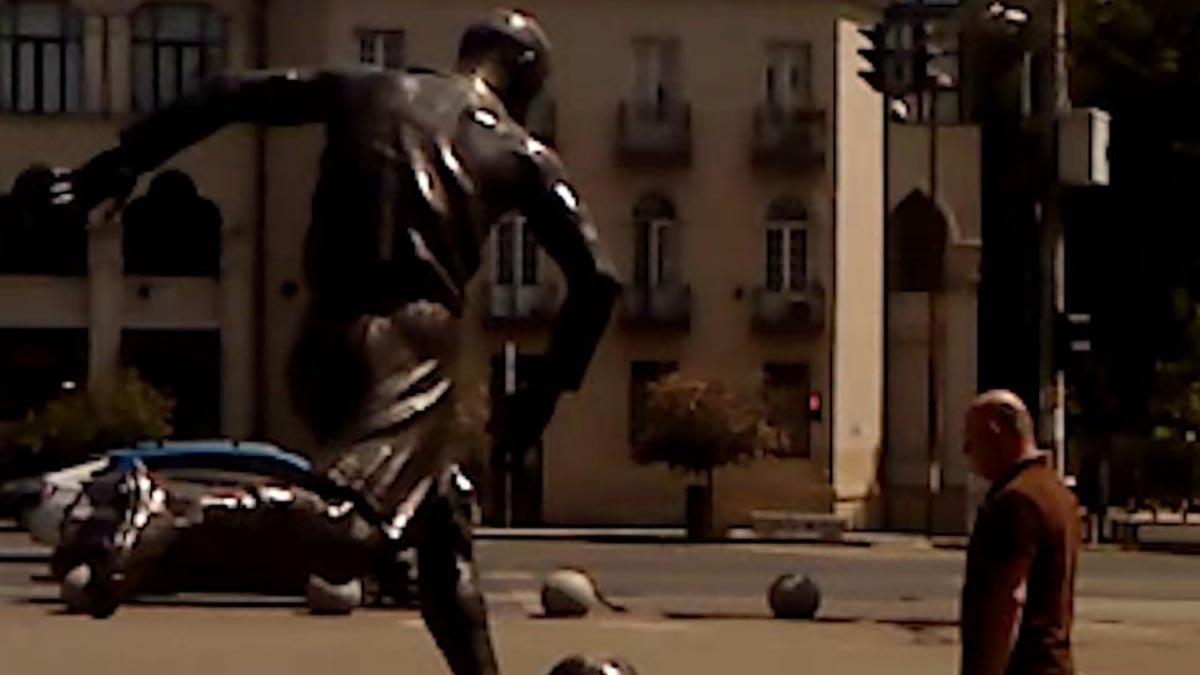
This is all by design, as the entire film was shot on a Sony Ericsson phone, one likely from the mid-2000s, which saves its video files with extremely lossy compression, resulting in chunky digital compression artifacts (called DCT blocks) that obscure most of what’s on screen, especially if it’s moving, and especially at night. It’s difficult to reacquaint oneself with such images after thinking the days of 144p Flash files and YouTube videos were a thing of the past, and it’s more than a little infuriating to see the fog-dappled Georgian countryside, so masterfully framed by Koberidze’s camera, reduced to a few countable pixels on screen.
But the film’s aesthetic becomes increasingly mesmerizing. Since we come across this form of compression so rarely these days, Dry Leaf’s tableaux are impressionistic in ways that recall the plein air landscapes of Claude Monet. But when the figures within the frame move, they resemble the globs of color and lines in a J.M.W. Turner seascape. Koberidze’s film is at its most hypnotic during such moments of near-total abstraction, like when the sudsy water applied during car wash dances along during the drying cycle or trees moves in the wind. Koberidze reminds us that not seeing is sometimes a way of seeing the world differently.
By the time Irakli returns home after his failed journey, the case of Lisa’s disappearance is immediately resolved, almost as an afterthought. Dry Leaf cares little for our investment in its MacGuffin, as evinced by Irakli’s casual strolling through football fields and his patient conversations with children. This is par for the course for a festival-bound work of slow cinema—that is, one that never aspired to be the next Taken or Laura. The bold, alternately solemn and upbeat, arpeggiating score by Giorgi Koberidze makes plain that this isn’t a film interested in generating tension around a missing loved one. Perhaps Irakli knew that Lisa would be fine all this time and was simply looking for an excuse to leave the house. “Seeing the same things, even if not at the same time,” he reflects, “is a kind of togetherness.”
With Dry Leaf, Koberidze tasks his audience with filling in empty stretches of the screen space with, among other things, kids at play, and with seeing wild dogs in the distance of a shot in compressed blocks of data. Its tour of abandoned Georgian football pitches, with their overgrown fields and rotting goalposts, evokes a sad tale of poorly attended games—of a world left behind. But, then, near the end of the film, Irakli asks a group of invisible children, after learning their football field is being converted into a new hotel, where they’ll play, and they say, “Everywhere.” That word acts as a final counterpoint to Dry Leaf’s imagery—a casual hope that mirrors what the film expects from us as viewers: to imagine recreating the world.
Since 2001, we've brought you uncompromising, candid takes on the world of film, music, television, video games, theater, and more. Independently owned and operated publications like Slant have been hit hard in recent years, but we’re committed to keeping our content free and accessible—meaning no paywalls or fees.
If you like what we do, please consider subscribing to our Patreon or making a donation.