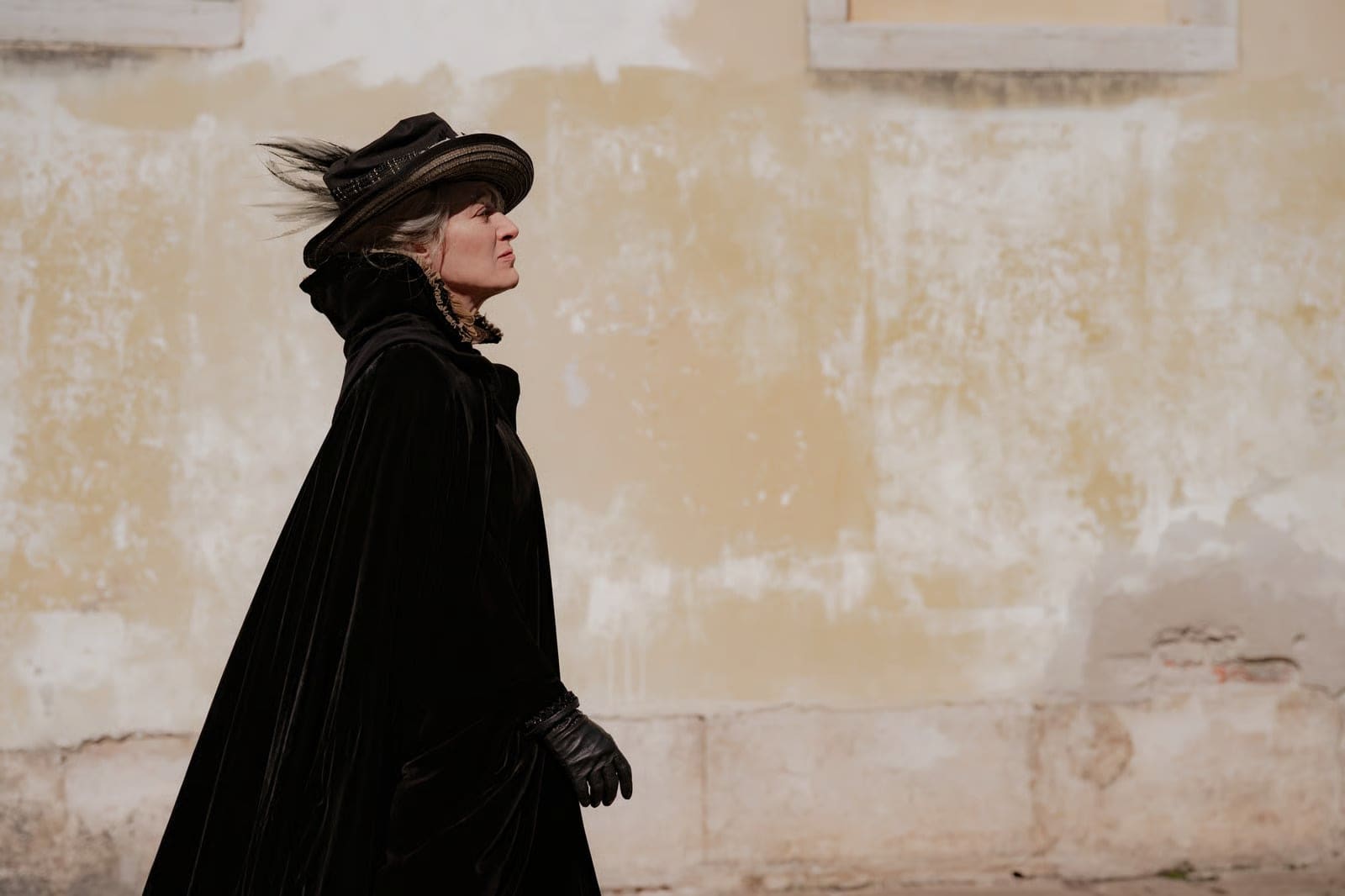
The title of Pietro Marcello’s Duse may refer to Eleonora Duse (Valeria Bruni Tedeschi), the great fin de siècle Italian stage actress, but the film isn’t just a portrait of the artist’s life. Marcello trenchantly examines the value of art itself. Duse is in the third act of her life at the start of the film, and as Italy emerges from the Great War, the actress believes she can contribute to lifting the national mood. Rather than acknowledge the conflict’s lingering effects, she attempts to turn back the clock by helping reset cultural tastes to their previous baseline.
Duse loiters about in some of this expository table-setting as the actress mounts the revival of a play by Henrik Ibsen, the playwright whose work helped put her on the map. Marcello’s script, co-written with Letizia Russo and Guido Silei, gives center stage in these early sections to establish the artist’s prowess. Even in these thematically meandering sections, Bruni Tedeschi always compels with her embodiment of Duse’s skilled craftsmanship, which is so precise in rehearsals that it masks just how out of sync her barometer for the public’s appetite is.
The film kicks into high gear when the immovable object that is Duse meets the unstoppable force of Sarah Bernhardt (Noémie Lvovsky). In the dim afterglow of the less than triumphant opening night performance of Duse’s production, her French archrival, who was also dubbed “The Divine,” asserts that the continent’s mood has irrevocably shifted following the war. Her observation comes with a warning: Duse can either adapt to a present reality where grief lingers and fascism looms, or she can become a relic of history.
It’s in this moment that the true purpose of the film snaps into focus, pushing aside subplots about Duse’s ailing health and her strained relationship with her daughter (Noémie Merlant). Marcello seeks nothing less than to question, alongside his subject, what the role of the artist can and should be in a society teetering on the verge of an authoritarian takeover. In Duse’s time, this concern was even more acute given how Benito Mussolini’s fascist movement co-opted the grandiloquence of dramatic arts to sell a different kind of fiction to the people.
Duse acts as if she’s operating on borrowed time, and Marcello takes his charge no less seriously in also meeting the moment urgency. After all, the far right isn’t just at the door in contemporary Italy, it’s in the highest seat of power. Marcello argues a powerful thesis for the importance of art by presenting its antithesis. He first thoroughly debunks the actress’s delusions that an enraged populace’s proclivities could be reset to their previous status after enduring a psychic shock like war. Then, he shows the impossibility of trying to bargain with a fascist regime in a literal conversation between Duse and Il Duce (Vincenzo Pirrotta) himself.
Duse’s repeated references to creating a new Athens within Italy provide a crucial insight into how she threads a delicate needle for her persistence under fascist rule. She believes that Italy can secure the promise of the future in a manner premised on exultation of the past, but even after giving the performance of a lifetime in pleading her case directly to Mussolini, she gains little traction for her scheme. There’s no convincing a leader whose movement thrives on dehumanization to champion an art form that thrives on seeing the humanity in others.
But Marcello doesn’t turn Duse into a martyr for her cause. Duse avoids revanchist notions similar to those that pervade fascist ideology, even if certain elements of the subject’s struggle may be righteous. The film doesn’t dwell on the old at the expense of creating something new. Unlike Duse, who struggles to disprove Bernhardt’s notions of her art as “like walking into a world where time stopped,” Marcello’s creativity maintains an undeniably contemporary streak.
His artistic innovation shines through most strongly in the seamless integration of archival video alongside contemporaneously shot footage recreating that history. The images of fascism on the march, colorized and initially accompanied by a throbbing synth score, make the archive feel both foreign in comparison to the characters yet outdated for a modern audience. That anachronistic score gradually gives way to the baroque strings of Vivaldi, squaring the spectacle of the Blackshirts as timeless for viewers of illiberal eras past, present, and future.
As Duse approaches its inevitable end with the subject’s health continuing to deteriorate, Marcello moves beyond something as simplistic as a fable or morality tale. This is a declaration of purpose from a filmmaker finding new vitality by continuing to push the plasticity of an established medium. For Marcello, the only responsible art in times of need is a responsive art.
Since 2001, we've brought you uncompromising, candid takes on the world of film, music, television, video games, theater, and more. Independently owned and operated publications like Slant have been hit hard in recent years, but we’re committed to keeping our content free and accessible—meaning no paywalls or fees.
If you like what we do, please consider subscribing to our Patreon or making a donation.