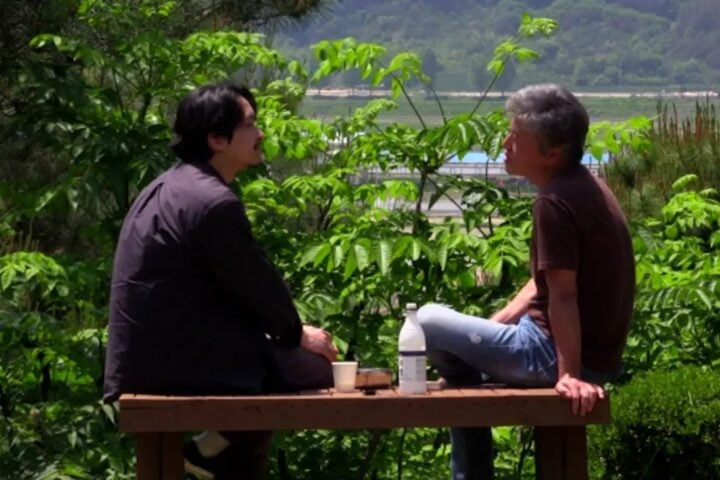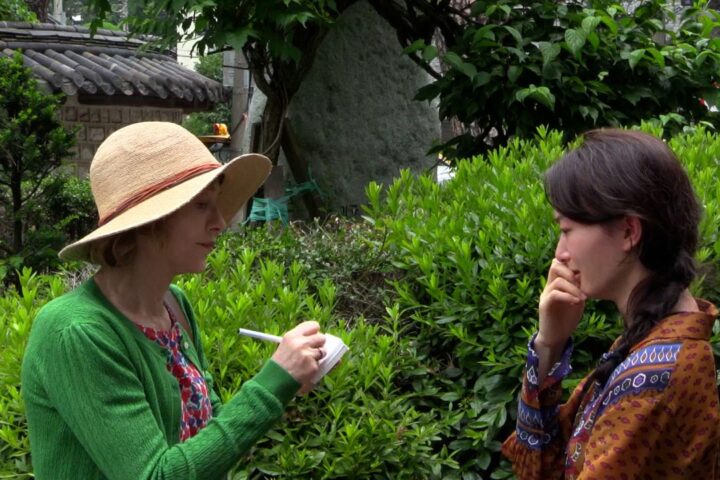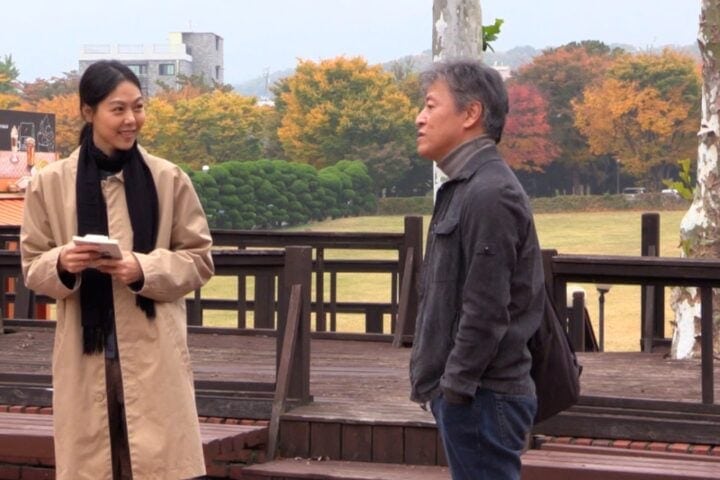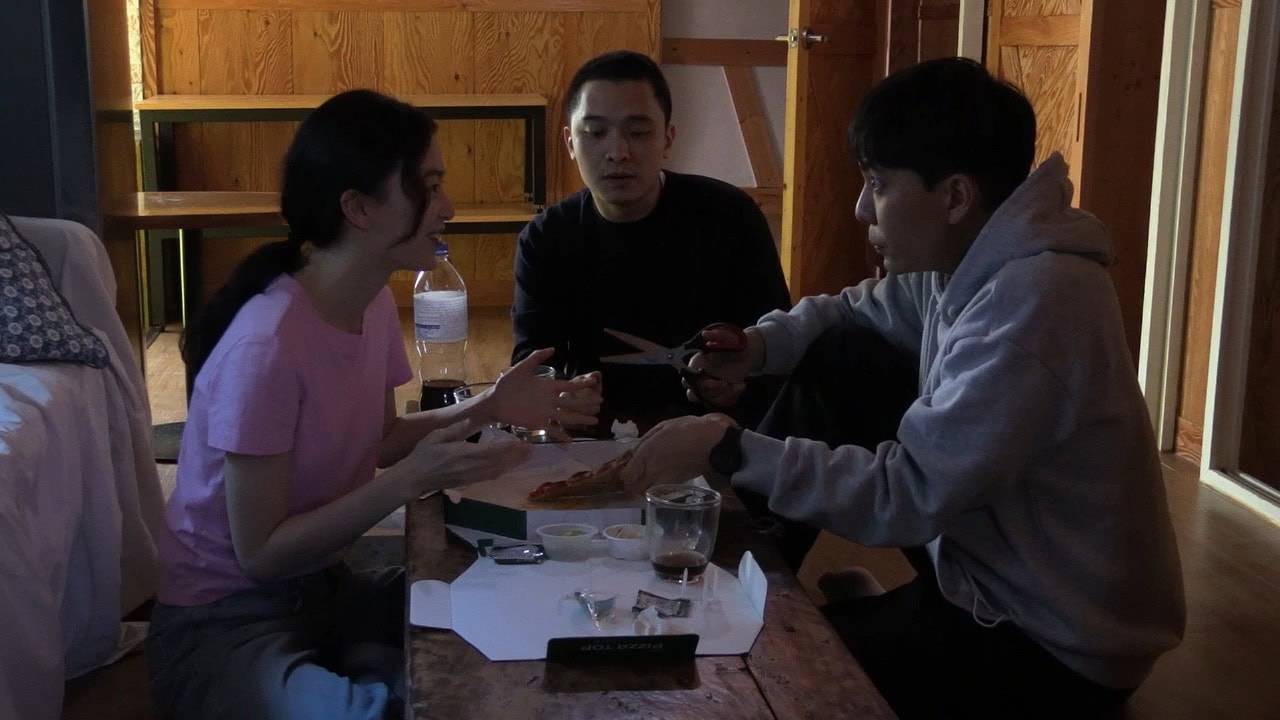
Early on, In Water offers a window into Hong Sang-soo’s astonishingly free and streamlined working methods. An actor turned aspiring director, Seoung-mo (Shin Seok-ho), scouts an alleyway with his cameraman, Sang-guk (Ha Seong-guk), and actress, Nam-Hee (Kim Seung-yun). Throughout the sequence, Hong shows the audience how he hides his artfulness in plain sight, working In Water’s formal DNA into its very narrative.
Seoung-mo wants to see how the alleyway and Nam-Hee look together in a frame, and the shot he contemplates is presumably close to the composition that we’re seeing as viewers. The alleyway curves across the frame, providing the image with a “found” brushstroke evoking an apostrophe. The eye-tickling image reveals the physical specifics of the beachside neighborhood where the friends find themselves, while offering a cartography of their group dynamic.
Connoisseurs of Hong’s cinema will no doubt be fascinated by such sequences of transcendent minimalism, as In Water suggests Picasso knocking off a sketch on a piece of paper in a matter of seconds. But the uninitiated may be left responding with irritation, awaiting the emergence of a more traditional narrative across sequences that feel as if little has been done. Hong takes his own minimalism to a breaking point here, seemingly testing his aesthetic for fault lines.
In Water is concerned entirely with the aforementioned location scout, following Seoung-mo as he tries to fashion a narrative that fits this setting. Like Hong much of the time, he isn’t working with a traditional script, but rather casting about for ingredients that appeal to him, from the beachside surf to fish in a pond, to a woman cleaning debris from rocks.
Unlike Hong, though, Seoung-mo isn’t actualized as an artist yet. The man is uncertain, suspecting that he’s a fraud. And until it becomes evident that he’s a familiar Hong surrogate, we come to share this suspicion, Seoung-mo doesn’t seem at first to know what he’s doing. The fact that he’s strapped for cash and spending over 3,000 dollars on a trip that could prove merely to be an idyll may provoke a kind of empathetic anxiety from the audience.
Seoung-mo’s sense of being unformed, like a moth that’s yet to emerge from its chrysalis, is literalized by Hong in a blunt formal device, as much of In Water is shot out of focus. In the close-ups of the three friends at its center, this decision is less noticeable, but the characters are reduced to blobs in the film’s frequent landscape shots, with the ocean and various buildings and clothing providing broad line strokes and blasts of color in the frame.
At times, it’s as if Hong is daring you to call his bluff, contesting whether or not In Water is even a film. Perhaps he even wants us to call him out. And yet, these compositions are hauntingly beautiful. Hong really seems able to make intensely personal cinema out of anything, and perhaps, rather than Picasso, he’s the filmmaking equivalent of the chef who can turn a piece of stale bread, some rotten fruit, and a few odds and ends in the pantry into a revelatory dessert.
Take a moment in which the trio stands on a hill looking out at the water. Sang-guk and Nam-Hee are close together in conversation while a contemplative Seoung-mo stands apart from them. We’re looking at their backs in a medium shot, yet we can feel Seoung-mo’s intense loneliness without any cuts or close-ups. Part of this resonance is achieved via a larger context: Throughout the film, Sang-guk and Nam-Hee are paired together, at times seemingly flirting toward romance, while Seoung-mo is by himself. This group dynamic ushers in a low-key form of suspense: Is Seoung-mo really trying to make a movie or is this trip a cry for help? Anyone conversant in Hong will know the answer probably entails both explanations at once.
When Seoung-mo speaks with the woman collecting trash on the rocks separating the beach from the tourist town proper, a moment of such rich emotional delicacy as to rate among Hong’s finest scenes as a filmmaker, Seoung-mo’s project finally finds a shape. Correspondingly, of course, In Water reveals its design. Seoung-mo transforms his loneliness and confusion into an empathetic comment on the setting that he’s staked out, as does Hong.
Both Hong and Seoung-mo forge a scene that combines the macro-social texture of the town’s thoughtless consumption with the micro-social observation of the woman’s honor and of the filmmakers’ own appreciative melancholia. Seoung-mo appears to have found a way to work as an artist, yet the final devastating image suggests that such progress alone isn’t enough to ward off desolation. It’s as if Hong is saying, “There but for the grace of God go I.”
Since 2001, we've brought you uncompromising, candid takes on the world of film, music, television, video games, theater, and more. Independently owned and operated publications like Slant have been hit hard in recent years, but we’re committed to keeping our content free and accessible—meaning no paywalls or fees.
If you like what we do, please consider subscribing to our Patreon or making a donation.