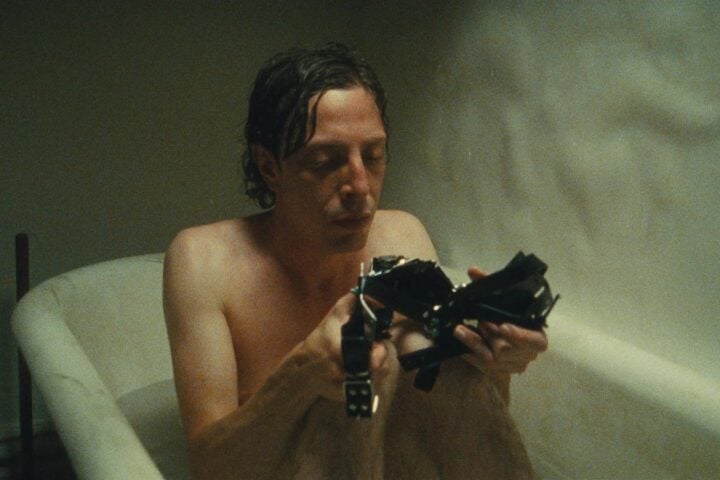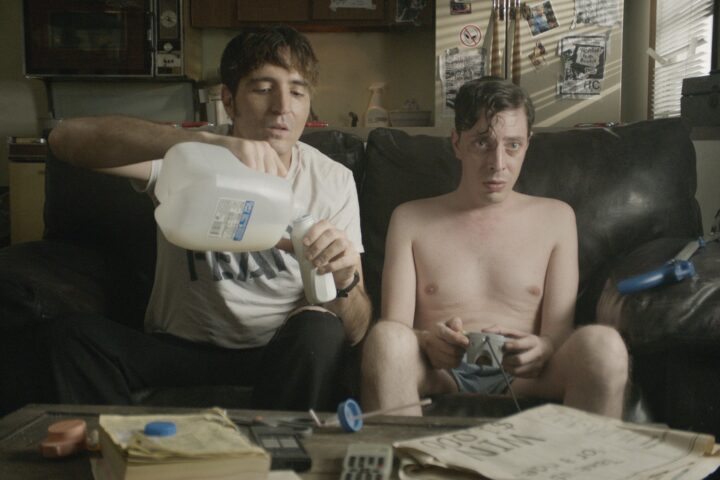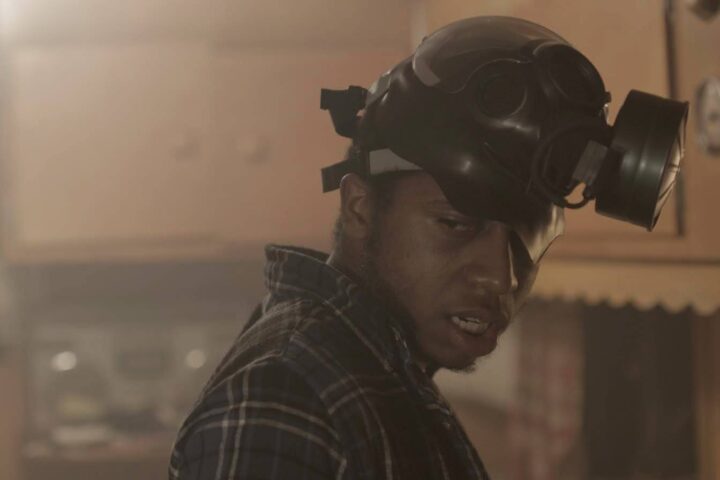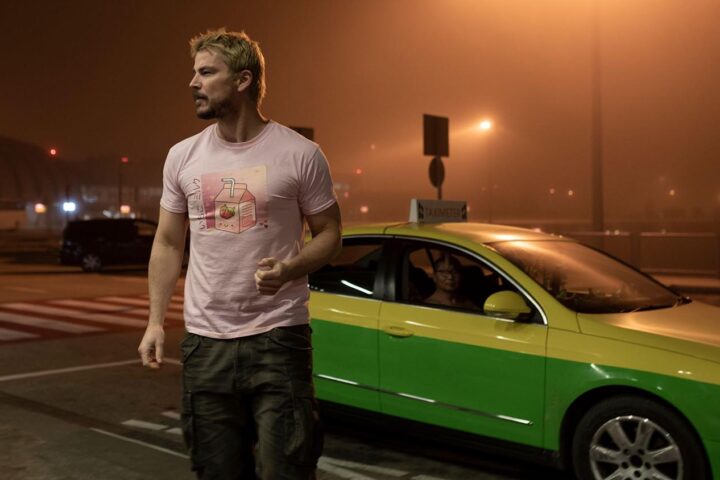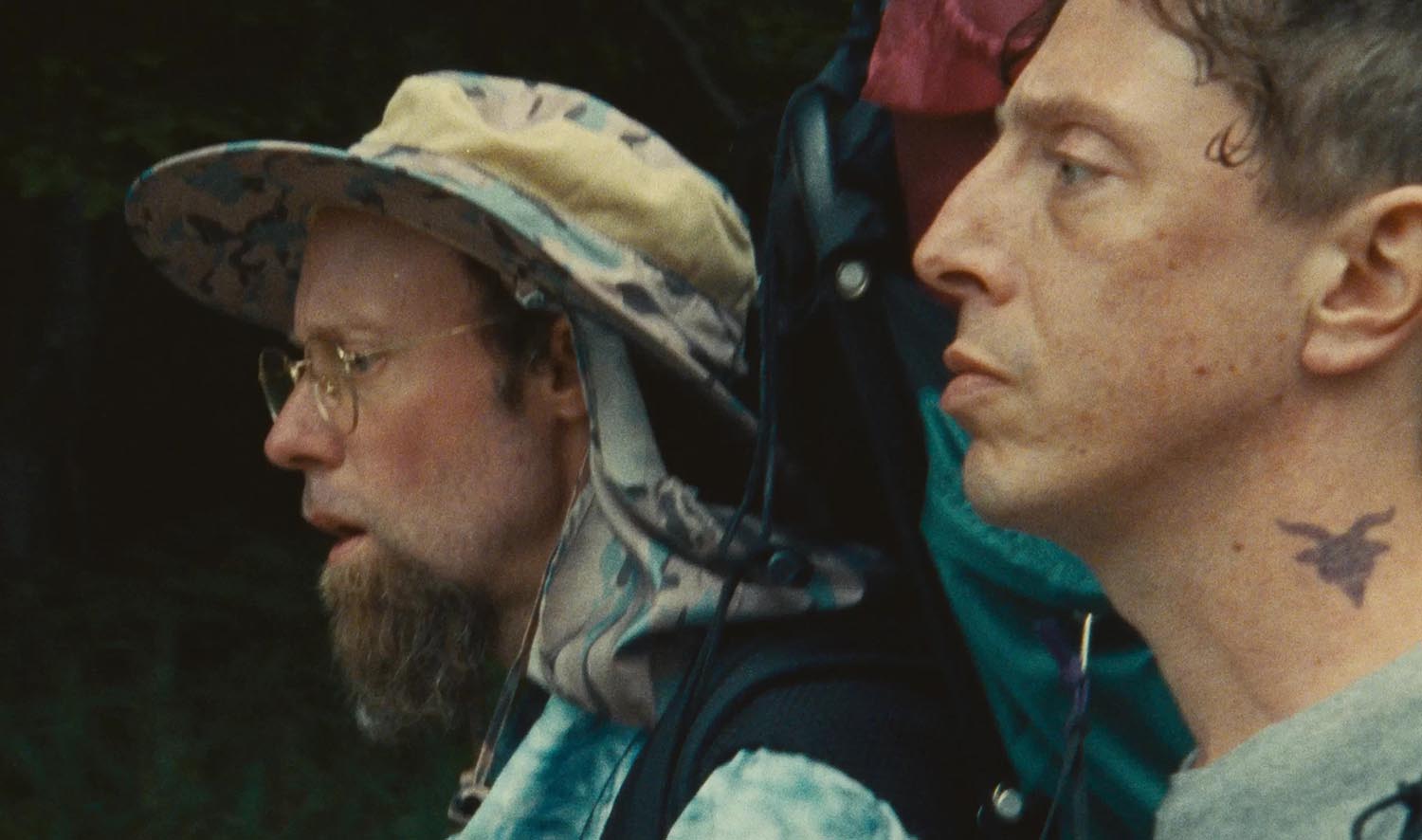
Writer-director Joel Potrykus’s latest film, Vulcanizadora, isn’t being advertised as a sequel to his earlier Buzzard, nor does it require any foreknowledge on the part of the viewer. Still, by revisiting the characters of Marty Jackitansky (Joshua Burge) and Derek Skiba (Potrykus) a decade on from their first appearance, the Grand Rapids-based filmmaker offers us the chance to deepen our understanding of who these guys are—to see them in a new, middle-aged context, with a different set of priorities and responsibilities.
Potrykus describes Vulcanizadora as his most personal work, in that it reflects a new set of fears and anxieties he’s experienced since the birth of his son. But Potrykus’s films have always been as personal as they come. He works close to home, mostly with friends and family, and litters his frames with visual details (from recurring junk-food brands to back issues of Fangoria), that reflect a singular sensibility—one that revels in the Jackass-style antics of antisocial, emotionally undeveloped men while finding the quiet tragedy and desperation therein.
In a recent conversation ahead of the film’s theatrical rollout, Potrykus discussed the film that made him want to become a filmmaker, the advantages of making low-budget films, and the favor-based production method that he’s developed in Grand Rapids.
Was it always the plan to bring back Marty and Derek from Buzzard in Vulcanizadora, or did you conceive the story first and then plug the characters in?
Josh is in all my stuff, so I knew he was going to be in it, and I was trying to figure out who would play alongside him. I knew that one of them had to be the straight man and one of them had to be the comic relief. That’s the simplest way to describe it. If they’re both serious, you’re making a drama, and if they’re both goofy, you’re making a comedy, and I don’t want to fall into either one of those. But I didn’t know [what their relationship was]—if they were going to be brothers, or father and son. It took a few months to lock in on Derek and Marty.
Once I figured out that it was going to be those two guys, exactly 10 years after Buzzard, and recontextualize two characters that I love, the whole thing took on a whole different level of importance to me, and the story just wrote itself. It was organic, man. It was really great.
I noticed on your IMDb page that in 2016 you were in a film called Accidental Exorcist, where you are also credited with playing “Derek.” Coincidence?
No. So, that was made in Grand Rapids by my friend Dan Falicki. He wanted me to play an annoying office worker, and I was like, “Dude, I just did that two years ago, I’ll just do that guy again and you can call me Derek.” I’ve got a full beard I was growing out for some other thing, so Derek has a beard, and I also remember putting a gigantic oversized bandage on my face for no reason at all. That scene is a very strange little Easter egg, and I told Dan he should cut it because it doesn’t add anything to the movie and kind of distracts from the story, but he held onto it. So, yeah, Derek has been around three times, actually.
In Vulcanizadora, Marty’s father is played by Bill Vincent, whom I didn’t recognize, but he has a number of acting credits, including for three early Sam Raimi films. How do you know him and why did you cast him in that role?
Bill Vincent is this amazing Michigan legend. He’s been teaching at Michigan State University for 60 years! Sam Raimi was in his classes, and when the first Evil Dead was having trouble in Tennessee—[the production was going too long] and over budget, and the crew started to mutiny—Bill packed up a duffel bag and drove down to help his student, Sam, collect himself and get the production back on track. I don’t think he’s actually in [the Evil Dead trilogy], but Sam Raimi would always give him a “Fake Shemp” credit.
Bill is a savior for me, because Evil Dead is the movie that made me want to become a filmmaker. I worked at MSU for one year and I would go and sit in Bill’s office and hear stories about how he would bring Lindsay Anderson and all these legendary filmmakers that I love to campus. So, when it came time to cast a dad for Marty, I knew I wanted somebody older to show that he had this disconnection with his father growing up, like his dad had him when he was 50 and felt distanced from this baby in his life. Bill Vincent just felt real for this world.
While you’ve continued doing the kind of low-budget, handmade movies that Raimi was known for early on, he’s now gone on do much bigger studio projects. I get the sense that you want to stay in the world you’re in now, but do you have aspirations to make films on a larger scale?
I have never aspired to make a big-budget movie because filmmaking is so stressful as it is that, the smaller the crew, the more relaxed I’m able to be. The more money [you’re given], the more restrictions the people who give you the money will have. I don’t think I could make these movies with a big budget because people would say, “You have a five-minute shot of a guy eating spaghetti—lose that.” And then I’m not able to make the movies I want to. So I don’t.
Even without those strings attached, I just have never needed 10 million dollars, or five million, for these little movies in Michigan that maybe would cost a million if I were to do them in New York or L.A. Michigan is my home, and we just don’t need that much money because people are excited to help you here. And I work with my friends still.
I guess with a bigger budget you could’ve done a few more takes of the exploding head in Relaxer, but yeah, I’m not sure where else those dollars would go. There’s a trend, though, of indie filmmakers getting snapped up by studios, like Chloe Zhao, who became known for doing small-scale dramas in South Dakota and then suddenly is directing a Marvel movie. It seems totally incongruous.
Yeah, and the thing is I’ve never been approached, because that would seem weird. I don’t know how you would watch Buzzard or Relaxer and make the connection that this guy can helm the next Fast and Furious or something. But really, the warning that I took to heart was from Ti West. I really admired his career early on. I loved The House of the Devil. And then he got a job to do Cabin Fever 2, and that was pulled away from him and he wanted his name off of it.
I feel like that’s probably where I would go—somebody would want to do a remake or sequel of a horror movie with me directing. That’s as big as I would get. I would spend years of my life making something that I got paid a few bucks for but ultimately feel no artistic integrity about. I wouldn’t feel proud of that work. That could be a great stepping stone to something bigger, but I just have low ambitions, I guess. I really do. The movies that I’m making and the career that I’ve got…the Joel of 10 years ago would have been blown away to know that I’m still able to make movies with my friends. That’s amazing. Never thought that would be possible.

Vulcanizadora seems a bit more ambitious from a production standpoint than your previous work. You’re shooting the first half in the woods, as in The Alchemist Cookbook, but then there’s the police station in the second half, a schoolyard, and a few others, all of which I assume are relatively close to home.
Again, we really couldn’t make this movie in L.A., because we’d have to get location releases and production insurance. I don’t even know if we had production insurance. I have a friend who owns this cabin on like five acres in the woods who was really excited for us to shoot on his land. So that’s easy—that’s a guy I’ve known for 20 years. In a small city like Grand Rapids, you can just send out a text and have your location the next day.
As far as the police station, that was actually kind of tricky because my wife, who’s our producer, did have to get a permit. And the irony is that we shoot inside the police station, but I only want to shoot close-ups. So we could have shot it at a college or something, it probably would have looked the same. I think that goes back to when I heard Wes Anderson talking about shooting The Royal Tenenbaums. There’s this scene in Battery Park where they frame Gene Hackman so that his body blocks out the Statue of Liberty. It’s almost like a weird joke, to go all the way down and do that, and that’s always been in my head when I go to a location. We don’t need to “prove” to everybody that we got an actual police station.
We don’t have an official location scout. It’s really just me and some of my friends driving around and literally knocking on doors. We’re all pulling our weight and doing different things when it’s needed. We’re all still learning how to make movies. We haven’t really figured out a system for doing it, so we’re just making it up as we go along.
Up through Relaxer in 2018, you’d been working at a steady clip with a new film every two years. Were you setup to shoot something else when the pandemic hit in 2020, or were you still figuring out what you would do next?
There’s a big gap because right when we were making Relaxer, my wife learned that she was pregnant. So, a kid came along and then the pandemic hit two years after that. But it was more having a kid. I didn’t have the drive to make a feature, probably because I was just so exhausted—there was no artistic juice. It took some four years for it to start to feel like I had something to say again. I had all these new fears and anxieties that I’d never had before, and I was like, “If I don’t make a movie and get these things out, I’m going to lose my mind.” People didn’t warn me how scary fatherhood is, and I needed to talk about that in a movie.
And again, I don’t know if I would have the luxury to tell this particular story with a big budget. Somebody might say you need to dial it back, or throw in a romantic interest or something, to offset the darkness or the bleak tone that it takes on where the whole point is not to make crowds feel great and rejoice in the redemption of cinema or any of that stuff. No, it’s just…yuck, that’s what Joel’s been dealing with in his head for the last few years. I can do that and see the vision through with the scale [we’re working with].
It’s definitely the opposite of a “crowdpleaser.”
[Laughs] Yeah, totally, man!
I’m curious to hear your thoughts about time period, because other than Relaxer, your films are quite vague about when they take place. There are a lot of ’90s signifiers, and based on your birth year you would technically be considered late Gen X, but to me there’s a feeling of belatedness rather than nostalgia, almost like a long-delayed aftershock from movies like Slacker and Clerks.
We talk about that before we [shoot]: what the characters can have, what we can and can’t see. We don’t want this kind of nostalgic retro thing that I think Gen X definitely is addicted to. Actually, for Relaxer I was really bugged that I used Pac-Man at first because it felt so cute, and everybody remembers Pac-Man, but that was the game with the legendary broken level, so it had to be that. Otherwise it was going to be Tony Hawk’s Pro Skater, which is very Gen X.
I love having that question of “when does this take place?” debated on Letterboxd. I can’t fully control the aesthetic. Cars will drive by in the background and people will notice a modern car, so I just accepted this weird kind of Pulp Fiction-y, “is it the ’70s or modern times?” thing. And at this point, there’s no time period. I’m really just working with things that I love, I think, which is probably me being nostalgic in a retro way, but less self-conscious about it.
Does this mean you’re coming out as a Godsmack fan?
Oh man, I didn’t even think more than five seconds about that when I was writing the script. That was the most inescapable shit when I was in college. Every time you turned on modern rock radio, it was some Godsmack song. “Voodoo” just seemed like the perfect song that Derek would feel had a dark, mysterious edge to do this woods ritual to. Good lord, those guys drive me crazy, man. Derek loves them, but I definitely do not.
Well, lastly, I wanted to ask about some of the films you selected to be shown at IFC Center in New York leading up to the release of Vulcanizadora. I see you’re introducing The Beaver Trilogy on Friday night…
That’s an amazingly bizarre movie, and I was so stoked when they said they could show it. I threw it on my list of possibilities as a wild card. There are no prints of it because it’s just a little movie that Trent Harris made, and he owns it. They never got the rights to one of the songs, so it’s self-distributed, and I assume Trent Harris is really excited right now because he got a few hundred dollars from his licensing his movie. The others [I’m showing] are pretty straightforward. I’m sure you’ve seen Mad Max, Evil Dead, Psycho II…
I have not seen Psycho II.
Oh, it’s so weird. It’s a tonal masterpiece, man. Hitchcock was like, “Don’t show it,” and Psycho II is like, “We’re gonna show it!” It’s got one of the best closing scenes ever.
Since 2001, we've brought you uncompromising, candid takes on the world of film, music, television, video games, theater, and more. Independently owned and operated publications like Slant have been hit hard in recent years, but we’re committed to keeping our content free and accessible—meaning no paywalls or fees.
If you like what we do, please consider subscribing to our Patreon or making a donation.