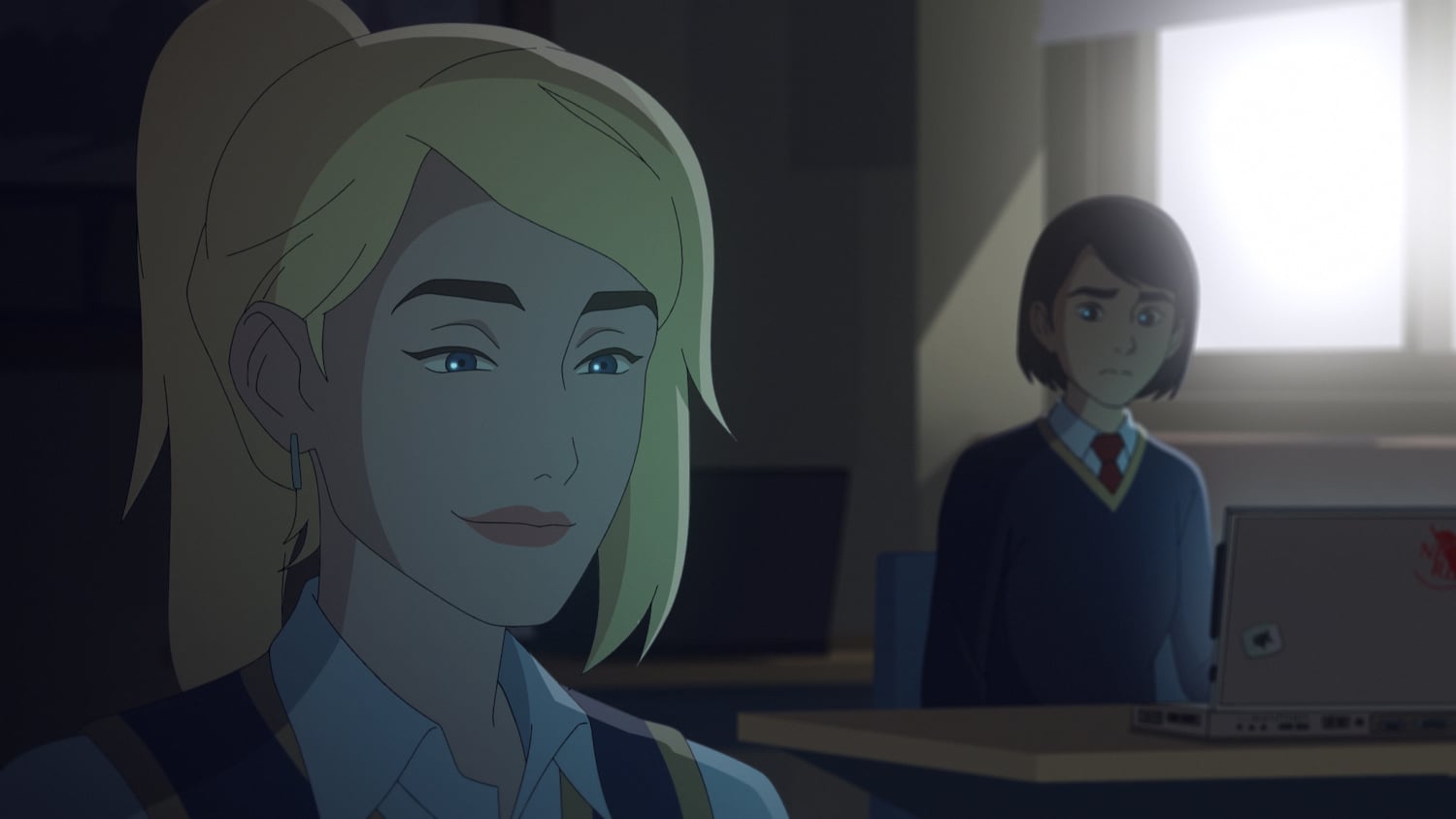
Through a skillful blend of family drama and high-concept thriller tropes, AMC’s new animated series Pantheon asks big, Blade Runner-sized questions about what it means to be human. Maddie (Katie Chang) is a teenage girl struggling to deal with the loss of her father, David (Daniel Dae Kim). Bullied by her classmates and distanced from her mother, she feels completely alone in the world—that is, until a mysterious stranger, who turns out to be the disembodied consciousness of her late father, reaches out to her over the internet.
This father-daughter reunion puts Maddie on a collision course with Logorhythms, the tech giant that once employed David and is now responsible for his existence as an “Uploaded Intelligence,” or UI. And she’s not the only one in Logorhythms’s line of fire, with the first of four episodes of the season made available to press introducing us to two other characters embroiled in the company’s schemes: Caspian (Paul Dano), a mathematics wonderkid with a troubled home life, and Chanda (Raza Jaffrey), a software engineer for one of Logorhythms’s rivals. By coming at the story from three distinct perspectives and making us wait to see how they all fit together, Pantheon turns its plot into a compelling puzzle.
Based on a collection of short stories by Ken Liu, the series doesn’t fall into the trap of creating mystery just by withholding information. It plays many of its cards early: From the truth about Maddie’s father to the fact that Caspian’s parents are actually actors hired to stage-manage every moment of his life, the reveals come thick and fast. Each new thing we learn about the main characters leaves us wanting to know even more. Logorhythms is clearly evil, but what’s their end game? Why did they put all of this time and effort into Truman Show-ing Caspian? And what exactly do they plan on doing with UIs like David?
Heady sci-fi concepts like the posthuman self can easily send a series tumbling down a philosophical rabbit hole of techno-babble, but Pantheon does an admirable job of grounding its high-concept conceit in a lived-in, believable reality. The series has a great eye for the quotidian, animating quiet moments like the filling of a coffee cup and the perusal of a supermarket aisle with an intimate attention to detail. And the stellar ensemble cast makes sure each character feels fully human—even the ones that live inside computers.
Pantheon arrives at a time when computers are integrated into almost every aspect of our “smart-world.” In one especially effective scene, a UI slowly hacks the devices inside a mall and forces them to play Queen’s “Your My Best Friend”—both a fun techno-prank and a haunting indication of how pervasive computer technology has become in our lives. It isn’t long before we see the same ability used in a much more spectacular and sinister fashion.
Pantheon also follows in the footsteps of Hosoda Mamoru’s Belle and Summer Wars by using the digital world as a blank canvas for colorful and sometimes deeply haunting visual creations. From the triumphant scenes in which Maddie and David rekindle their relationship inside a World of Warcraft-like video game to Chanda’s disturbing encounter with the ghoulish remains of UIs past, the wildly inventive Pantheon paints an online world as a place of boundless possibility, a lifeless digital abyss, and everything in between.
Since 2001, we've brought you uncompromising, candid takes on the world of film, music, television, video games, theater, and more. Independently owned and operated publications like Slant have been hit hard in recent years, but we’re committed to keeping our content free and accessible—meaning no paywalls or fees.
If you like what we do, please consider subscribing to our Patreon or making a donation.