

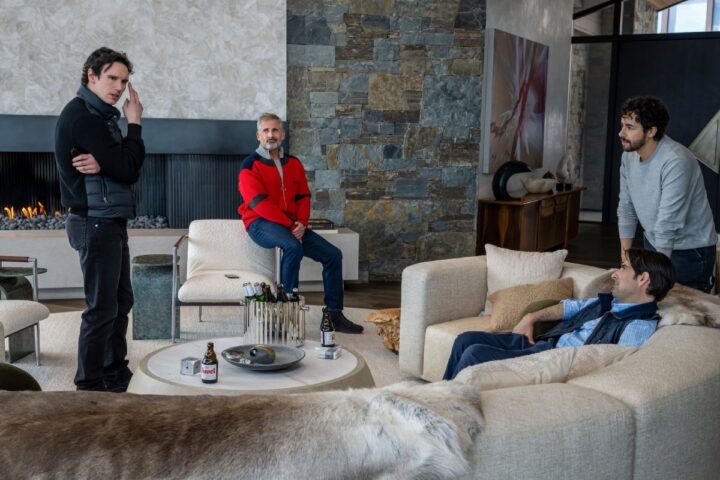
Aging therapist Dr. Alan Strauss (Steve Carell) enjoys the quiet domestic life of a widower with two grown children. He works with his patients, checks in on his kids, and does what he can with fresh fruit and foot cream to slow the grinding effects of time. Alan’s fluffy, graying beard rounds Carell’s face in a kindly way, giving him the impression of a wise old owl, and this is the energy that the actor brings to the role. There’s a little of Carell’s Foxcatcher performance in the deliberate way he chooses his words, but with none of John du Pont’s coldness. We feel from the start that this is a man who deeply cares.
One day, Alan’s humble life is thrown into disarray when a patient, Sam Fortner (Domhnall Gleeson), kidnaps him, takes him to a house in the middle of nowhere, and forces him to continue their sessions while shackled to the floor. It turns out that Sam isn’t just an awkward young man struggling to deal with the trauma of an abusive childhood, but a serial killer. A long way from the charismatic killers at the center of Hannibal or Dexter, Sam is played by Gleeson with the deepened voice and gawky body language of an overgrown teenager.
Mostly taking place inside one room, the series suggests My Dinner with Andre with a bomb under the table, turning the slow and intimate process of therapy into a high-wire act. And when we aren’t confined in Sam’s woodland home, flashbacks provide insight into Alan’s pre-abduction life. For one, we learn about his wife Beth’s (Laura Niemi) role as a cantor at their liberal synagogue and how fraught their relationship with their son, Ezra (Andrew Leeds), became after he converted to Orthodox Judaism. Alan and Beth try and fail to breach this gap across a series of frustrated family events, and the fissure widens as Beth’s health declines.
In the show’s early episodes, these cutaways, while fascinating and elegantly shot, feel unmoored from the more immediate drama playing out between Sam and Alan. It’s initially hard to see what theological schisms and paternal strife have to do with treating a serial killer. But as The Patient unfolds, it returns to the theme of empathy and skillfully connects its two seemingly disparate narrative threads: that everyone from Alan to Beth and even Sam is unable to get beyond their very different and stubborn way of looking at the world.
As Alan tries to make Sam get in touch with his humanity, he finds himself thinking more about his own failures and the price he’s paid for them. A lot of Alan’s inner journey is played out via the introduction of Charlie (David Alan Grier), a former therapist of Alan’s whom he likes to revisit in his mind during times of intense stress. Their imagined conversations are inspired, as they not only offer us another escape from the stifling main setting and Carell with another exquisite scene partner to play off of, they also reverse the dynamic of the Sam-Alan encounters. In his own therapy sessions, Alan doesn’t feel compelled to be so resolutely non-judgmental or emotionally controlled; he can call Sam a psycho and tell Charlie to go to hell, and in the process the character reveals deeper layers of humanity.
But The Patient never dives as deeply into Sam’s psychology. He appears at first as an angry young man with a grudge against society stemming from his abusive past, and our picture of him never really becomes more complicated than that, no matter how hard Alan tries to probe into the precise nature of Sam’s deadly compulsion. The series is clearly concerned with masculinity, trauma, and abuse, but by the end of its 10 episodes those very big ideas go largely unexplored. Throughout, if can feel like we’re always just on the edge of a major breakthrough, only for The Patient to tell us that, sadly, that’s all the time we have today.
Perhaps the most remarkable thing about The Patient is the way it gets us to root for a nonviolent resolution. Throughout the series, Alan regularly fantasises about stabbing Sam or luring in the police to blow his head off, and we thoroughly understand those desires. The urge to see these fantasies avoided comes not out of sympathy for Sam, but out of solidarity for Alan’s mission. He’s such a compassionate figure that we want to see him triumph.
With its morbidly intriguing premise and two powerhouse actors at its center, The Patient would have been a blast even if it was just another grisly thriller about a high-functioning psychopath. But it chooses to delve deeper than that, asking some poignant questions about empathy that even those of us who don’t shackle people to our bedroom floors can learn from.
Since 2001, we've brought you uncompromising, candid takes on the world of film, music, television, video games, theater, and more. Independently owned and operated publications like Slant have been hit hard in recent years, but we’re committed to keeping our content free and accessible—meaning no paywalls or fees.
If you like what we do, please consider subscribing to our Patreon or making a donation.


Ezra did not “convert” to Orthodox Judaism. He joined a different movement or branch within Judaism. He did not change his religion.
they all deserve awards – hope they get them
I appreciate the sincerity of this write-up of yours. Can’t wait to see more!