In Rachael Holder’s feature directorial debut, Love, Brooklyn, André Holland’s Roger, a writer, does everything in his power to avoid working on a puff piece about Brooklyn. His feelings about the borough are more complicated than the gentrifier propaganda he’s been commissioned to pump out, so he spends the majority of the film putting it off.
When we finally hear what Roger ends up writing, his musings on Brooklyn call to mind Manhattan’s opening sequence, in which Woody Allen’s Isaac, in voiceover, struggles to poeticize the Big Apple. As Isaac manically revises his words, he exhibits some self-awareness with lines like “he romanticized it all out of proportion.” The same outsize romanticism can be said of Roger, but he, and by extension Love, Brooklyn, lack the same self-awareness.
That flaw, though, is an indicator of the film’s admirable earnestness. What’s refreshing about Love, Brooklyn, as written by Paul Zimmerman, is how reasonable its characters are. Roger’s procrastination tactics involve dividing his time between two women: Casey (Nicole Beharie), his ex-cum-platonic friend, and Nicole (DeWanda Wise), a widowed mother with whom he’s enjoying a commitment-free fling. Across scenes in which the characters by and large communicate how they feel to each other with sufficient honesty and emotional consideration, the film is invested in realistically depicting how resentments build up between people.
That’s to say that Love, Brooklyn makes little room for cynicism or lampooning. So little, in fact, that the two comic-relief characters—Roger’s best friend, Alan (Roy Wood Jr.), and a snobbish friend of a friend, Lorna (Cassandra Freeman)—feel ripped out of a more parodic or satirical film. Considering the grounded realism that Love, Brooklyn brings to its plot, these satirical caricatures might have been more at home in, well, any number of Woody Allen films.
Love, Brooklyn, especially its loftier ideas, might have benefited from more of that satirical bite. Per the piece he should be writing, Roger complains to Casey about gentrification stripping Brooklyn of its character, introducing a theme that in theory should underscore the rest of the story. After this early sequence, however, the film spends most of its runtime uncritically jumping between the various upscale apartments that Roger and his associates inhabit, putting on full display the sanitized modernism he so detests—or at least claims to. Surely, there’s an intended irony here, but Zimmerman’s script doesn’t connect the dots by framing these locations as contributing to Roger’s anxieties about the city in any way.
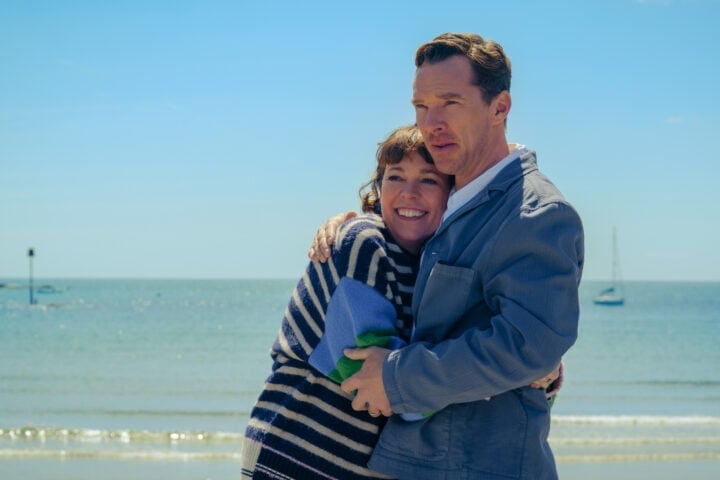
Where Manhattan’s Isaac claims the city for himself (“New York was his town, and always would be”), Roger seems to submit to the city as it is. Backed into a corner with nothing to do but put pen to paper, his bigger-picture ramblings about Brooklyn end up equating Casey with the “old city” he has to leave behind and Nicole with the “new city” he must learn to love in a new way. And while it would be a mistake to simply idolize the past and be angry about the present, this final sentiment, reinforced by Roger’s embrace of Nicole, makes the film closer to a puff piece than the cautiously optimistic critique of Brooklyn’s evolution that it strives to be.
Since 2001, we've brought you uncompromising, candid takes on the world of film, music, television, video games, theater, and more. Independently owned and operated publications like Slant have been hit hard in recent years, but we’re committed to keeping our content free and accessible—meaning no paywalls or fees.
If you like what we do, please consider subscribing to our Patreon or making a donation.