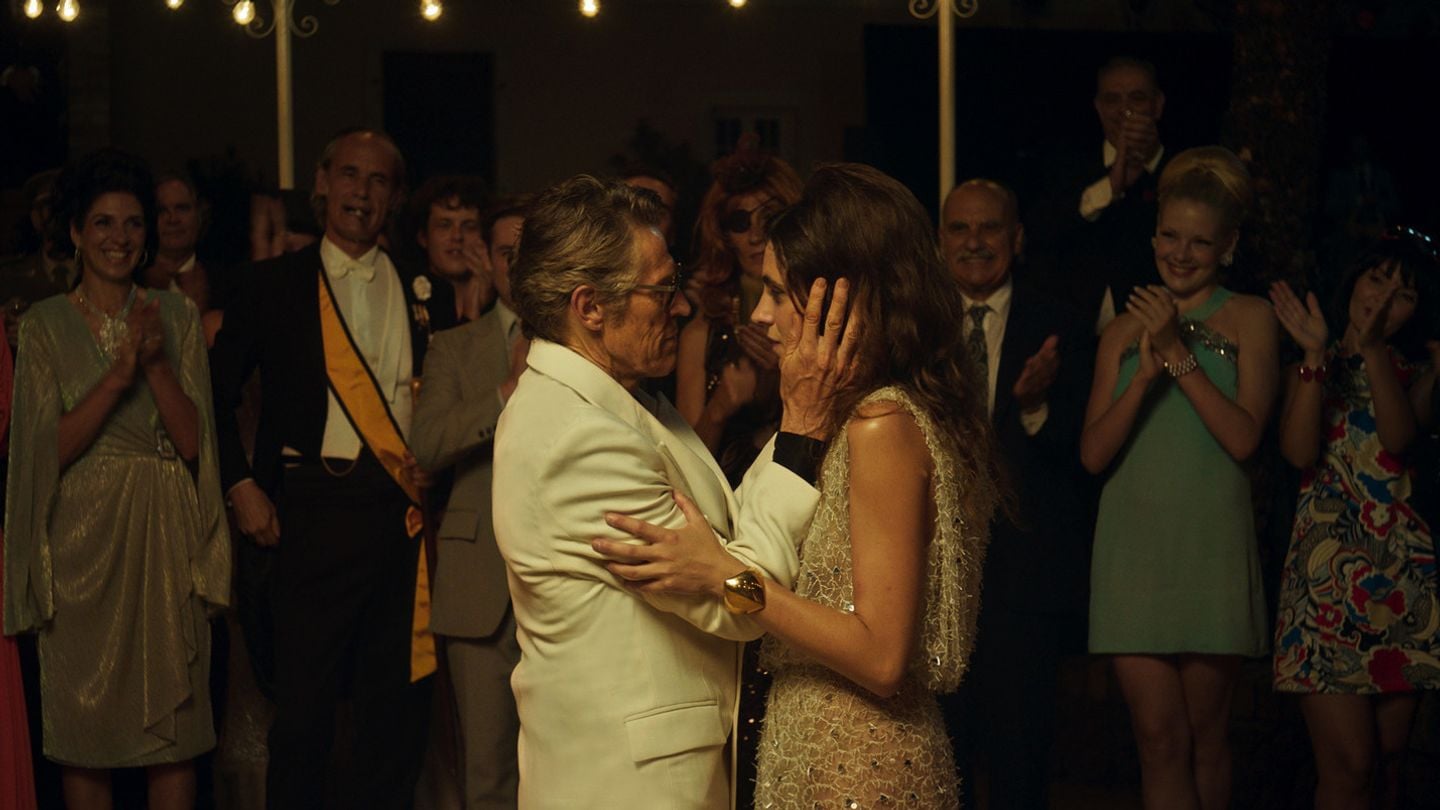
One of the first of the central Piazza Grande screenings at this year’s Locarno Film Festival, the premiere of The Birthday Party brought an old-world European glamour well suited to the 78th edition of the glitzy showcase in the Swiss Alps. Adapted from a 2007 novel of the same name by Parnos Karnezis, Miguel Ángel Jiménez’s The Birthday Party stars Willem Dafoe as aging businessman Marcos Timoleon, who’s hosting a lavish celebration on his private Greek island for the birthday of his twentysomething daughter, Sofia (Vic Carmen Sonne).
Boasting an impressive global network and significant political influence, the character bears a number of similarities to real-world Greek tycoon Aristotle Onassis—even down to the death of his son at a young age, which features as a prologue here before an unspecified years-long time jump, casting a dark pallor over the apparently jubilant festivities that follow. The Birthday Party’s setup is somewhat reminiscent of The Godfather’s opening sequence, a reference point used in relation to Marcos by a party guest early in the film, before he responds that Jaws is perhaps a more appropriate comparison for his behavior and demeanor.
This predatory nature is evident in his interactions with the large entourage of relatives, lovers, and various high-society well-wishers, with whom his relationships appear to be as transactional as they are intimate. His attempted reconciliation with his daughter, who has apparently become increasingly distant and wayward since the aforementioned death in the family, is similarly stymied by the controlling aspect that lurks beneath his gregarious persona.
As a portrait of mid-20th-century luxury and the sentimental malaise of the idle rich, The Birthday Party is efficiently orchestrated, with a pleasingly nostalgic color palette and a series of vibrant, extended dance sequences. But its storytelling is remarkably leaden and incoherent. While the competing plot strands are mostly intriguing to begin with, they become frustratingly tangled, eventually robbing the film of momentum as the party wears on. Through it all, the incessantly declarative, soap-operatic dialogue mostly functions to convey the vague sense that these characters don’t trust or particularly like being around each other.
Perhaps more clearly elucidated in the novel, it seems as though some kind of conflict is supposed to be established between Marcos’s self-mythologizing and the more sordid realities that surround him, hinted at by the recurring threat of journalists secretly recording conversations at the party and the presence of his biographer (Joe Cole). In the film, the latter is primarily relevant as Sofia’s unconvincing love interest, while Marcos’s true self remains just as unclear to the viewer as it does to the wider public. What’s even less clear is how an actor of Dafoe’s caliber found himself spearheading such an undercooked melodrama.
Since 2001, we've brought you uncompromising, candid takes on the world of film, music, television, video games, theater, and more. Independently owned and operated publications like Slant have been hit hard in recent years, but we’re committed to keeping our content free and accessible—meaning no paywalls or fees.
If you like what we do, please consider subscribing to our Patreon or making a donation.