
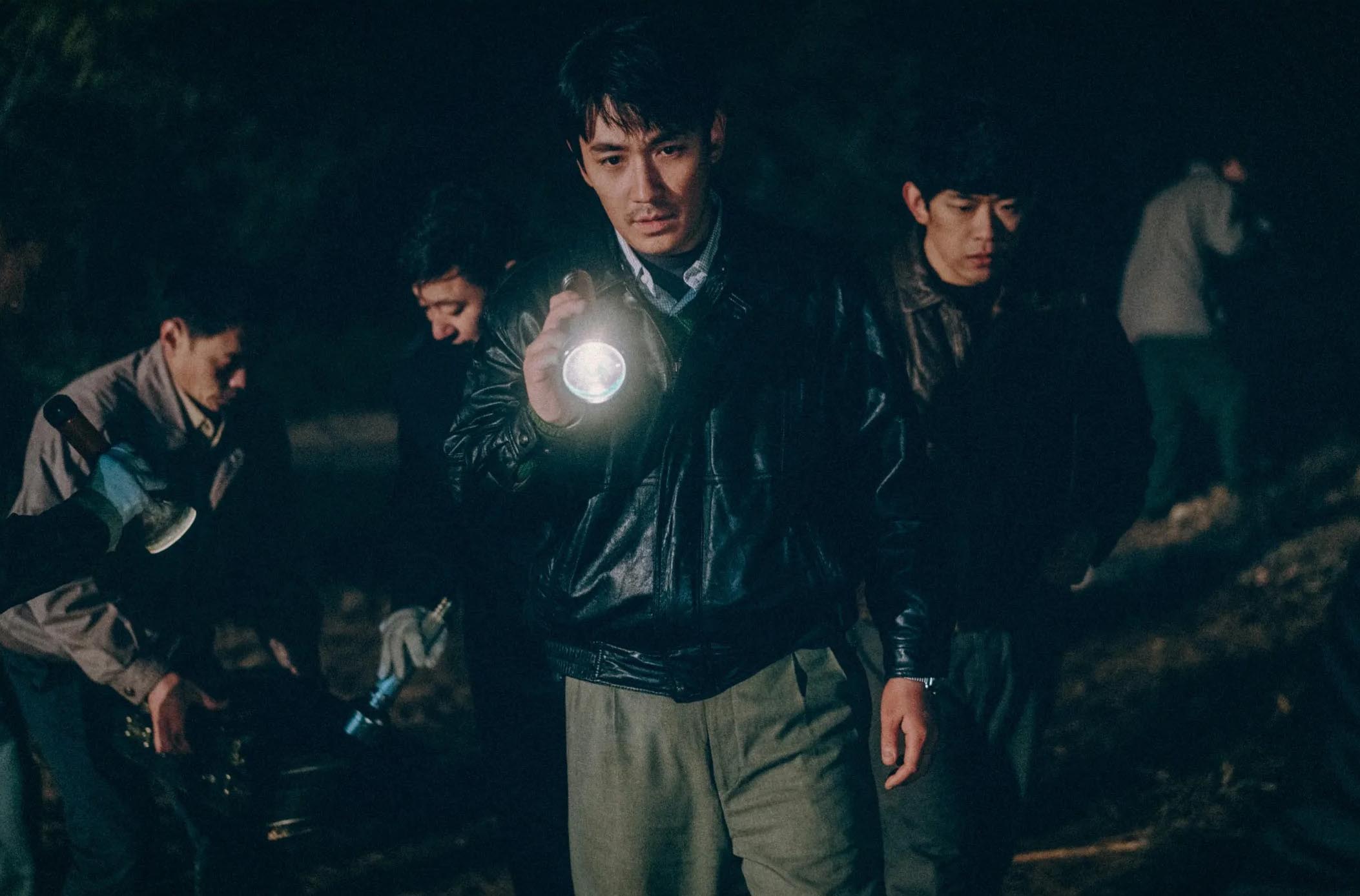
In Only the River Flows, Wei Shujun’s adaptation of the Yu Hua novella, an old woman (Cao Yang) is murdered on the bank of a Chinese town’s river. There are no taunting notes or occult artifacts left behind in the weeds. The body hasn’t been cut up or otherwise contorted into a nihilistic art project. It simply lies in the mud, blood trailing from a neck wound.
Wei has crafted a noir that rejects the more dramatic trappings of such stories. In a too-knowing bit of contrast, the rural town’s police operate out of an abandoned movie theater, as if to suggest that the tidy fictions once projected there are at odds with a reality that’s more mundane yet far less explicable. Even when an arrest is made, the loose ends haunt lead investigator Ma Zhe (Zhu Yilong), despite pressure from his superior (Hou Tianlai) to put a bow on the case.
We often watch Ma through a cloud of cigarette smoke, brooding away in his leather jacket. He may look like the latest in the long tradition of obsessive detectives who ache for justice or vengeance, maybe both, but he’s never portrayed as uniquely insightful or even particularly empathetic. He stumbles upon most of his leads by chance or in concert with his subordinates, and he has no personal stake in the events, keeping the people he investigates at arm’s length.
The victims and suspects alike are outcasts and otherwise marginalized, each having gravitated toward the tranquility of the river. Over the course of the investigation, their secrets are brought to light, but in keeping with the film’s subdued style, those secrets hardly add up to some vast conspiracy. They’re personal, everyday secrets that point to the impotence of authority figures who are tasked with ensuring order but cannot understand the people whose lives they probe. With this in mind, you can draw a parallel between Ma and the little boy in the first scene who plays hide and seek with friends in an abandoned building. Wearing a policeman’s hat, the boy loses sight of his friends and opens a door onto the demolished exterior of a crumbling building.
In concert with sticking to Ma’s perspective for much of the film, Wei depicts the proceedings at a remove. The 16mm cinematography, with its soft hues of blue and brown, captures the investigation in long takes that don’t call attention to themselves. The one moment of flair is a dream sequence that plays out partly in first-person, its more confrontational style so impactful because of how sharply it contrasts the rest of Only the River Flows. The look serves the 1990s-set story, with the haze and grain of celluloid representing the police’s limited perspective.
As the film starts to wrap up, though, its detached attitude becomes a hindrance. When Ma begins to lose himself to paranoia and delusion, you don’t feel that he’s been convincingly brought to the edge. Early on, Ma and his wife (Chloe Maayan) learn that her pregnancy runs a high risk of birth defects, and while a late scene gives us the incredibly novelistic touch of Ma flushing pieces of the puzzle his wife is building down the toilet in a fit of rage, we don’t understand him in this moment with much more clarity than the people he investigates.
If the film, in staying so locked to Ma’s perspective, doesn’t exactly illuminate the social context in which the story is set, that’s more or less by design. Economic collapse is simply hinted at, as in the opening scene that ends with the shot of the crumbling building. We also don’t see the ripple effects of the political pressures against Ma, and you may find yourself doing more surmising than even he does about the motivations of the marginalized characters he comes across, like the possibly queer hairdresser (Wang Jianyu) who unconvincingly confesses to the old woman’s murder. The craft brought to bear on Only the River Flows is captivating, but when it comes to matters of story, it cultivates a frustrating air of disinterest.
Since 2001, we've brought you uncompromising, candid takes on the world of film, music, television, video games, theater, and more. Independently owned and operated publications like Slant have been hit hard in recent years, but we’re committed to keeping our content free and accessible—meaning no paywalls or fees.
If you like what we do, please consider subscribing to our Patreon or making a donation.


