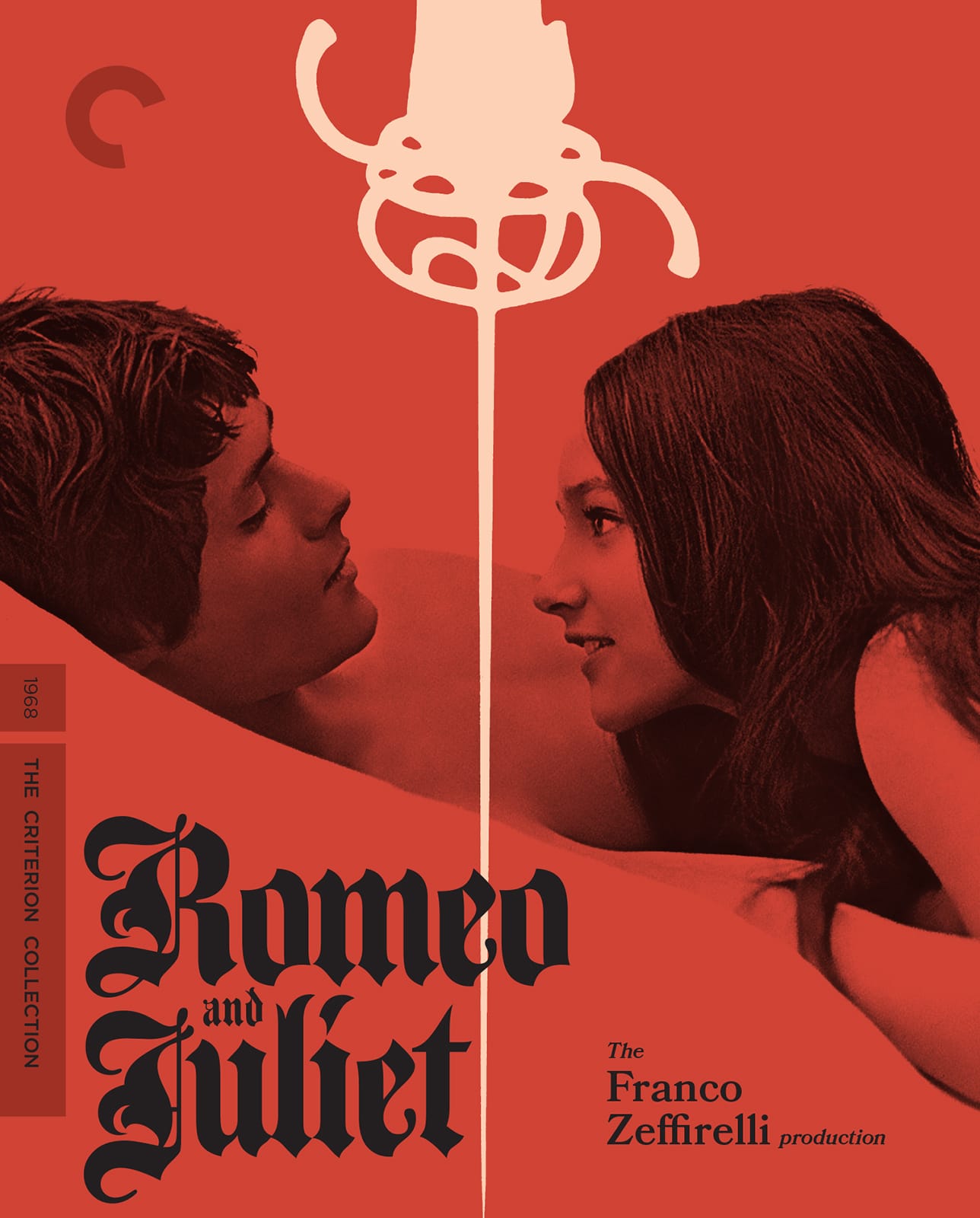
 Filmed during the Summer of Love and released soon after the Hollywood Renaissance was kickstarted by anti-authoritarian films like Bonnie and Clyde and The Graduate, Franco Zeffirelli’s Romeo and Juliet was marketed to the youth and counterculture market of the late ’60s. In doing so, the filmmakers privileged verisimilitude over rigorous devotion to Shakespeare’s verse, as evidenced by the casting of actual teenagers in the eponymous roles for the first time in a film adaptation of the legendary play. By shooting on location in Italy and employing handheld camerawork, Zeffirelli further differentiated his film from more traditionally stagey Shakespeare adaptations, fully leaning into a distinctive naturalism with a stylistic dexterity that favored the urgency and immediacy of emotions above all else.
As Romeo and Juliet, Olivia Hussey and Leonard Whiting exhibit an innocence, naïveté, and verve that enlivens their characters, making them feel startlingly modern even as they’re reciting Shakespearean verse. Their line readings are also at times distinctly modern-sounding, which is a feature, not a bug, of this Romeo and Juliet. One need only to watch the famed balcony scene to see how Hussey’s almost casual rendition of Juliet’s “Where for art thou, Romeo?” speech captures the passion and yearning of love-struck teens in a very contemporary manner.
The looseness with which this sequence plays out lends it a striking realism that helps to defamiliarize one of literature’s most iconic moments. Hussey and Whiting move awkwardly about, loose-limbed and excited as their characters continually fight the urge to explore each other’s mouths and bodies, knowing that Romeo will be killed if he’s discovered on the premises. Their dialogue is recognizably Shakespeare’s, but the way this Romeo and Juliet move about, so organically and erotically, allows the sequence to be reimagined for a new generation.
The same can be said for Zeffirelli’s rendition of the outdoor fight between Tybalt (Michael York) and Mercutio (John McEnery) and the ensuing battle between Tybalt and Romeo. What could have been stiff, carefully choreographed sword fights are instead rushes of desperate teenage energy as the young men’s showy displays of bravado give way to a believable vulnerability and fear. There’s a dynamic, improvised quality to these scenes that causes the characters’ heated emotions to feel especially raw and authentic.
The film’s modernist bent is also evident in its unambiguously siding with Romeo and Juliet—that is, only the adults are blamed for fanning the flames of the bitter rivalry between the Montague and Capulet families. It’s a relatively minor divergence from Shakespeare’s text. But in presenting the star-crossed lovers as victims of their irresponsible and domineering elders, rather than being equally culpable in their own demise, Romeo and Juliet spoke directly to the convictions and frustrations of countless young people who saw their fates being controlled by a hypocritical older generation all too willing to send them to their dooms in Vietnam.
It would be a few more decades before modernized Shakespeare adaptations, including Baz Luhrmann’s Romeo + Juliet, became in vogue. Yet, Zeffirelli’s film shows that even when they aren’t recontextualized to different settings and time periods, Shakespeare’s works are malleable and durable enough that adaptations can still very much reflect the eras in which they’re made.
Image/Sound
The Criterion Collection’s transfer of a 4K digital restoration looks absolutely gorgeous, with color timing that highlights the vibrant colors present in many of the costumes and the naturalistic look of the film’s location shooting in several Italian towns. The image is occasionally a bit soft, but the level of detail is impressive, particularly in the textures of buildings, the costumes, and the actors’ faces in close-ups. The lossless mono audio features a well-balanced mix that’s quite robust in its presentation of Nino Rota’s beautiful, elegiac score and has a strong separation between the various ambient sounds of chatter and street noise.
Extras
The slim slate of extras includes two interviews with actors Olivia Hussey and Leonard Whiting. In the first, shot in 1967 just after shooting had wrapped on Romeo and Juliet, the pair discuss the challenges of working on such a big film with little acting experience, as well as their feelings on the now notorious nude scene. In the second, a 2016 Q&A at Los Angeles’s Aero Theater, they talk at length about the casting and production process and share fond memories of working with Rota, Franco Zeffirelli, and cinematographer Pasqualino De Santis. The final extras on the disc are the original trailer and a five-minute clip from Franco Zeffirelli: Directing from Life that touches on Zeffirelli’s decision to cast actual teenagers for his adaptation. Rounding out the package is a foldout booklet with an essay by Shakespeare scholar Romona Wray that keenly breaks down the ways in which Zeffirelli’s adaptation diverges from the Bard’s original text.
Overall
The dearth of extras is disappointing, but the lush transfer ensures that the film looks infinitely better than the murky VHS tapes that many first encountered it on in high school English class.
Since 2001, we've brought you uncompromising, candid takes on the world of film, music, television, video games, theater, and more. Independently owned and operated publications like Slant have been hit hard in recent years, but we’re committed to keeping our content free and accessible—meaning no paywalls or fees.
If you like what we do, please consider subscribing to our Patreon or making a donation.